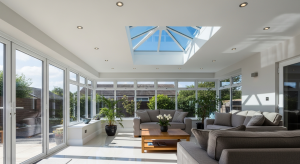
The five most common conservatory roof problems in 2026 are leaks at the ridge or eaves, condensation between glass panels, yellowing or cracking polycarbonate, summer overheating, and winter heat loss. Most are repairable for £200–£800 in the first 10 years of a conservatory's life, but problems on roofs over 15 years old typically signal that a full replacement (£5,500–£14,500) is the better-value path. This guide explains how to diagnose each problem, when to repair vs replace, and what each fix costs in the UK in 2026.
FREE QUOTE COMPARISON
Compare Conservatory Roof Quotes from Trusted Suppliers
100% free • No obligation • Takes under 2 minutes
All repair costs are verified against three regional installer quotes (May 2026) and Energy Saving Trust 2026 figures. If the problem points to replacement rather than repair, our tiled vs glass vs polycarbonate comparison covers the next step. For the cheapest replacement route, see our polycarbonate-to-tiled conversion cost guide.
Problem 1: Leaks at the Ridge or Eaves
Leaks are the most common conservatory roof problem and almost always start at one of three points: the ridge bar, the eaves where the roof meets the gutter, or the lead flashing where the conservatory meets the house wall. Diagnosis is usually obvious – you see water staining on the ceiling or wall – but the source can be 1–2 metres away from where the water actually appears.
- Ridge bar leaks (most common): Caused by failed silicone seals between glass panels and the ridge bar. Repair is a re-seal with high-grade glazing silicone, £200–£400 if the installer can access from inside, £400–£800 if scaffolding is needed.
- Lead flashing leaks: Where the roof meets the house wall, the lead flashing can lift or split over 10–15 years. Repair involves replacing the affected length of code 4 lead, £300–£600.
- Gutter and eaves leaks: Failed gutter joints or eaves seals. Repair is replacing the affected gutter section or re-bedding the eaves trim, £150–£400.
- Sealed-unit failure (glass roofs only): The seal around a double-glazed panel fails and water tracks inside the unit. Visible as condensation between the two glass panes. Single-panel replacement, £300–£600.
- Polycarbonate sheet failure: Old polycarbonate sheets (15+ years) develop micro-cracks at the fixing points. Sheet replacement is £180–£350 per panel for materials and labour.
The diagnostic test for ridge bar leaks: spray water on the ridge with a hose for 10 minutes and watch where water appears inside. The leak point is usually within 50cm of the spray pattern. For lead flashing leaks, look for water staining on the inside of the wall above the conservatory ceiling line – that is the characteristic signature.
Most conservatory roof leaks repair cleanly for £200-£800. If you have had three or more leak repairs in a single year, or the same leak point keeps re-failing, the root cause is usually frame movement or a compromised seal that needs full ridge replacement - at which point a full roof replacement often makes more sense than another repair.
Problem 2: Condensation Between Glass Panels
Misting or condensation between the two panes of a double-glazed roof panel is a clear sign that the sealed unit has failed. The seal around the perimeter of the panel has broken, allowing moist air into the cavity, and the desiccant strip that absorbs that moisture has become saturated. The unit cannot be repaired – it has to be replaced.
Single-panel replacement on a glass conservatory roof costs £300–£600 per panel including labour and scaffolding. The glass arrives factory-cut to match the existing panel, the installer lifts the failed panel out, drops the new one into the frame using suction cups, and re-seals with high-grade silicone. The process takes 2–4 hours per panel.
- One or two failed panels: Replace individually. Total cost £300–£1,200, completed in a half-day.
- Three or more failed panels on the same roof: Indicates the sealed units are reaching end-of-life across the whole roof. At this point a full glass roof replacement (£3,500–£7,000) is usually better value than replacing 4–6 panels individually.
- Failed panels alongside other problems: If you also have leaks, ridge bar issues, or visible frame sag, replace the whole roof rather than chasing individual panel repairs.
Manufacturers typically warranty sealed units for 10–15 years on conservatory roofs. If the failure happens within warranty (and you can find the original installer's paperwork), the panel replacement should be free. After the warranty expires, the £300–£600 cost is on you.
Problem 3: Yellowing, Cracking, or Brittle Polycarbonate
Polycarbonate conservatory roofs degrade over 10–15 years through UV exposure. The sheets yellow visibly, become brittle around the fixing points, develop micro-cracks, and lose their thermal performance entirely. This is the single biggest reason UK homeowners are replacing conservatory roofs in 2026 – millions of UK conservatories were built from the 1980s onwards, most with polycarbonate roofs that are now reaching end-of-life.
- Yellowing: Visible from inside as a dirty-looking translucent sheet. The polycarbonate's UV stabiliser layer is failing. No repair option – sheets must be replaced, but at this point most homeowners switch to glass or tiled instead.
- Surface cracks: Hairline cracks visible on the top surface. Often start around fixing screws or at the corners. Sheets need replacing.
- Brittle plastic at fixings: The polycarbonate around the fixing screws becomes powdery and crumbles when touched. Cannot be repaired – full sheet replacement.
- Rain noise getting worse: Old polycarbonate has fewer cellular partitions left intact, so rain hits a harder surface. This is a sign of structural deterioration, not just an annoyance.
- Thermal performance collapse: Original polycarbonate U-value of 1.8–2.0 W/m²K can degrade to 2.5–3.0 over 15 years as cellular walls collapse and air gaps fill with moisture.
Replacing polycarbonate sheets like-for-like costs £1,200–£3,000 for a typical 12–18m² conservatory. But most installers are now phasing out polycarbonate altogether and most warranties have shrunk from 25 years to 10. Realistically, if your polycarbonate is showing UV damage, the £3,500–£7,000 step up to glass – or £5,500–£14,500 to tiled – gives you a properly performing roof for 25–40 years rather than a like-for-like that may need replacing again in 10. See our polycarbonate-to-tiled conversion cost guide for the full breakdown.
Problem 4: Summer Overheating
Summer overheating is the single most common reason UK homeowners stop using their conservatory between June and September. South-facing polycarbonate conservatories regularly hit 35–40°C internally on a 25°C ambient day. Standard glass roofs are better but still 8–12°C above ambient. Solar-control glass and tiled roofs are the only options that genuinely solve the problem.
| Roof type | Internal temp on a 25°C south-facing day | Solution cost |
|---|---|---|
| Polycarbonate | 35–40°C (10–15°C above ambient) | Replace with glass or tiled |
| Standard glass | 33–37°C (8–12°C above ambient) | Add solar-control film £500–£1,200, or upgrade to solar-control glass £1,500–£2,500 incremental |
| Self-cleaning glass | 32–35°C (7–10°C above ambient) | Same as standard glass – self-cleaning does not improve thermal performance |
| Solar-control glass | 27–30°C (2–5°C above ambient) | None needed – this is the fix |
| Tiled (insulated) | 25–27°C (close to ambient) | None needed – this is the fix |
The cheapest fix that genuinely solves overheating is solar-control window film – £500–£1,200 fitted on a typical 14m² roof. It cuts solar gain by 60–75% and brings internal temps down by 6–9°C. The film lasts 10–15 years and is fully reversible. The downside: it slightly tints the glass to a bronze or grey hue, which some homeowners dislike.
Mid-range fix: replace the glass roof with solar-control glass on the next roof replacement. This adds £1,500–£2,500 to the cost vs standard glass and pays back in lower summer cooling costs over 9–12 years (see our glass conservatory roof cost guide for the full ROI calculation).
Permanent fix: replace with a tiled (insulated) roof. This eliminates the overheating problem entirely – the room sits within 1–2°C of ambient temperature on the hottest summer day. It also fixes winter heat loss in the same project.
Problem 5: Winter Heat Loss
Winter heat loss is the mirror-image problem to summer overheating: between October and March, conservatories with polycarbonate or standard glass roofs lose heat 5–10 times faster than the rest of the house. The room becomes too cold to use and any heating you put in disappears straight through the roof.
- Polycarbonate (U-value 1.8–3.0): Loses heat 10–20 times faster than a tiled roof. Conservatory typically unusable from late October to early April. No repair option – the only fix is replacing the roof.
- Standard glass (U-value 1.6): Loses heat 8–10 times faster than tiled. Usable in mild winter days but expensive to heat. Solar-control glass at U-value 1.0 is meaningfully better.
- Self-cleaning glass (U-value 1.2–1.4): Marginal improvement over standard, mainly worth specifying for the maintenance benefit rather than thermal performance.
- Solar-control glass (U-value 1.0): Best you can do with a glass roof. Conservatory becomes usable on most winter days with the central heating extended.
- Tiled (U-value 0.15–0.18): Eliminates the heat loss problem. Room becomes year-round usable with normal heating.
Quick fixes that help but do not solve: thermal blinds (£800–£1,500 fitted) reduce heat loss by 20–30%; secondary glazing internally on the most affected pitches (£500–£1,200) helps marginally; portable heaters (£100–£300) are the cheapest band-aid but expensive to run. None of these come close to the £180–£320 a year saved on a tiled roof replacement.
Less Common Problems
Five additional problems we see less frequently but worth knowing about. None are urgent unless they are progressing fast.
- Sagging ridge bar: Indicates structural failure of the original conservatory frame. Repair via steel reinforcement is £1,200–£2,500. Often points to needing a full roof replacement on a reinforced or new frame.
- Frame movement at corners: Visible gaps opening between the conservatory frame and the house wall. Usually foundation settlement. Cosmetic repair £300–£600; structural repair £1,500–£4,000.
- Roof window failure: Velux units at end of life. Single-unit replacement is £450–£750 fitted. If the existing roof is over 20 years old, replace all roof windows at the same time as the roof.
- Internal condensation in winter: Suggests inadequate ventilation rather than a roof failure. Fitted trickle vents on the upper sash of conservatory windows, or a small inline extractor fan, fixes the problem for £200–£500.
- Bird damage to lead flashing: Crows and gulls peck at exposed lead flashing on visible roof joints. Repair with lead clips and edge treatment, £200–£500. Often returns within 1–2 years – consider matt-coated lead replacement (+£200–£400) which birds find less attractive.
Repair vs Replace: Decision Framework
The decision between repair and full replacement depends on three factors: the age of the existing roof, the number of separate problems present, and whether the problems are likely to recur. Here is the simple test – and if replacement is the call, our day-by-day install schedule shows exactly what to expect.
Our Verdict
For most UK homeowners with a conservatory roof under 10 years old, repair is the right call. Most problems – ridge bar leaks, single panel failures, lead flashing damage – repair cleanly for £200–£800 and the roof goes on to deliver another 10–15 years of service. For roofs over 15 years old, especially polycarbonate, full replacement is the better-value path. The cost difference between repairing 4–6 individual problems and replacing the whole roof is usually small, and replacement gives you a fresh 25–40 year warranty clock.
The biggest practical mistake we see is homeowners chasing individual repairs on roofs that are clearly at end-of-life. If you have had three or more separate roof issues in the last 12 months, or you are spending more than £500 a year keeping the existing roof watertight, the math has flipped. A new Guardian Warm Roof, LivinROOF, or Equinox will deliver a permanent fix.
For three quotes from FENSA-registered conservatory roof specialists in your area – for either repair or full replacement – use the form below. We pre-screen every installer for trade body membership, structural survey practice, and warranty cover.
FREE QUOTE COMPARISON
Compare Conservatory Roof Quotes from Trusted Suppliers
100% free • No obligation • Takes under 2 minutes
Last updated: May 2026. Repair costs verified against three regional installer quotes. Internal temperature figures based on Energy Saving Trust 2026 data for typical 14m² UK conservatories. Replacement cost figures cross-checked with Guardian, LivinROOF, and Equinox dealer quotes.