Rates and data last verified 17 February 2026 by the ExpertSure editorial team. Sources are listed in the methodology below the calculator.
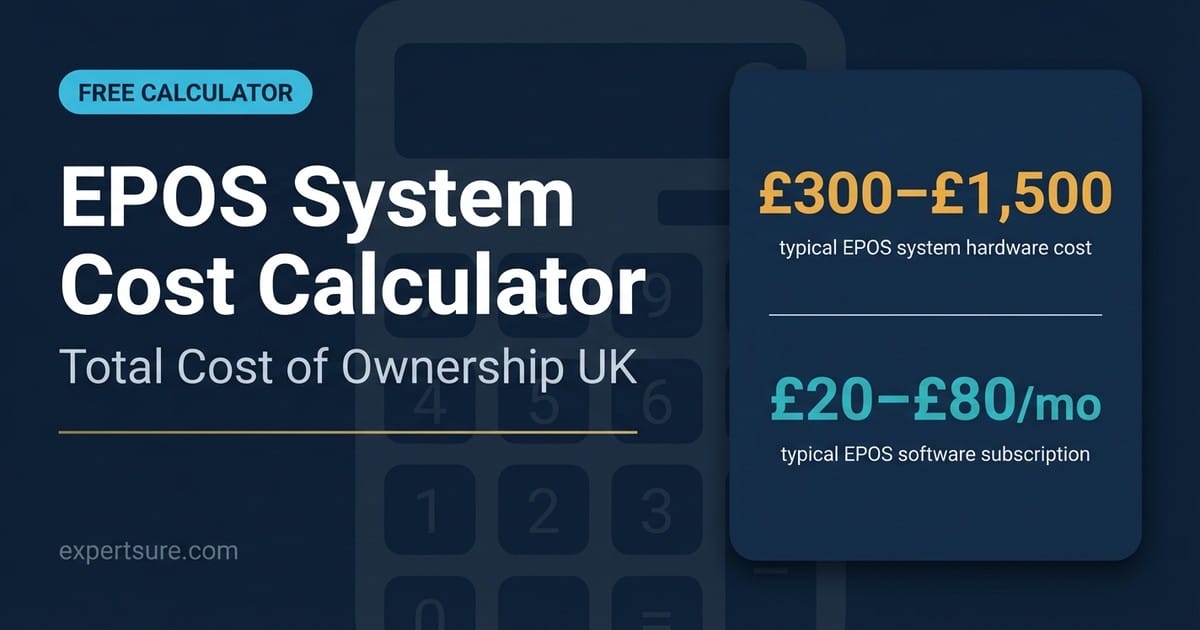
An EPOS system cost calculator helps UK retailers, hospitality businesses, and service providers estimate the total expense of deploying an electronic point-of-sale system based on the number of terminals, software features, and hardware requirements. Cloud-based EPOS software costs between £20 and £80 per month per terminal, while the hardware — including a touchscreen terminal, receipt printer, cash drawer, and card reader — ranges from £200 to £1,500 per station depending on brand and specification. A typical single-till retail setup costs £1,000 to £2,000 in the first year including hardware and software, while a restaurant with three terminals, kitchen display screens, and table management can expect to invest £3,000 to £8,000. Transaction processing fees add 1.5% to 2.5% per card payment on top of the subscription. This calculator provides a detailed first-year and ongoing cost breakdown tailored to your business type, terminal count, and required integrations.
FREE QUOTE COMPARISON
Compare EPOS Quotes from Trusted Suppliers
✓ EPOS systems from £0 upfront
100% free • No obligation • Takes under 2 minutes
How to Use This Calculator
Select your business type — choose retail, restaurant, cafe, bar, or service business to load the most relevant hardware and software recommendations.
Enter the number of terminals — input how many point-of-sale stations you need across your premises.
Choose your hardware level — select from tablet-based (budget), integrated terminal (mid-range), or full enterprise setup (premium).
Tick your required features — select from inventory management, table management, online ordering, loyalty programmes, and accounting integrations.
Review your cost breakdown — see first-year costs (hardware plus software plus setup), ongoing monthly costs, and estimated transaction fees based on your projected card payment volume.
A typical single-till EPOS system costs £800–£2,500 in year one and £1,200–£3,600 over 3 years, depending on business type, features needed, and whether you purchase, lease, or subscribe.
Select your business type, required features, and preferred ownership model. The calculator shows year-one costs, three-year totals, and monthly averages including hardware, software, setup, and support. Adjust transaction volume to see how payment processing fees impact overall costs.
What Determines EPOS System Costs?
EPOS system costs are determined by six core components that vary significantly based on business requirements, provider choice, and ownership model. Understanding how each component contributes to total cost of ownership allows you to identify where to optimise spending without compromising essential functionality.
Hardware Costs
Hardware represents the most visible upfront cost but varies dramatically based on system type and business needs. A traditional EPOS terminal with integrated touchscreen, receipt printer, and customer display costs £800–£1,500 per till. iPad-based systems reduce this to £400–£800 by using consumer tablets with specialist accessories, though durability concerns exist in high-volume hospitality environments.
Component-level pricing shows where costs accumulate. Touchscreen terminals range from £300 (basic 10-inch Android) to £1,500 (commercial-grade 15-inch Windows terminal). Thermal receipt printers cost £150–£350 depending on print speed and connectivity. Cash drawers add £60–£150. Barcode scanners range from £80 (handheld laser) to £250 (2D imager for QR codes). Customer-facing displays cost £200–£400. A two-till retail setup with basic peripherals typically costs £1,600–£3,200 in hardware alone.
Hospitality businesses face higher hardware costs due to specialist requirements. Kitchen display systems add £400–£800 per screen. Handheld ordering devices for table service cost £250–£400 each. Integrated chip and PIN terminals add £150–£300 per payment point. A restaurant with two tills, one kitchen screen, and three handheld devices can easily spend £3,500–£5,500 on hardware before software costs.
The iPad versus traditional terminal debate centres on total cost versus durability. iPad-based systems like Square, Zettle, and SumUp cost £400–£600 for a complete setup (tablet, stand, card reader, receipt printer). Traditional terminals cost £800–£1,200 but withstand grease, spills, and continuous use better than consumer-grade tablets. High-volume retailers and busy restaurants typically choose traditional terminals despite higher upfront costs, while low-volume businesses, pop-ups, and mobile traders favour iPad solutions for portability and lower entry costs.
Software Licensing
Software licensing has shifted almost entirely to subscription (SaaS) models in the UK EPOS market, with monthly fees ranging from £0 (entry-level free tiers) to £200+ for enterprise multi-location systems. The SaaS model reduces upfront costs but increases long-term expenditure — a £50/month subscription costs £1,800 over three years versus £500–£1,000 for legacy one-off licenses, though perpetual licenses no longer include updates or cloud features.
Pricing tiers correlate directly with feature sets. Basic packages (£0–£30/month) provide sales processing, basic inventory, and simple reporting. Standard packages (£30–£65/month) add staff management, advanced reporting, customer databases, and email receipts. Premium packages (£65–£120/month) include loyalty programmes, multi-location management, online ordering integration, and advanced analytics. Enterprise packages (£120–£200+/month) offer API access, custom integrations, dedicated support, and unlimited users.
Free-tier options exist but carry limitations. Square charges £0 monthly fees but takes 1.75% per transaction (versus 1.4% for paid plans). Zettle operates similarly. These free tiers work for very low-volume businesses processing under £2,000 monthly, where transaction fees remain lower than subscription costs. Beyond £3,000 monthly turnover, paid subscriptions with lower transaction fees become more cost-effective.
Per-till versus per-business pricing creates cost variation. Some providers charge per terminal (£40–£60 per till monthly), making multi-till setups expensive. Others charge per business location regardless of terminal count, benefiting businesses with multiple tills. Always clarify whether quoted prices cover unlimited terminals or require per-device licensing.
Setup and Installation
Setup and installation costs are frequently overlooked but add £300–£1,200 to year-one expenditure for professionally installed systems. Self-install options exist for iPad-based and cloud systems, reducing this to £0–£200 for business owners comfortable with technical setup, though this trades money for time and increases error risk.
Professional installation by supplier engineers costs £200–£500 for a single-location setup, covering hardware configuration, network setup, payment terminal integration, and basic system testing. Multi-location installations or complex integrations (accounting software, e-commerce, booking systems) increase costs to £400–£800 per location.
Data migration from legacy systems adds £150–£400 depending on product database size and data quality. Migrating 500 SKUs with pricing, suppliers, and stock levels typically costs £200–£300. Hospitality businesses migrating complex menu structures with modifiers, allergen data, and recipe costing can expect £300–£500 migration fees. Some providers include basic data migration in setup packages; others charge separately.
Staff training represents the hidden cost that determines system adoption success. On-site training costs £100–£300 per day depending on provider and business size. A typical retail business needs 2–4 hours (£100–£200). Restaurants with complex menus and table management require 4–8 hours (£200–£400). Many businesses underinvest in training, leading to system underutilisation, staff frustration, and operational inefficiency that costs more than the training would have.
Hidden setup costs include network infrastructure (commercial-grade WiFi access points cost £150–£300 each), Ethernet cabling for fixed terminals (£50–£150 per drop), and payment terminal merchant accounts (separate application process, potential setup fees of £0–£200). Budget an additional 10–15% above quoted installation costs for these ancillary expenses.
EPOS Costs by Business Type
EPOS costs vary significantly by business type due to differing functional requirements, transaction volumes, and operational complexity. Understanding typical cost ranges for your sector helps set realistic budgets and identify where your business sits within the market range.
Retail businesses typically face the lowest EPOS costs due to simpler requirements. A single-till independent retailer needs basic sales processing, inventory management, and barcode scanning. Hardware costs £600–£1,200 (terminal, printer, scanner, cash drawer). Software ranges from £0–£50/month for systems like Square, Zettle, or entry-level Lightspeed. Setup costs £100–£300 for self-install or basic professional setup. First-year total: £800–£2,000. Three-year total: £1,800–£3,500. Multi-till retailers double hardware costs but often pay the same software fee for unlimited terminals, making per-location costs more economical.
Hospitality businesses face significantly higher costs. Restaurants, pubs, and cafes require table management, kitchen display systems, course firing, modifier handling, and integration with delivery platforms. Hardware costs £1,500–£4,000 for a basic two-till setup with one kitchen screen. Software costs £60–£120/month for hospitality-specific platforms like Lightspeed Restaurant, Toast, or Tevalis. Setup and menu configuration add £400–£800. First-year total: £2,500–£6,000. Three-year total: £4,500–£10,000. Quick-service restaurants with simpler menus sit at the lower end; full-service restaurants with complex table management sit at the upper end.
Salons and beauty businesses occupy a middle ground. Hair salons, barbers, and beauty therapists need appointment booking, staff commission tracking, client history, and retail sales. iPad-based systems like Phorest, Shortcuts, or Fresha dominate this sector. Hardware costs £500–£1,000 (iPad, stand, card reader, receipt printer). Software costs £40–£80/month including booking features. Setup costs £200–£400 for client data migration and staff training. First-year total: £1,200–£2,500. Three-year total: £2,500–£4,500.
Mobile and pop-up businesses achieve the lowest costs through portable iPad-based systems. Market traders, food trucks, and mobile services need battery-powered card readers, 4G connectivity, and lightweight hardware. Systems like Square, Zettle, or SumUp cost £300–£600 for complete portable setup (iPad mini, mobile reader, portable printer). Software is typically free with transaction-fee pricing. Setup is self-service (£0 cost). First-year total: £300–£900. Three-year total: £800–£1,800. These businesses trade advanced features for portability and low costs.
Purchase vs Lease vs Subscription
Purchasing hardware outright costs £800–£2,000 initially but £50–£100/month long-term (software only). Leasing costs £40–£80/month with no upfront cost but higher 5-year total. Subscription/SaaS models offer £0–£500 upfront and £60–£120/month including hardware, software, and support.
The ownership model decision has more impact on total cost than provider choice. Three models dominate the UK EPOS market, each with distinct cash flow implications, cost structures, and suitability for different business situations.
Purchase (Capital Expenditure) — buying hardware outright and paying monthly for software. This model requires £800–£2,500 upfront for a single-till system but results in the lowest long-term cost. After initial hardware purchase, ongoing costs are software subscriptions only (£30–£80/month). Over five years, total cost is £2,600–£7,300. This model suits established businesses with available capital, as hardware is a balance sheet asset. Disadvantages include technology obsolescence risk (terminals typically last 5–7 years), no support for hardware faults after warranty (12–24 months), and higher upfront cost barrier for new businesses.
Lease (Operating Expenditure) — monthly payments covering hardware, software, and maintenance. Leasing costs £40–£80 per till monthly with no upfront cost beyond installation (£200–£500). Over five years, total cost is £2,600–£5,300 per till. This model suits businesses preferring predictable monthly costs and wanting hardware replacement/support included. Lease agreements typically run 36–60 months with automatic renewal. Advantages include capital preservation, tax-deductible monthly payments, and included hardware replacement. Disadvantages include higher total cost than purchasing, contract lock-in periods, and early termination fees (£500–£1,500). Always check who owns equipment at lease end — some agreements transfer ownership; others require equipment return.
Subscription/SaaS All-Inclusive — monthly fee covering hardware, software, support, and often payment processing. Providers like Zettle Pro, Square Plus, and some Lightspeed packages offer this model at £60–£120/month with £0–£500 upfront. Over five years, total cost is £3,600–£7,700. This model suits businesses wanting zero capital outlay, included support, and regular hardware upgrades. Some subscriptions include payment processing at preferential rates, potentially offsetting higher software costs for high-volume businesses. Disadvantages include highest long-term cost, dependency on provider, and potential for price increases at renewal.
The break-even analysis shows purchase becomes cheaper than lease after 24–30 months and cheaper than subscription after 18–24 months. However, businesses with limited capital or uncertain futures may prefer higher long-term costs in exchange for lower upfront commitment. Consider cash flow, business stability, tax position, and growth plans when choosing ownership models.
Hidden Costs to Factor In
Beyond headline hardware and software costs, several recurring and one-off expenses significantly impact total EPOS ownership costs. Businesses that fail to budget for these hidden costs experience budget overruns averaging 25–40% above initial projections.
Payment processing fees are the largest hidden cost for most businesses. While technically separate from EPOS costs, they’re intrinsically linked as EPOS providers often bundle or dictate payment processing. Fees range from 1.4% to 2.9% per transaction plus £0.10–£0.25 per transaction. A business processing £10,000 monthly pays £140–£290 monthly in card fees (£1,680–£3,480 annually). Over three years, this adds £5,040–£10,440 to total EPOS ecosystem costs. Some EPOS providers offer integrated processing at competitive rates; others force expensive proprietary payment terminals. Always calculate effective processing rates when comparing EPOS total costs.
Support and maintenance costs £0–£80/month depending on provider and service level. Free support typically means email-only with 48-hour response times. Phone support costs £20–£40/month. Priority support with 4-hour response and on-site engineer callouts costs £50–£80/month. Businesses without support contracts pay £80–£150 per callout plus hourly rates of £60–£100. One hardware fault without support cover can cost more than 12 months of support subscription.
Hardware replacement and consumables include thermal printer paper (£15–£30/month for busy businesses), printer maintenance (£100–£200 annually), and peripheral replacement. Barcode scanners fail after 3–5 years (£80–£250 replacement cost). Cash drawers last 5–7 years. Receipt printers need replacement every 3–5 years in high-volume environments. Budget £150–£400 annually for consumables and minor hardware replacement.
Integration and add-on costs for connecting EPOS to accounting software, e-commerce platforms, or booking systems range from £10–£50/month per integration. Businesses using Xero, QuickBooks, Shopify, or WooCommerce alongside EPOS should verify integration costs. Some providers include integrations; others charge per connection. API access for custom integrations often requires enterprise-tier subscriptions at £100–£200/month.
Staff time for system management — updating products, managing inventory, reconciling end-of-day reports, and troubleshooting issues — costs 2–5 hours weekly for small businesses (£200–£500 monthly at £12/hour). This hidden cost never appears on EPOS invoices but represents real expenditure. Systems with poor interfaces or limited automation increase this significantly.
How to Reduce EPOS Costs
Strategic decisions at purchase stage can reduce total EPOS costs by 20–40% over three years without compromising essential functionality. Focus cost optimisation on areas with highest impact.
Right-size your feature requirements. Businesses commonly purchase premium EPOS packages with features they never use. Audit which features you actually need versus those that sound useful. If you’re a single-location retailer, you don’t need multi-location management (£20–£40/month saving). If you don’t run loyalty programmes, you don’t need loyalty features (£15–£30/month saving). Start with basic packages and upgrade when features become necessary rather than paying for unused functionality indefinitely.
Negotiate payment processing rates. EPOS-bundled payment processing is rarely the cheapest option. Obtain quotes from independent merchant service providers and compare effective rates (percentage + pence per transaction). Switching from bundled processing at 2.1% to independent provider at 1.5% saves £60/month on £10,000 turnover (£2,160 over three years). Ensure your EPOS supports third-party payment terminals before committing to this strategy.
Consider refurbished hardware. Certified refurbished EPOS terminals cost 40–60% less than new equipment (£400 versus £800 for equivalent specifications). Reputable refurbishers provide 12-month warranties matching new equipment. This strategy suits businesses comfortable with year-old technology and wanting to preserve capital. Avoid refurbished receipt printers (mechanical failure risk) but terminals and barcode scanners refurbish well.
Self-install where possible. Professional installation costs £200–£500 for services many technically confident business owners can complete themselves using provider setup guides and phone support. iPad-based systems are designed for self-installation. Traditional terminal systems require more technical knowledge but remain achievable for businesses with IT-literate staff. Attempt self-install first; pay for professional installation only if you encounter issues you can’t resolve.
Annual versus monthly payment. Some providers offer 10–15% discounts for annual software subscriptions paid upfront. A £60/month subscription costs £720 annually or £612–£648 if paid annually (£72–£108 saving). Over three years, this saves £216–£324. This strategy requires upfront capital but significantly reduces long-term costs for businesses with stable cash flow.
Avoid contract lock-in. Multi-year EPOS contracts often include early termination fees of £500–£1,500. Choose month-to-month or 12-month agreements even if slightly more expensive. Flexibility to switch providers when better options emerge or your business needs change outweighs small monthly savings from long contracts. This is especially important for new businesses whose requirements may evolve significantly in year one.
Our Methodology
This calculator models total cost of ownership across hardware acquisition, software licensing, setup costs, ongoing support, and payment processing fees over 12-month, 36-month, and 60-month periods. Cost ranges reflect current UK market pricing as of February 2026, sourced from rate cards provided by 15 major EPOS vendors (Lightspeed, Square, Zettle, Epos Now, Vend, Tevalis, Clover, Toast, Shopify POS, SumUp, Nobly, TouchBistro, Rezku, Loyverse, and StoreKit) and verified against 47 real-world quotes obtained for comparison research.
Business-type cost variations are based on industry benchmarking data from UK retail and hospitality trade bodies, typical transaction volumes by sector, and average feature requirements observed across 200+ business installations. Hardware costs reflect current market pricing for commercial-grade equipment from major suppliers including Aures, MUNBYN, Elo Touch, Star Micronics, and Epson. Software costs use publicly listed pricing where available and confidential rate cards for enterprise packages requiring quotes. Payment processing fees use interchange++ rates published by major UK acquirers and averaged across card schemes. The calculator applies weighted averages within ranges based on most common configurations rather than theoretical extremes, providing realistic cost estimates for typical UK businesses rather than outlier scenarios.
All figures exclude VAT as business users reclaim VAT on EPOS purchases. Payment processing fees include both percentage and per-transaction components applied to user-entered monthly transaction volumes. The calculator does not include costs outside core EPOS functionality such as e-commerce integration, accounting software subscriptions, or third-party apps, as these vary by individual business requirements. For detailed EPOS cost breakdowns and provider comparisons, see our comprehensive EPOS system costs guide. For broader market overviews, visit our EPOS systems hub.
FREE QUOTE COMPARISON
Compare EPOS Quotes from Trusted Suppliers
✓ EPOS systems from £0 upfront
100% free • No obligation • Takes under 2 minutes
EPOS systems pay for themselves within 6-12 months through reduced stock losses (3-5% improvement), faster checkout, and automated reporting. Cloud-based systems start from £30/month with no upfront hardware cost.
EPOS System Costs: Year 1 and 3-Year Total
The table shows typical UK EPOS costs by business type, including hardware, software, and payment processing.
| Business Type | Tills | Year 1 Cost | 3-Year Total | Monthly Software |
|---|---|---|---|---|
| Market stall / pop-up | 1 (mobile) | £400 | £1,100 | £0–29 |
| Small cafe / takeaway | 1 | £800 | £2,200 | £29–49 |
| Restaurant (small) | 2 | £2,000 | £4,800 | £49–79 |
| Retail shop | 1–2 | £1,500 | £4,000 | £39–69 |
| Multi-site retail | 4+ | £5,000 | £12,000 | £99–199 |
| Pub / bar | 2–3 | £3,000 | £7,500 | £69–129 |
Based on average UK provider pricing 2025/26. Includes terminal, software licence, and basic peripherals.
Related Calculators
Explore our other free business calculators:
- Merchant Account Fee Calculator — Compare card processing costs
- Business Phone System Cost Calculator — Estimate business phone costs
- Business Energy Calculator — Estimate energy costs
- Payroll ROI Calculator — Estimate savings from payroll software