Rates and data last verified 17 February 2026 by the ExpertSure editorial team. Sources are listed in the methodology below the calculator.
Installing solar panels on a UK home typically costs £5,000 to £7,000 for a standard 4kW system and can save homeowners between £300 and £500 per year on electricity bills, depending on location, roof orientation, and how much generated power is consumed on-site rather than exported. Additional income is available through the Smart Export Guarantee, where energy suppliers pay approximately 5p per kWh for surplus electricity fed back to the grid, adding £50 to £100 annually for a typical household. With electricity prices averaging 24p per kWh in 2025, every kilowatt-hour you generate and use yourself avoids that cost entirely, making self-consumption the key driver of returns. A south-facing roof in southern England generates around 3,800 kWh per year from a 4kW array. This calculator estimates your annual savings, payback period, and lifetime return based on your specific property details and energy consumption patterns.
FREE QUOTE COMPARISON
Compare Solar Panel Quotes from Trusted Suppliers
✓ Save up to £975/year on energy bills
100% free • No obligation • Takes under 2 minutes
How to Use This Calculator
Enter your postcode — this determines the solar irradiance for your area, which directly affects how much electricity your panels will generate.
Select your roof orientation and pitch — south-facing roofs at 30-35 degrees produce the best results, but east/west-facing systems still generate around 80% of optimum.
Input your annual electricity consumption (found on your energy bill) and your current electricity tariff rate so the calculator can estimate how much you will save.
Choose your system size — 4kW is standard for a 3-bedroom home, while larger properties may benefit from 5-6kW systems if roof space allows.
Review your estimated annual savings, payback period, and 25-year return, including SEG export income.
How Much Do Solar Panels Cost in the UK?
A typical UK home solar installation costs £5,500–£10,500 depending on system size. Prices include panels, inverter, mounting, and installation — and attract 0% VAT until March 2027.
Solar panel system costs have fallen dramatically over the past decade, making them accessible for most UK homeowners. The total installed cost depends primarily on system size, which determines how much electricity you can generate:
- 3kW system (8–10 panels): £5,500–£7,000 — suitable for 1–2 bedroom homes with annual consumption around 2,700 kWh
- 4kW system (10–12 panels): £7,000–£8,500 — the UK average, ideal for 3-bedroom homes consuming 3,600 kWh per year
- 5kW system (12–15 panels): £8,500–£9,500 — for larger homes or higher electricity usage (4,500 kWh+)
- 6kW system (15–18 panels): £9,500–£10,500 — maximum practical size for most domestic roofs, generates around 5,400 kWh annually
These prices include everything: solar panels, inverter (the device that converts DC to AC electricity), mounting rails, cabling, installation labour, and MCS certification. Crucially, domestic solar panels attract 0% VAT until March 2027 under the government’s energy-saving materials scheme — a saving of 20% compared to standard-rated installations.
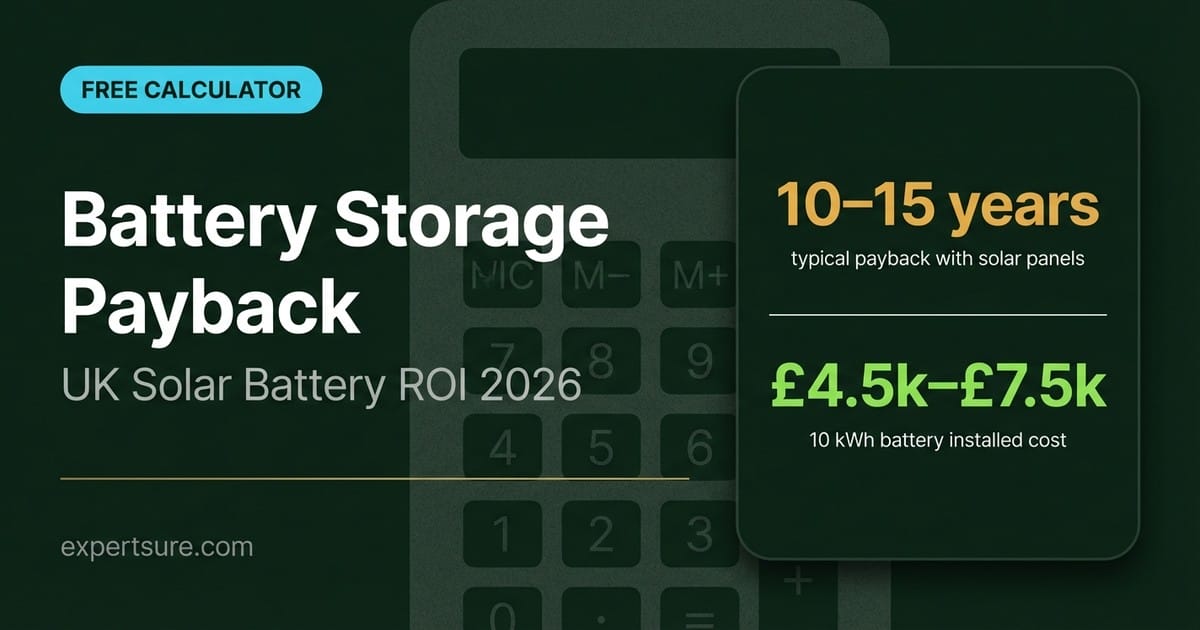
Adding battery storage increases upfront costs by £3,000–£6,000 depending on capacity (5kWh–10kWh), but can boost self-consumption from 40% to 70%, significantly increasing savings. For homes with high daytime electricity usage, batteries may not be necessary — the calculator helps you decide whether the additional cost is worthwhile.
How Solar Savings Are Calculated
Solar savings come from two sources: electricity you generate and use yourself (self-consumption), saving you the retail price, and surplus electricity exported to the grid via the Smart Export Guarantee at 12p+ per kWh.
Understanding how savings are calculated is essential for realistic expectations. Your total annual saving comes from two distinct income streams:
Self-Consumption Savings (The Biggest Component)
Every kilowatt-hour (kWh) you generate and use in your home is a kWh you do not buy from your energy supplier. At the current Ofgem price cap (Q1 2026), electricity costs around 27.7p per kWh. If your solar panels generate 3,600 kWh per year and you self-consume 40% (1,440 kWh), that is £399 saved in grid electricity you did not buy.
Self-consumption rates vary significantly based on when you use electricity. Without a battery, typical UK homes self-consume 30–50% of solar generation — the rest is exported because it is generated during the day when you are not home. Adding a battery increases self-consumption to 60–80% by storing surplus generation for evening use, but costs £3,000–£6,000 upfront.
Smart Export Guarantee (SEG) Payments
Electricity you cannot use is exported to the grid and paid for under the Smart Export Guarantee (SEG), which replaced the old Feed-in Tariff. SEG rates vary by supplier — from as low as 4p/kWh (standard tariffs) to 12p+ per kWh with competitive fixed-rate exporters like Octopus Energy or E.ON Next.
For a 4kW system generating 3,600 kWh annually with 40% self-consumption, you export 2,160 kWh. At 12p per kWh SEG rate, that is £259 per year in export income. Combined with self-consumption savings, total annual benefit is around £600–£1,200 depending on usage patterns.
Degradation and System Lifespan
Solar panels degrade at approximately 0.5% per year, meaning a system generating 3,600 kWh in year one will produce around 3,420 kWh in year twenty. Our calculator accounts for this degradation when projecting 25-year savings.
Panel warranties typically guarantee 80–85% performance after 25 years, but real-world data shows most quality panels exceed this. Inverters last 10–15 years and cost £800–£1,500 to replace — a cost factored into lifetime return calculations.
Self-consumption savings are worth 2× more than export payments (27.7p vs 12p per kWh). Maximising self-consumption - either through battery storage or shifting usage to daytime - is the most effective way to increase solar panel returns.
What Affects Your Solar Savings?
Your savings depend on roof orientation, location (solar irradiance), shading, electricity usage patterns, and whether you add battery storage. South-facing roofs in southern England with high daytime usage deliver the best returns.
Solar panel performance varies significantly across the UK based on geographic and property-specific factors. Understanding these variables helps set realistic expectations and informs whether solar is a good investment for your home.
Roof Orientation and Pitch
South-facing roofs receive the most sunlight and generate 100% of optimal output. East or west-facing roofs produce around 80–90% of a south-facing system, which is still economically viable. North-facing roofs generate 50–60% and are rarely cost-effective in the UK.
Roof pitch (angle) also matters. The ideal pitch for UK latitudes is 30–40 degrees, but roofs between 20–50 degrees perform well. Flat roofs require mounting frames to tilt panels, adding £500–£1,000 to installation costs.
Geographic Location
Solar irradiance (sunlight intensity) varies across the UK. Southern England receives approximately 1,000 kWh/m² per year, while northern Scotland gets around 800 kWh/m². This means a 4kW system in Brighton generates roughly 3,800 kWh annually, while the same system in Aberdeen produces 3,200 kWh — a 15–20% difference.
However, solar panels remain viable across the entire UK. Even in Scotland, savings of £600–£900 per year are achievable, delivering payback within 8–10 years.
Shading
Partial shading from trees, chimneys, or neighbouring buildings significantly reduces output. A single shaded panel can reduce string performance by 30–50% on older systems without optimisers. Modern systems use panel-level optimisers or microinverters to minimise shading impact, but these add £500–£1,200 to installation costs.
Electricity Usage Patterns
The more electricity you use during daylight hours, the higher your self-consumption rate and the greater your savings. Homes with high daytime usage (home offices, heat pumps, EV charging during the day) achieve 50–70% self-consumption without batteries.
Households where everyone is out during the day may only self-consume 25–35%, making battery storage or time-shifting usage (running dishwashers, washing machines during the day) more attractive.
- Best case: South-facing roof, 30° pitch, southern England, minimal shading, high daytime usage — payback 5–6 years
- Good case: East/west roof, 25° pitch, Midlands, occasional shading, moderate daytime usage — payback 7–9 years
- Marginal case: North-facing roof, flat roof, northern Scotland, significant shading, all usage in evening — payback 12–15 years or not viable
Solar Panel Savings by System Size
The table shows estimated costs, annual savings, and payback periods for common residential solar panel system sizes at 2025/26 electricity rates.
| System Size | Panels | Installed Cost | Annual Saving | Payback (Years) |
|---|---|---|---|---|
| 2 kW | 5 | £4,500 | £550 | 8.2 |
| 3 kW | 7–8 | £5,800 | £800 | 7.3 |
| 4 kW | 10 | £7,500 | £1,100 | 6.8 |
| 5 kW | 12–13 | £8,500 | £1,350 | 6.3 |
| 6 kW | 15 | £9,800 | £1,550 | 6.3 |
| 4 kW + battery | 10 | £12,000 | £1,500 | 8.0 |
Source: MCS data, Ofgem Q1 2026 electricity rate (27.7p/kWh), typical SEG export rate (12p/kWh). South-facing roof assumed.
Related Calculators
Explore our other free business calculators:
- Heat Pump Running Cost Calculator — Estimate heat pump costs
- Boiler Running Cost Calculator — Compare boiler running costs
- Business Energy Calculator — Estimate energy costs