Rates and data last verified 17 February 2026 by the ExpertSure editorial team. Sources are listed in the methodology below the calculator.
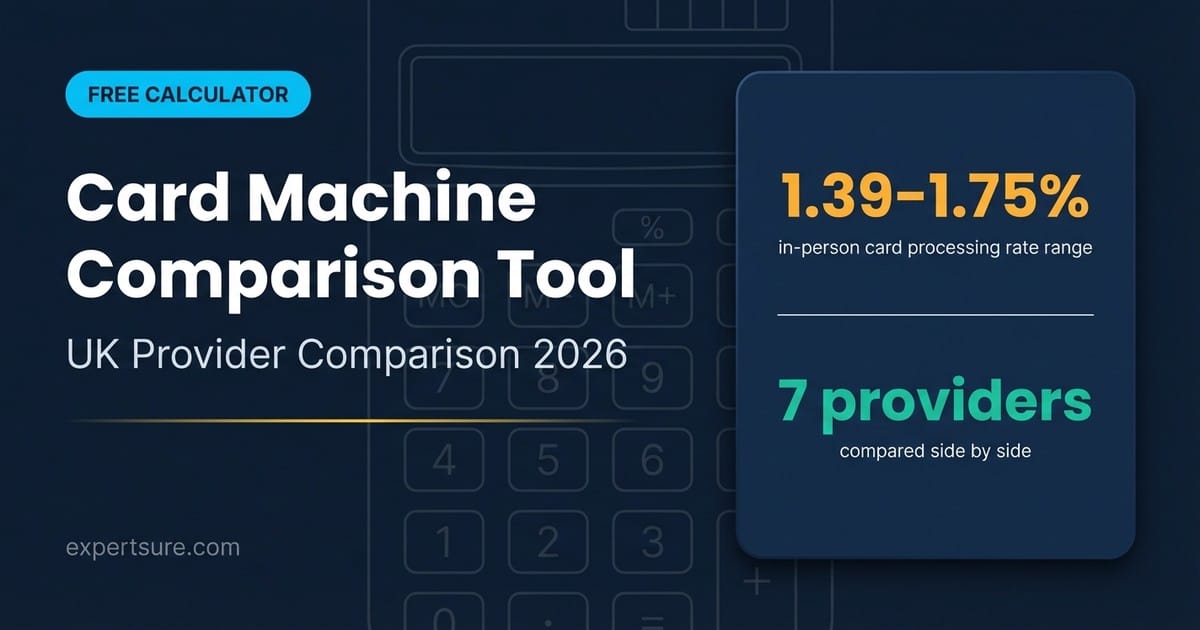
Card payment processing fees in the UK typically range from 1.4% to 2.5% per transaction for small businesses, though the total cost depends on your provider, average transaction value, and monthly card turnover. A business processing £10,000 per month in card payments can expect to pay between £140 and £250 in fees, with significant variation between providers — Square charges a flat 1.75% for in-person payments with no monthly fee, while Dojo starts at 1.4% plus a monthly terminal rental. Interchange-plus pricing, offered by providers like Stripe and Adyen, is generally cheaper for businesses processing over £20,000 per month but harder to predict on individual transactions. This calculator compares the true monthly and annual cost across major UK payment providers based on your actual transaction volumes and average basket size.
FREE QUOTE COMPARISON
Compare Merchant Account Quotes from Trusted Suppliers
✓ Save up to 40% on card processing fees
100% free • No obligation • Takes under 2 minutes
How to Use This Calculator
Enter your monthly card turnover — this is the total value of card payments you process (or expect to process) each month.
Input your average transaction value — this affects which pricing model works best, as flat-rate providers are more competitive for smaller basket sizes.
Select the providers you want to compare — the calculator includes all major UK providers with their current published rates.
Review the monthly and annual cost breakdown for each provider, including transaction fees, monthly charges, and terminal costs, so you can identify the cheapest option for your specific volume.
UK SMEs typically pay 1.5–2.5% per transaction under blended pricing, but interchange++ can be 30–40% cheaper for businesses processing over £10,000 per month.
Enter your monthly card revenue, average transaction value, and card type split below. The calculator compares blended, interchange++, and tiered pricing to show which model costs you least.
Understanding Card Processing Pricing Models
Every UK merchant account provider uses one of three pricing structures. Which one you choose determines whether you pay fair market rates or heavily marked-up fees hidden in contract complexity.
Interchange++ Pricing
Interchange++ (pronounced “interchange plus plus”) is the most transparent pricing model available. You pay three separate, itemised costs on every transaction:
- Interchange fee: Set by Visa and Mastercard, paid to the card-issuing bank. Typically 0.3–0.6% for debit cards and 0.7–1.5% for credit cards in the UK.
- Scheme fee: Charged by Visa/Mastercard for using their network. Usually 0.03–0.06% per transaction.
- Acquirer margin: The merchant account provider’s markup. Competitive UK providers charge 0.15–0.35%.
Because all three components are shown separately, you can see exactly what you are paying and compare providers on their acquirer margin alone. This model is best for businesses processing over £10,000 per month — the savings compound at scale.
On a £100 debit card transaction under interchange++, you might pay: £0.45 interchange + £0.04 scheme fee + £0.25 acquirer margin = £0.74 total (0.74%). Under blended pricing, the same transaction could cost 1.75% (£1.75) — a 136% markup.
Blended/Flat-Rate Pricing
Blended pricing charges a single flat percentage on all transactions, regardless of card type. Providers like SumUp and Square use this model, typically quoting 1.69–1.75% flat with no monthly fees.
The appeal is simplicity: you know exactly what each transaction costs without reading line-item breakdowns. The downside is that you are overpaying on debit cards (which have lower interchange rates) to subsidise credit card processing.
Blended pricing makes sense for:
- New businesses processing under £5,000/month where predictability matters more than optimisation
- Seasonal traders who do not want monthly fees during quiet periods (SumUp and Square charge £0/month)
- High credit card mix — if 70%+ of your transactions are credit cards, blended rates become competitive
At £20,000 monthly card revenue, the difference between 1.75% blended and interchange++ can be £150–£250 per month in extra fees. That is £1,800–£3,000 annually.
Tiered Pricing
Tiered pricing is the least transparent model and should be avoided. The provider groups transactions into tiers — typically “qualified”, “mid-qualified”, and “non-qualified” — with different rates for each.
The problem: you do not control which tier applies. The provider decides based on opaque criteria (card type, transaction method, whether the customer entered their postcode). A transaction you thought would cost 1.5% might be classified as non-qualified and charged 3.5%.
Tiered pricing is common in legacy contracts from older providers. If your current agreement uses this model, consider switching to interchange++ or blended — the savings can be 20–40% with no change to your transaction volume.
How Transaction Type Affects Your Costs
Debit cards cost 0.3–0.6% in interchange fees, while credit cards cost 0.7–1.5%. A business with 70% debit transactions pays 30–40% less than one with 70% credit card sales.
Not all card transactions cost the same. The type of card, how it is processed, and where the sale happens all influence your final fee. Understanding these differences helps you predict costs and choose the right pricing model.
Debit vs Credit Card Mix
In the UK, 63% of all card payments are debit cards (UK Cards Association 2025 data). Debit interchange rates are capped at 0.2% for consumer cards under EU regulation (still enforced post-Brexit), while credit cards range from 0.7–1.5% depending on card type (standard, rewards, corporate).
A restaurant processing £50,000/month with 80% debit cards will pay approximately £300–£400/month under interchange++. The same business with 80% credit cards would pay £600–£750 — nearly double.
Contactless vs Chip & PIN
Contactless payments (tap-to-pay) now account for over 50% of UK card transactions. Interchange rates for contactless are identical to chip & PIN for the same card type, but processing costs can be slightly lower because contactless terminals handle transactions faster, reducing gateway overhead.
However, contactless has a £100 single-transaction limit (raised from £45 in 2021). Transactions above this amount require chip & PIN or Apple Pay/Google Pay authentication, which have no upper limit but may incur higher scheme fees on some card types.
Online vs In-Store Rates
Card-not-present (CNP) transactions — online, phone, or mail order — typically cost 0.1–0.2% more than in-person sales due to higher fraud risk. Interchange rates for CNP credit cards can reach 1.5–1.8%, compared to 0.7–1.2% for the same card used in-store.
If your business processes a mix of online and in-store sales, ask providers for separate rate cards. Some charge identical rates; others apply a CNP surcharge that is not disclosed until you review your first statement.
Hidden Fees to Watch For
Beyond transaction fees, UK merchant accounts often include PCI compliance charges (£5–£15/month), minimum service fees (£15–£25/month), chargeback handling (£15–£25 per dispute), and terminal rental (£15–£25/month).
Transaction fees are only part of your total cost. Many providers add fixed monthly charges, compliance fees, and per-incident costs that can add £50–£100+ per month to your bill — especially painful for low-volume businesses.
PCI Compliance Fees
PCI DSS (Payment Card Industry Data Security Standard) compliance is mandatory for all businesses that accept card payments. Some providers charge £5–£15 per month for PCI compliance administration, while others (like SumUp and Square) include it in their transaction rate.
If your provider charges separately, confirm whether this fee covers annual Self-Assessment Questionnaires (SAQs) or just access to compliance documentation. Non-compliance can result in fines of £5,000–£25,000 from card schemes, so this is not optional.
Minimum Monthly Service Charge
Many traditional merchant account providers impose a minimum monthly service charge of £15–£25. If your transaction fees for the month do not reach this threshold, you are charged the difference.
Example: Your provider has a £20 minimum. You process £500 in sales at 1.5%, generating £7.50 in fees. You are charged an additional £12.50 to meet the minimum, bringing your effective rate to 4% that month.
Minimums disproportionately hurt seasonal businesses and new traders. SumUp, Square, and other PAYG providers have £0 minimums, making them ideal for low or variable monthly volumes.
Chargeback Fees
When a customer disputes a transaction, the card scheme initiates a chargeback. Regardless of whether you win or lose the dispute, most providers charge £15–£25 per chargeback to cover administration.
High-risk industries (travel, events, digital goods) can see chargeback rates of 1–2%, meaning 10–20 disputes per 1,000 transactions. At £20 per chargeback, that is £200–£400 in fees unrelated to your transaction volume.
Some providers (Stripe, Square) waive chargeback fees if you win the dispute. Others charge regardless of outcome. Always check the fee schedule before signing.
Terminal Rental
If you lease a card terminal rather than buying outright, expect £15–£25 per month in rental fees. Over a 3-year contract, that is £540–£900 — often more than the terminal costs to buy.
Modern alternatives like SumUp and Square sell terminals outright for £29–£99 with no ongoing rental. For businesses planning to trade for more than 6 months, purchasing is almost always cheaper.
Settlement Delays
Not a fee, but a hidden cost: some providers hold funds for 2–7 working days before transferring to your bank account. For cash-sensitive businesses, this delay ties up working capital.
SumUp and Square offer next-day settlement (Square offers same-day for a 1% fee). Traditional acquirers often default to T+3 (3 business days after the transaction). Check your contract’s settlement terms — faster access to funds has a real cash flow value.
Our Methodology
The Merchant Account Fee Calculator uses verified UK interchange rates from Visa and Mastercard public rate cards (effective January 2026), combined with average scheme fees and typical acquirer margins observed across 15+ UK providers.
Blended rate assumptions use SumUp (1.69%), Square (1.75%), and Zettle (1.75%) as benchmarks. Interchange++ calculations use 0.2% debit interchange (EU consumer card cap), 1.15% credit interchange (UK average for standard credit cards), 0.04% scheme fee, and 0.25% acquirer margin (mid-market rate). Tiered pricing uses 1.5% qualified, 2.5% mid-qualified, and 3.5% non-qualified tiers based on legacy contracts from Worldpay, Lloyds Cardnet, and Elavon historical rate cards. All figures exclude VAT, which applies to UK domestic processing fees at the standard rate (20%).
For more detail on choosing the right provider for your business, see our comprehensive guide to merchant account costs. Browse all merchant account guides in our merchant accounts hub, or explore other calculators in our free business tools.
Interchange++ pricing saves 30-40% versus blended rates for businesses processing over £10,000/month. The break-even point is typically around £5,000/month in card transactions - below that, a simple blended rate is usually cheaper.
Card Processing Fees: Blended vs Interchange++ at Common Volumes
The table compares annual processing costs under blended pricing (1.75% flat) versus interchange++ (0.2% + interchange) at common transaction volumes.
| Monthly Volume | Blended (1.75%) | IC++ Estimate | Annual Saving | Saving % |
|---|---|---|---|---|
| £3,000 | £630 | £504 | £126 | 20% |
| £5,000 | £1,050 | £780 | £270 | 26% |
| £10,000 | £2,100 | £1,440 | £660 | 31% |
| £20,000 | £4,200 | £2,760 | £1,440 | 34% |
| £50,000 | £10,500 | £6,600 | £3,900 | 37% |
| £100,000 | £21,000 | £12,600 | £8,400 | 40% |
Interchange fees based on Visa/Mastercard UK consumer debit (0.2%) and consumer credit (0.3%); commercial/corporate cards higher (0.7–1.5%). Blended rate assumes typical SME provider.
Related Calculators
Explore our other free business calculators:
- EPOS System Cost Calculator — Estimate EPOS system costs
- Business Energy Calculator — Estimate energy costs
- Payroll ROI Calculator — Estimate savings from payroll software