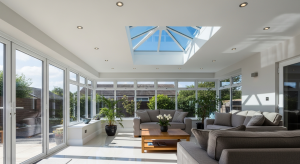
Conservatory roof insulation in 2026 typically uses 100–120mm of PIR foam board sandwiched between a breather membrane, foil reflective sheet, and fire-rated plasterboard, achieving a U-value of 0.15–0.18 W/m²K on tiled systems. Glass roofs hit 1.0–1.6, polycarbonate 1.8–3.0. Building Regulations Part L requires 0.18 or better for habitable extension space, which is the threshold every mainstream tiled system (Guardian, LivinROOF, Equinox, SupaLite) is engineered to meet. This guide explains how U-values work, what insulation systems each roof type uses, and what compliance level you actually need.
FREE QUOTE COMPARISON
Compare Conservatory Roof Quotes from Trusted Suppliers
100% free • No obligation • Takes under 2 minutes
All U-value figures are verified against BBA Agrément certificates, JHAI registration documents, and Building Regulations Approved Document Part L (2021 edition, incorporating 2023 amendments). For the underlying roof choices, see our tiled vs glass vs polycarbonate comparison, the cost breakdown, and our planning permission and Building Regs guide.
What Is a U-Value?
U-value is the rate of heat loss through a building element measured in watts per square metre per kelvin (W/m²K). The lower the number, the better the insulation. For UK conservatory roofs, U-values range from 0.15 (best-in-class tiled) to 3.0 (worst-case old polycarbonate). Building Regulations Part L sets the legal threshold for habitable extension space at 0.18 W/m²K – any roof at or below this counts as habitable; anything above does not.
To put the numbers in perspective: a U-value of 0.18 means the roof loses about 1 watt of heat per square metre for every 5.6°C of temperature difference. A U-value of 1.8 (typical polycarbonate) loses 10 times that much – about 1 watt per m² per 0.56°C difference. Over a typical UK heating season, the polycarbonate conservatory loses 8-10 times more heat than a tiled equivalent at the same indoor temperature.
U-value measurements are made under laboratory conditions and the real-world performance is typically 5-15% worse, especially on aged systems. A polycarbonate roof rated 1.8 when new can degrade to 2.5-3.0 over 15 years as the cellular walls collapse and air gaps fill with moisture. A tiled roof at 0.18 typically holds its rated U-value for the full 30-40 year service life because the insulation is sealed inside the structure.
U-Value by Roof Type
The five conservatory roof options sit at very different points on the U-value scale. Tiled systems achieve insulation comparable to a fully-insulated house wall (0.15-0.18); glass options are 5-10x worse; polycarbonate 10-20x worse. The gap is the single biggest reason tiled roofs are now the default choice for year-round room conversions.
| Roof type | U-value (W/m²K) | Building Regs Part L | Habitable space? |
|---|---|---|---|
| Tiled (LivinROOF, lightweight tile) | 0.15 | Exceeds (best in class) | Yes – with Building Notice |
| Tiled (Guardian, Equinox, SupaLite) | 0.18 | Meets Part L threshold | Yes – with Building Notice |
| Solar-control glass | 1.0 | Fails (5.6x worse than threshold) | No |
| Self-cleaning glass (Pilkington Activ) | 1.2–1.4 | Fails | No |
| Standard glass (toughened) | 1.6 | Fails (8.9x worse) | No |
| Polycarbonate (modern, 35mm) | 1.8 | Fails (10x worse) | No |
| Polycarbonate (aged, degraded) | 2.5–3.0 | Fails (14-17x worse) | No |
The takeaway: only tiled (insulated) systems meet the Building Regs Part L threshold for habitable extension space. Glass and polycarbonate are both outside the threshold by 5-17x, which is why the conservatory itself is legally classified as a "substantially glazed" structure that sits outside the heated envelope of the house.
How Tiled Insulation Systems Are Built
The U-value of 0.15-0.18 on a tiled conservatory roof comes from a multi-layer composite of lightweight tiles, breather membrane, PIR insulation foam, foil reflective sheet, and fire-rated plasterboard. Each layer plays a specific thermal and structural role. The total assembly thickness is typically 180-220mm.
- Lightweight composite tile (outer skin): 18kg/m² tile in slate grey, terracotta, antique red, or burnt umber. Provides weather resistance and structural surface.
- Tile battens and counter-battens: Engineered timber, 25-50mm. Creates ventilation gap above the membrane.
- Breather membrane: Tyvek or equivalent. Lets water vapour escape, blocks rainwater. 0.2mm thick.
- PIR foam insulation board: 100-120mm Celotex, Kingspan, or equivalent. The thermal heart of the system – delivers most of the U-value performance.
- Foil reflective sheet: 0.05mm aluminium foil. Reflects radiant heat back into the room. Adds 0.02-0.04 to the U-value performance.
- Engineered timber rafters: Structural support, factory-cut to the conservatory's exact frame plan.
- Fire-rated plasterboard ceiling: 12.5mm Gyproc Fireline or equivalent. 30-minute fire resistance, smooth white finish for paint.
The PIR foam is the critical layer. PIR (polyisocyanurate) is a closed-cell rigid foam with a thermal conductivity of around 0.022 W/mK – one of the best insulators available for residential construction. At 100mm thickness, PIR alone delivers a U-value of 0.22, and the additional layers (foil reflective, plasterboard, structural timber) bring the assembly down to 0.15-0.18.
Some installers offer multi-foil insulation as a budget alternative to PIR foam. Multi-foil is thinner (15-25mm vs 100-120mm) and cheaper, but the U-value performance does not match PIR. For Building Regs sign-off you need PIR or equivalent rigid foam - multi-foil alone will not pass without supplementary insulation, and is best used as a top-up layer rather than the main insulation.
Glass Conservatory Roof Insulation
Glass conservatory roofs use a different insulation principle: they rely on the air gap inside the double-glazed unit, plus low-emissivity coatings on the inner glass surface, plus warm-edge spacer bars. The best-performing glass units (solar-control, low-E, argon-filled, warm-edge spacer) achieve U-values of 1.0 W/m²K – significantly better than polycarbonate but still 5-6x worse than tiled.
- Standard double-glazed (no coating): U-value 1.6-2.0. Two panes of toughened glass with a 16-20mm air gap. Cheapest glass option, worst thermal performance.
- Low-E coating (Pilkington K-glass or equivalent): U-value 1.4-1.6. Microscopic metallic oxide coating on the inner pane reflects radiant heat back into the room.
- Self-cleaning glass (Pilkington Activ + low-E): U-value 1.2-1.4. Adds titanium dioxide outer coating for self-cleaning, with the same low-E thermal performance.
- Solar-control glass (Pilkington Suncool, Saint-Gobain Cool-Lite): U-value 1.0-1.2. Multi-layer metallic oxide coating reflects 60-75% of solar heat while letting visible light through.
- Argon-filled with warm-edge spacer: U-value reduces by 0.1-0.2 vs air-filled. Argon has lower thermal conductivity than air; warm-edge spacer reduces edge heat loss vs traditional aluminium spacer.
- Triple-glazed: U-value 0.8-1.0. Rare in conservatory roofs because of weight and cost. Only specified on premium new-build conservatories or solar-focused renovations.
None of the glass options approach the Building Regs Part L threshold of 0.18, which is why conservatories with glass roofs are always classified as substantially-glazed structures outside the heated envelope. The legal status does not change with the glass spec – even a triple-glazed argon-filled premium unit at 0.8 still fails Part L by a factor of 4.4.
Polycarbonate Insulation (Or Lack Of)
Polycarbonate sheets are multi-cellular plastic panels with internal partitions creating air pockets. The air pockets provide thermal performance but the U-value is significantly worse than glass because plastic conducts heat more readily than glass and the cellular structure breaks down over 10-15 years.
| Polycarbonate spec | Sheet thickness | U-value when new | U-value at year 15 |
|---|---|---|---|
| 3-wall | 16mm | 2.5 | 3.5+ |
| 5-wall | 25mm | 2.0 | 2.8 |
| 7-wall (premium) | 35mm | 1.8 | 2.5 |
| Twinwall (basic) | 10mm | 3.0 | 4.0+ |
The U-value degradation over 15 years is the bigger story. Polycarbonate sheets lose thermal performance as the cellular partitions collapse, water vapour fills the air gaps, and the UV stabiliser layer breaks down. A polycarbonate roof installed at U-value 1.8 in 2010 will be performing closer to 2.5-3.0 in 2026. This is why most homeowners with 2005-2015 polycarbonate roofs experience progressively worse thermal comfort year-on-year.
Building Regulations Part L Compliance
Building Regulations Part L (Conservation of Fuel and Power) sets the U-value thresholds for new construction and renovations in England and Wales. Scotland uses the Section 6 equivalent in the Building Standards Technical Handbook; Northern Ireland uses Technical Booklet F. The thresholds are functionally similar across all four UK nations.
- Habitable extension roof: Maximum U-value 0.18 W/m²K (England, Wales, Scotland, NI). All mainstream tiled systems meet this.
- Habitable extension wall: Maximum U-value 0.30 W/m²K. Conservatory frames typically need additional insulation panels to comply if the room is being brought inside the heated envelope.
- Habitable extension window: Maximum U-value 1.4 W/m²K. Most modern A-rated double-glazed units comply.
- Conservatory exemption: Conservatories under 30m² floor area, with external doors retained between the house and conservatory, no fixed heating extended in, are exempt from Part L compliance entirely.
- Replacement roof on existing conservatory: Like-for-like replacement is not regulated work and does not need to meet Part L. The Part L threshold applies only when the conservatory is being brought inside the heated envelope.
The practical implication: most conservatory roof replacements you see in 2026 are like-for-like swaps that do not legally need to hit the Part L threshold. Owners specify a tiled roof at 0.18 anyway because it delivers year-round comfort and resale value uplift – but it is technically optional from a Building Regs standpoint as long as the conservatory keeps its external doors and stays thermally separated. See our planning permission guide for the full Building Regs decision tree.
U-Value vs Comfort: What the Numbers Actually Mean
Theoretical U-values matter less than how the room actually feels. A U-value improvement from 1.8 to 0.18 (10x reduction in heat loss) translates to a noticeable difference in three things: indoor temperature on cold days, heating bill, and condensation behaviour.
| Performance metric | Polycarbonate (1.8) | Glass (1.0) | Tiled (0.18) |
|---|---|---|---|
| Internal temp on a 5°C winter day, room heated to 18°C | 11–13°C (loses heat fast) | 15–16°C | 17–18°C (holds set point) |
| Annual heating cost (typical 14m² conservatory used 6 months) | £320–£380 | £110–£160 | £30–£75 |
| Internal condensation in winter | Heavy – daily wipe-down required | Moderate – visible on cold mornings | None – surface stays warm |
| Time to reach comfort temperature from cold | 2–3 hours (or never) | 30–45 minutes | 15–20 minutes |
| Comfortable for use Oct–March | No | Mild winter days only | Yes (year-round) |
The biggest comfort gain is between polycarbonate and glass (going from unheatable to mild-day usable). The biggest cost gain is between glass and tiled (going from £110-£160/year heating to £30-£75/year). The biggest legal gain is between glass and tiled (only tiled meets habitable-space thresholds for resale value uplift).
Common Insulation Mistakes
Five mistakes we see repeatedly when homeowners specify or evaluate conservatory roof insulation. All are avoidable with the right questions at the quote stage.
- Accepting multi-foil as the main insulation: Multi-foil sheets are thinner and cheaper than PIR but cannot achieve U-value 0.18 alone. Always specify PIR or equivalent rigid foam as the primary insulation; multi-foil is acceptable only as a supplementary layer.
- Skipping the foil reflective sheet: Some budget installs omit the foil reflective layer to save £100-£200. The foil contributes 0.02-0.04 to the U-value performance and prevents radiant heat loss – a significant compromise on a system that is supposed to deliver Part L compliance.
- Specifying real slate or clay tile without structural reinforcement: Real tile weighs 70-90kg/m² vs lightweight composite at 18kg/m². Frames not engineered for the load require £800-£2,500 in steel reinforcement. Insulation performance is identical between tile types – the choice is purely aesthetic and structural, not thermal.
- Not asking about U-value in writing: Reputable installers (Guardian, LivinROOF, Equinox) print the certified U-value on the quote. Smaller installers sometimes quote "insulated" without specifying the U-value. Always ask for the BBA Agrément number or equivalent third-party certification.
- Forgetting that glass panels reduce average U-value: A LivinROOF with 60% tile / 40% glass split sits at U-value ~0.95 on average, not the 0.15 of fully-tiled. The glass panels dominate the average. Plan the glass-tile ratio with this in mind.
Our Verdict
For most UK homeowners replacing a conservatory roof in 2026, a tiled (insulated) system at U-value 0.18 is the only option that delivers genuine year-round comfort – the 10-20x improvement over polycarbonate translates directly to lower heating bills, no condensation, and habitable-space classification. Glass at U-value 1.0-1.6 is a meaningful improvement over polycarbonate but does not meet Part L thresholds and the conservatory remains classified as outside the heated envelope. Polycarbonate is functionally obsolete at U-values 1.8-3.0 (degrading to 2.5-4.0 over 15 years).
The biggest practical question is not which roof type, but whether the install will hit Part L (0.18 or better with proper PIR insulation, foil reflective sheet, and certified components). Some budget installers cut corners on insulation specification while still calling the result "insulated" – always check the BBA Agrément number, the PIR thickness (100mm minimum), and the certified U-value on the quote. See our best conservatory roof companies guide for installers we trust on certification, or our conservatory roof house value guide for the resale uplift the proper Part L compliance unlocks.
FREE QUOTE COMPARISON
Compare Conservatory Roof Quotes from Trusted Suppliers
100% free • No obligation • Takes under 2 minutes
Last updated: May 2026. U-value figures verified against BBA Agrément certificates, JHAI registration documents, and Building Regulations Approved Document Part L (2021 edition, incorporating 2023 amendments). Performance figures are modelled estimates for a typical 14m² UK conservatory, derived from the U-values above and standard UK heating-season assumptions.