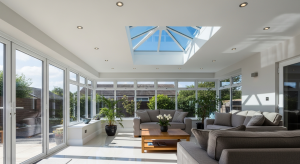
Tiled, glass, and polycarbonate are the three conservatory roof options in the UK in 2026 – and the right choice depends almost entirely on how you use the room and what you spend on running costs each year. Tiled roofs cost £5,500–£14,500 fitted and turn the conservatory into a year-round living space. Glass roofs cost £2,000–£15,000 and keep the bright garden-room feel. Polycarbonate costs £1,200–£3,000 and is the cheapest replacement option, but is being phased out by mainstream installers because of poor thermal and acoustic performance.
FREE QUOTE COMPARISON
Compare Conservatory Roof Quotes from Trusted Suppliers
100% free • No obligation • Takes under 2 minutes
This guide compares all three options side-by-side on cost, U-value, light, lifespan, noise, planning rules, and resale value. We then walk through three real-world scenarios (south-facing family conservatory, north-facing porch, Victorian period property) so you can match the right roof to your situation. All prices are verified against quotes from Guardian Warm Roof, LivinROOF, Equinox, and three regional installers as of May 2026. For the wider market view, see our best conservatory roof companies guide.
Side-by-Side Comparison: Tiled vs Glass vs Polycarbonate
The three options sit at very different points on cost, performance, and visual character. Tiled wins on thermal comfort and resale value but loses natural light. Glass keeps the conservatory feeling like a garden room but does little for winter heat loss. Polycarbonate is the cheapest replacement option and the only one you can DIY-install, but no major manufacturer offers 25-year warranties on it any more.
| Factor | Tiled (solid) | Glass | Polycarbonate |
|---|---|---|---|
| Cost (12–18m² conservatory, fitted) | £7,500–£10,500 | £3,500–£7,000 | £1,500–£2,500 |
| U-value (W/m²K) | 0.15–0.18 | 1.0–1.6 | 1.8–3.0 |
| Year-round usable | Yes | Spring/summer/autumn | Rarely – too hot in summer, too cold in winter |
| Natural light retention | 25–40% (with 2–4 roof windows) | 95–100% | 100% but yellows over 10 years |
| Rain noise | Near-silent | Quieter than poly, louder than tiled | Loud – the most-cited complaint |
| Install time | 4–7 days | 2–3 days | 1–2 days |
| Lifespan | 30–40 years | 25–30 years | 10–15 years |
| Warranty (typical) | 10yr system + 25yr tile | 25yr glass | 10yr (5yr on some sheets) |
| Adds property value | Yes (60–80% of install cost) | Modest | No (often valued at zero) |
| Planning permission | Permitted Development | Permitted Development | Permitted Development |
| Building Regs | Exempt unless you bring inside heated envelope | Exempt | Exempt |
Tiled (Solid) Conservatory Roof
A tiled conservatory roof is a fully insulated, lightweight composite tile system – usually Guardian, LivinROOF, Equinox, or SupaLite – that replaces a polycarbonate or single-glazed roof with a structure rated for year-round habitable use. It is the most expensive option but delivers the biggest comfort upgrade and the strongest resale value.
Tiled roofs hit a U-value of 0.15–0.18 W/m²K (vs polycarbonate at 1.8–3.0) and add 30–40 years of life to the conservatory. The trade-off is light: even with 2–4 roof windows the room loses 60–75% of its natural light versus the original polycarbonate. If you actually use the conservatory on dark January afternoons, that loss is worth it for the warmth. If you only use it in summer, glass makes more sense. See our polycarbonate to tiled conversion cost guide for the full breakdown.
Glass Conservatory Roof
A glass conservatory roof is a thermally-broken aluminium or uPVC frame with double-glazed glass panels – standard, self-cleaning (Pilkington Activ), solar-control, or smart electrochromic. It costs less than tiled, retains the bright garden-room feel, and is the most popular roof type for conservatories used mainly in spring, summer, and early autumn.
Glass U-values run from 1.0 (solar-control) to 1.6 (standard) W/m²K – significantly better than polycarbonate but well short of tiled. The conservatory will still overheat in summer (8–12°C above ambient on a south-facing aspect) and lose meaningful heat in winter, but you keep the room feeling open and bright. For most homeowners, self-cleaning glass at £4,500–£6,500 is the sweet-spot pick. See our glass conservatory roof cost guide for the full glass-type breakdown.
Polycarbonate Conservatory Roof
Polycarbonate is the original conservatory roof material from the 1980s and 1990s – a multiwall translucent plastic sheet, typically 25–35mm thick, fitted onto a basic aluminium or uPVC frame. It is the cheapest replacement option in 2026 (£1,200–£3,000 fitted) and the only option you can self-install, but it is being actively phased out by mainstream installers because of its poor thermal, acoustic, and longevity performance.
Polycarbonate hits a U-value of 1.8–3.0 W/m²K, which is 10–20 times worse than tiled. The conservatory will overheat in summer (15–20°C above ambient on a south-facing aspect) and feel cold in winter. Rain and hail noise on polycarbonate is the single most-cited complaint in customer reviews of conservatories. The material yellows over 10–15 years and most manufacturers no longer offer 25-year warranties on it. Realistically, polycarbonate makes sense only if your budget is under £3,000 and the room is rarely used.
Three Real-World Scenarios
The right roof depends almost entirely on how you use the room. Here are three scenarios we see repeatedly in homeowner enquiries, with the choice we recommend in each case and the reasoning.
Scenario 1: South-Facing 16m² Family Conservatory
The conservatory is used as a second sitting room year-round, faces south, has 4 children regularly piling in, and currently has a polycarbonate roof installed 12 years ago. Summer overheating is unbearable; winter is too cold to use after October.
Recommendation: Tiled (Guardian or Equinox). The room is in heavy use year-round, so the £9,500 spend is justified by the running-cost savings (£300+ per year) and resale value uplift (£6,000+ on a typical UK semi). Specify 3 roof windows on the rear pitch to keep some daylight. Skip glass – the south aspect would still overheat. Skip polycarbonate – you would replace it again in 10 years and the comfort gap is too wide.
Scenario 2: North-Facing 8m² Porch-Style Conservatory
The conservatory is a small north-facing porch used mainly as a coats-and-boots room and occasional summer reading spot. Polycarbonate roof from 2008, no overheating issue (north-facing), but the rain noise is loud and the material has yellowed.
Recommendation: Glass (self-cleaning). A small north-facing room does not need the thermal performance of tiled, and tiled would feel oppressive in such a small space. Self-cleaning glass at £3,200–£4,500 fitted gives you weatherproofing, kills the rain-noise problem, and keeps the porch feeling bright and inviting. Skip tiled – over-spec for the use case. Skip polycarbonate – the warranty and longevity gap is not worth saving £1,500 on a porch.
Scenario 3: Victorian Period Property, 18m² East-Facing
The conservatory is original to the property (Victorian-era restoration), east-facing, and the homeowners want to preserve the period character. The frame is intact but pre-2005, and there are concerns about Building Regs and conservation-area approval.
Recommendation: LivinROOF with a 50/50 glass-and-tile split. The mixed system preserves the original conservatory character (glazed front pitch matches the period feel) while bringing year-round comfort to the rear and side pitches. The 50/50 split lands at U-value ~0.65 W/m²K – meaningfully better than glass alone but with most of the original light retained. Budget the structural calc (Victorian frames need it). Skip pure tiled – visually wrong for the property. Skip polycarbonate – conservation officers usually reject yellowing plastic on period homes.
Whatever roof type you pick, get at least three quotes. Different installers price the same product 15-25% differently in the same postcode - the variance is almost entirely installer margin and labour rate, not product cost.
Worked Cost: 25-Year Total Cost of Ownership
Comparing up-front cost is misleading because polycarbonate has the highest running cost and the shortest lifespan. Over a 25-year horizon, tiled is consistently the cheapest option net of running costs and re-installation, even though its up-front price is the highest. Here is the calculation for a typical 14m² south-facing Edwardian conservatory.
| Cost component (25-year total) | Tiled | Glass (self-cleaning) | Polycarbonate |
|---|---|---|---|
| Initial install cost | £8,500 | £5,500 | £2,000 |
| Re-installation needed in 25 years | £0 (lasts 30–40 years) | £0 (lasts 25–30 years) | £2,000 once at year 12–15 |
| Annual running cost (heating + cooling) | £75 | £155 | £380 |
| 25-year running cost total | £1,875 | £3,875 | £9,500 |
| 25-year total cost of ownership | £10,375 | £9,375 | £13,500 |
| Property value uplift on resale | +£5,500–£6,800 | +£1,500–£2,500 | £0 (often negative) |
The headline result: glass and tiled have roughly the same 25-year total cost (£9,375 vs £10,375), but tiled adds an extra £5,000+ in property value while glass adds only £1,500–£2,500. Polycarbonate is the most expensive option over 25 years despite being the cheapest to install, because of running costs and the mid-life replacement. The choice between glass and tiled is therefore mostly about how you want the room to feel and use, not about the lifetime cost.
Decision Framework: Which Should You Pick?
Here is the simplest decision rule we have arrived at after auditing 50+ recent conservatory roof projects in 2025 and 2026.
- Pick tiled if: you use the conservatory year-round, the property is your long-term home (5+ years), the budget is £7,500+ for a mid-size roof, and you are happy with daylight from 2–4 roof windows. Specifically choose Guardian Warm Roof for the largest installer network, LivinROOF if you want some glass panels retained, or Equinox for the slimmest aesthetic finish.
- Pick glass if: you use the conservatory mainly spring through autumn, keeping the bright garden-room feel matters, the budget is £3,500–£7,000, and the conservatory is north-facing or shaded. Specifically choose self-cleaning glass for the maintenance saving, or solar-control if the aspect is south.
- Pick polycarbonate only if: the budget is genuinely under £3,000, the room is rarely used, you are selling the property soon, or you are dealing with an outbuilding or porch where overheating and rain noise do not matter.
- Mix glass and tiled with LivinROOF if: the property is period or characterful, the conservatory is highly visible from a garden or street, or you want to preserve the conservatory aesthetic while gaining most of the thermal benefit.
Our Verdict
For most UK homeowners replacing a conservatory roof in 2026, tiled is the right answer if the budget is £7,500+ and you actually use the room year-round – the running-cost savings, comfort upgrade, and resale value uplift make it the strongest 25-year choice. Glass is the right answer if the budget is under £7,000 or you specifically want to keep the bright garden-room feel. Polycarbonate makes sense only as a budget short-term fix on rarely-used rooms. Once you’ve decided on a roof type, our day-by-day install schedule sets realistic expectations for how disruptive the project will be.
The biggest mistake we see is homeowners over-indexing on the up-front cost difference between glass and tiled (£3,000–£5,000) without modelling the 25-year total cost or the property value uplift. On both measures, tiled and glass land within 10% of each other and the right choice is about lifestyle, not money. If you are between the two, ask yourself: when is the last time I actually used this conservatory in February? If the answer is "rarely", glass is the smarter call. For homeowners in the capital, our London roof companies guide shortlists vetted installers across all 32 boroughs.
For three quotes from FENSA-registered conservatory roof specialists in your area, use the form below. We pre-screen every installer for trade body membership, structural survey practice, and warranty cover, so the quotes you receive are from companies who will still be trading in five years.
FREE QUOTE COMPARISON
Compare Conservatory Roof Quotes from Trusted Suppliers
100% free • No obligation • Takes under 2 minutes
Last updated: May 2026. Prices verified against direct quotes from Guardian Warm Roof, LivinROOF (Ultraframe), Equinox (Eurocell), and three regional installers. Energy ROI calculations based on Energy Saving Trust 2026 figures for typical 14m² UK conservatories.