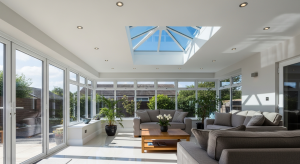
A glass conservatory roof costs £2,000 to £15,000 fitted in the UK in 2026, with most homeowners paying £3,500 to £7,000 for a typical 12–18m² replacement. The price is driven mainly by glass spec (standard, self-cleaning, solar-control, or smart) and the size and shape of your existing conservatory frame – lean-to and Edwardian roofs sit at the lower end, while Victorian, P-shaped and L-shaped roofs run 15–30% higher because they need bespoke glass cuts and additional ridge or hip detailing.
FREE QUOTE COMPARISON
Compare Conservatory Roof Quotes from Trusted Suppliers
100% free • No obligation • Takes under 2 minutes
This guide breaks down the four glass roof types you can fit in 2026, includes a worked cost example showing how solar-control glass pays for itself over 9–12 years, and gives you a decision framework for when glass beats tiled or polycarbonate. All prices are verified against quotes from Ultraframe, Pilkington, Aspect, and three regional installers as of May 2026. For a wider view of the conservatory roof market, see our conservatory roof replacement cost guide.
Glass Conservatory Roof Cost by Glass Type
Glass conservatory roof prices range from £2,000 for standard toughened glass on a small lean-to up to £9,500 for solar-control or smart glass on a Victorian conservatory. The four glass types differ on heat retention, glare, and maintenance – and the right choice depends on which problem you are trying to solve.
Most quotes you receive will be for one of four glass specifications. Each performs differently on heat retention (U-value), solar gain (g-value), self-cleaning, and acoustic performance. The price difference between standard and solar-control glass is often less than £3,000 on the typical job, and solar-control regularly pays back through reduced summer cooling and lower glare year-round.
| Glass type | Cost (12m² conservatory) | U-value (W/m²K) | Best for |
|---|---|---|---|
| Standard toughened | £2,000–£4,000 | 1.6–1.8 | Budget replacement of a polycarbonate roof |
| Self-cleaning (Pilkington Activ) | £4,500–£6,500 | 1.2–1.4 | Most homeowners – the standard mid-range pick |
| Solar-control | £6,000–£9,500 | 1.0–1.2 | South-facing rooms or families that want year-round comfort |
| Smart / electrochromic | £9,000–£15,000 | 0.9–1.1 | Premium installs – tunable tint, very few UK suppliers |
Standard toughened glass is the cheapest replacement option but offers the worst thermal performance. If you are coming from a polycarbonate roof you will notice a comfort improvement, but the conservatory will still overheat in summer and lose heat in winter.
Self-cleaning glass uses a microscopic titanium dioxide coating that breaks down dirt under UV light and lets rain wash it off. You still need an annual clean, but it cuts routine maintenance noticeably.
Solar-control glass includes a metallic oxide layer that reflects 60–75% of incoming solar heat while letting visible light through. On a south-facing conservatory it can cut summer temperatures by 8–12°C against standard glass.
Smart glass lets you electrically dim the panel between clear and tinted, but UK supply is currently limited to specialist orangeries and high-end extensions.
What Affects Glass Conservatory Roof Cost?
Glass conservatory roof prices are driven by four factors: conservatory size, roof shape, glass specification, and the structural condition of the existing frame. A 12m² lean-to with a sound aluminium frame is the cheapest job; a 25m² P-shaped with a tired uPVC frame can be three times the price.
- Conservatory size: Most quotes are priced by total roof area. A 6m² porch-style conservatory might cost £1,500 to fit; a 25m² family conservatory typically runs £7,500–£12,000 in the same glass spec.
- Roof shape: Edwardian (rectangular) and lean-to (single slope) roofs are the simplest to glaze. Victorian conservatories have a faceted bay end with three to five small triangular panels and cost 15–20% more. P-shaped, L-shaped, and gable-end roofs need bespoke ridge and hip flashing and run 25–35% above a like-for-like Edwardian.
- Glass specification: Self-cleaning glass adds £1,500–£2,500 over standard. Solar-control adds another £1,500. Smart glass is a step change – expect £500–£700 per m² for the panel alone.
- Frame condition: Most installers will refuse to fit a new glass roof onto a frame that is rotten, sagging, or out of square. If your existing frame needs reinforcement (typical on conservatories over 15 years old), add £800–£2,000.
- Region: London and the South East run 10–15% above national averages. Scotland and the North East are typically 5–8% below.
- Disposal of old roof: If you are replacing polycarbonate, expect a £150–£300 disposal charge that may not be itemised on the quote.
Always check that your quote includes scaffolding, ridge tiles, gutter replacement, and removal of the old roof. Cheap headline prices that exclude these can balloon by £500-£1,500 once the work starts.
Glass vs Polycarbonate vs Tiled: How Glass Compares
Glass sits in the middle of the conservatory roof market in 2026 – cheaper than tiled (£6,100–£15,000), more expensive than polycarbonate (£1,200–£3,000), and the only option that keeps your conservatory feeling bright and open. The right choice depends on whether you prioritise light, thermal performance, or budget.
Worked Cost Example: Is Solar-Control Glass Worth the Premium?
For a typical 12m² south-facing Edwardian conservatory in Manchester, standard glass costs £3,200 fitted but adds about £140 a year to summer cooling and winter heating costs. Solar-control glass costs £4,800 fitted – a £1,600 premium – but cuts those running costs by an average £180 a year. The break-even point is around year nine, and over a 25-year warranty period the solar-control option saves £2,900 net.
Below is the full calculation we used. Energy figures are based on Energy Saving Trust 2026 estimates for unheated conservatories used as living space May–September, plus a 4°C temperature delta on a south-facing aspect.
| Cost component | Standard glass | Solar-control glass |
|---|---|---|
| Roof installation (fitted, 12m²) | £3,200 | £4,800 |
| Annual summer cooling fan / portable AC running cost | £110 | £30 |
| Annual winter heat loss (additional gas use) | £45 | £20 |
| Combined annual running cost | £155 | £50 |
| Cumulative cost after 9 years | £4,595 | £5,250 |
| Cumulative cost after 25 years | £7,075 | £6,050 |
The premium glass pays for itself in year nine and saves about £1,000 over the warranty period – before counting the comfort benefit of avoiding a 35°C conservatory in July. If your conservatory faces north, the savings shrink to roughly £30–£60 a year and break-even moves to year 15–20, so standard or self-cleaning glass becomes the better-value pick.
When Glass Is the Right Choice
Glass roofs make sense when you want to keep the bright, open feel of a conservatory and your existing frame is sound. Choose tiled if you want a fully insulated extension that meets building regulations, and choose polycarbonate only if budget is your absolute priority and you accept the noise and glare downsides.
- Choose glass if: you use the conservatory mainly in spring/summer/early autumn, you want to keep the room bright, your frame is structurally sound, and you have a budget of £3,000–£7,000 for the roof alone.
- Choose tiled if: you want year-round use as a proper room, you are willing to spend £6,000–£15,000, and you can accept the conservatory feeling more like a small extension than a garden room. See our tiled conservatory roof cost guide for the full breakdown.
- Choose polycarbonate if: you have a budget under £3,000, the conservatory is rarely used, and you are not bothered by rain noise or summer overheating. Note that most polycarbonate roof manufacturers no longer offer 25-year warranties because the material is being phased out by mainstream installers. For the full alternative, see our solid conservatory roof guide or our pick of the best conservatory roof replacement companies UK.
How Long Does Installation Take?
A glass conservatory roof replacement typically takes 2 to 3 days on a standard Edwardian or lean-to, and 3 to 5 days on Victorian or P-shaped roofs. The conservatory is usable on day one because installers usually phase the work to avoid leaving the structure open to the weather overnight.
- Day 1 morning: Scaffolding goes up, old roof is stripped (1–2 hours for polycarbonate; 2–3 hours for old glass). The frame is inspected and any reinforcement added.
- Day 1 afternoon: Ridge bar and hip rafters are fitted. Bespoke glass panels arrive on the second van.
- Day 2: Glass panels are lifted and dropped into the frame using suction cups (a two-person job). Bead and silicone seal each panel. Gutter is replaced if specified.
- Day 3 (if needed): Final flashings, ridge cap, lead trims, internal cleaning, and snagging.
Bigger or more complex roofs (P-shaped, L-shaped, or any conservatory over 20m²) typically run an additional one to two days because the glass panels are larger and need a small crane or cherry picker to lift safely.
Do You Need Planning Permission for a Glass Conservatory Roof?
No, replacing a conservatory roof on a like-for-like basis is covered by Permitted Development Rights and does not need planning permission – provided you are not increasing the conservatory's height, footprint, or volume. If you are converting from polycarbonate to glass on the same frame, no planning application is required in 99% of cases.
Glass roof replacement is also exempt from full Building Regulations because the conservatory is treated as a "substantially glazed" structure. The exemption holds as long as the conservatory remains separate from the main house with external-quality doors and there is no fixed heating extended into the space. If you are planning to remove the doors between the house and conservatory, or to fit radiators on the heating system, you will fall under the regulated category and need a building notice – in which case a tiled roof becomes the more practical choice.
Listed buildings, conservation areas, and properties in National Parks have stricter rules. If your home is in any of these, contact your local planning office before signing a quote - some installers add a £500-£1,500 retrospective planning fee if a complaint is raised mid-project.
Are Self-Cleaning Glass Roofs Worth the Premium?
For most homeowners, yes. Self-cleaning glass adds £1,500–£2,500 to a typical roof but saves around £120–£180 a year on professional cleaning over the 25-year glass life – on top of the comfort benefit of not having to clean a high or awkwardly-pitched roof yourself.
The most common self-cleaning glass in UK conservatory roofs is Pilkington Activ, which uses a microscopic titanium dioxide coating activated by daylight. UV light breaks down organic matter (bird droppings, leaves, sap), and rainwater then sheets off the surface rather than forming droplets – carrying the broken-down dirt away. Independent testing by the Building Research Establishment showed Activ-coated panels stayed visibly cleaner over a 12-month period than equivalent uncoated glass.
Important caveat: self-cleaning glass still needs a manual clean every 12–18 months to remove mineral deposits from hard water and any stubborn organic build-up in shaded areas. The marketing claim that you "never have to clean it" is not accurate – the realistic claim is that the cleaning interval extends from quarterly to annual.
Our Verdict
Most UK homeowners replacing a conservatory roof in 2026 should pick self-cleaning glass at £4,500–£6,500 for the average 12m² conservatory – it is the sweet spot between the running-cost penalty of standard glass and the price step up to solar-control. Upgrade to solar-control if your conservatory faces south, and consider tiled instead if you want true year-round use as a proper room.
The biggest mistake we see is homeowners going to the cheapest installer for the cheapest glass and ending up with a roof that performs only marginally better than the polycarbonate they replaced. Spending an extra £1,500–£2,500 on glass spec changes the experience of using the room year-round; spending the same money on a cheaper installer with worse aftercare almost always backfires when seals fail or panels need replacing under warranty.
For three quotes from FENSA-registered conservatory roof specialists in your area, use the form below. We pre-screen every installer for trade body membership and warranty cover, so the quotes you receive are from companies who will still be trading in five years.
FREE QUOTE COMPARISON
Compare Conservatory Roof Quotes from Trusted Suppliers
100% free • No obligation • Takes under 2 minutes
Last updated: May 2026. Prices verified against direct quotes from Ultraframe, Pilkington-affiliated installers, Aspect, and three regional installers. Energy ROI calculations based on Energy Saving Trust 2026 figures.