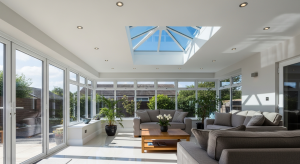
You do not need planning permission to replace a conservatory roof in the UK in 2026, in 95% of cases. Conservatory roof replacement is covered by Permitted Development Rights provided the new roof does not increase the conservatory's height, footprint, or volume. Building Regulations are also waived if the conservatory keeps its original external doors and is not heated by the main house. The exceptions – listed buildings, conservation areas, National Parks, and any change that brings the conservatory inside the heated envelope – trigger different rules and can add £500–£3,000 in fees and approvals. This guide walks through every scenario so you know exactly where you stand before signing a quote.
FREE QUOTE COMPARISON
Compare Conservatory Roof Quotes from Trusted Suppliers
100% free • No obligation • Takes under 2 minutes
All rules in this guide are based on the Town and Country Planning (General Permitted Development) (England) Order 2015, plus 2024 amendments to permitted development rights. Scotland and Northern Ireland have similar but not identical rules – we flag the differences inline. For the underlying roof choices, see our tiled vs glass vs polycarbonate comparison and the polycarbonate-to-tiled conversion cost guide.
Do You Need Planning Permission for a Conservatory Roof Replacement?
For the standard like-for-like replacement on an existing conservatory in England or Wales: no, you do not need planning permission. The roof replacement is covered by Permitted Development Rights under Schedule 2, Part 1, Class C of the General Permitted Development Order. This applies whether you replace polycarbonate with glass, glass with tiled, or any other combination – provided three conditions are met.
- The new roof does not increase the conservatory's height. A tiled roof typically sits at the same ridge height as the existing polycarbonate or glass. If your installer is proposing a deeper ridge that adds 200mm+ to the overall height, ask whether a slimmer system (Equinox, LivinROOF) would keep you within Permitted Development.
- The new roof does not increase the footprint. Standard replacement reuses the existing eaves line and gutter position. Any extension of the roof beyond the existing footprint – even by 100mm – pushes the project into a planning application.
- The new roof does not increase the conservatory's volume above the original permitted limits. The original conservatory was built within Permitted Development volume limits (typically under 30m² rear extension); the replacement roof must keep the structure within those same limits.
Reputable installers (Guardian, LivinROOF, Equinox) check Permitted Development eligibility as part of the survey before quoting. If they raise a planning concern, take it seriously – the retrospective planning fees and enforcement risk if a complaint is raised mid-project make pre-checking essential.
When Planning Permission IS Required
Six scenarios trigger a planning application requirement on a conservatory roof replacement. If any of these apply to your property, factor in 8–12 weeks of approval lead time and £0–£548 in council fees – and at that point, it’s worth comparing a full replacement vs a new conservatory build, because the planning route is sometimes simpler for new builds within permitted development.
| Scenario | Permission needed | Typical fee | Lead time |
|---|---|---|---|
| Listed building (any grade) | Listed Building Consent | £0 (no fee for LBC) | 8–12 weeks |
| Conservation area | Householder planning application | £548 | 8 weeks |
| National Park or AONB | Householder planning application | £548 | 8 weeks |
| New roof exceeds original height | Householder planning application | £548 | 8 weeks |
| Conservatory at front of house | Always needs planning | £548 | 8 weeks |
| Permitted Development rights removed by Article 4 | Householder planning application | £548 | 8 weeks |
Article 4 directions are the trickiest of these to spot – they are local council rules that override the national Permitted Development Order. If your property is in a high-amenity area (some London boroughs, parts of Brighton, Edinburgh New Town, etc), the council may have removed Permitted Development rights even if the property is not formally in a conservation area. Check with your local planning office before signing the quote: it takes 5 minutes by phone.
Article 4 directions are not always obvious from the address. Even in non-conservation areas, some local authorities have removed Permitted Development rights from specific streets or housing estates. Always call your local planning office to confirm your property's status before booking a tiled roof install - it is a 5-minute call that can save you a 10-week planning saga.
Listed Buildings and Conservation Areas
If your property is listed (any grade) or sits in a conservation area, the rules tighten significantly. Conservatory roof replacement is still possible in most cases, but you need explicit consent before any work begins, and the choice of materials and finishes is more constrained.
- Listed Building Consent (LBC): Required for any external change to a Grade I, Grade II*, or Grade II listed building. The conservatory roof itself may not be the listed element – but any change visible from the listed property (or a neighbouring listed property) needs LBC. Process is free but takes 8–12 weeks.
- Conservation areas: A formal householder planning application is required. Conservation officers typically reject dark composite tiles on traditional buildings and prefer either matching the original conservatory's glass roof or specifying a slate or clay tile that visually relates to the original property.
- Article 4 directions: Many conservation areas have additional Article 4 directions that go further than national conservation rules – for example, requiring a specific tile colour or restricting the use of roof windows on visible elevations. Always read the area's Article 4 direction in full before specifying.
- Listed buildings within conservation areas: Both LBC and conservation-area planning are required. Process and refusal rates are independent – you need both approvals to proceed.
- Curtilage listing: A conservatory built before 1948 attached to a listed property is typically also listed by curtilage, even if not separately listed. This is a frequent source of confusion. Check the listing description carefully.
The practical implication: in conservation areas, glass roofs (especially with self-cleaning glass) tend to get approved faster than tiled because they preserve the original conservatory aesthetic. Tiled is approvable but the colour palette is restricted – expect conservation officers to push you toward slate grey or natural terracotta and away from anthracite or charcoal options.
Building Regulations: When They Apply
Building Regulations are separate from planning permission. Most conservatory roof replacements are exempt from Building Regs under the Building Regulations 2010 Schedule 2 (Class 7) exemption for "substantially glazed" structures. The exemption holds as long as four conditions are met.
- Conservatory remains thermally separated from the house: External-quality doors between the house and conservatory stay in place. Removing those doors triggers full Building Regs.
- No fixed heating extended into the conservatory: Radiators on the main heating system or extended underfloor heating brings the room inside the heated envelope and triggers Building Regs.
- The roof is at least 75% glazed (or under 30m² total floor area): Tiled roof replacements technically fail the "substantially glazed" test – but if the conservatory is under 30m² total floor area, the exemption still applies under the small-extension rule.
- The conservatory has its own external door: Some councils strictly enforce this requirement. A conservatory accessible only through the house may not qualify for the exemption.
If any of these conditions fail – and most commonly the first two, when homeowners want to bring the room inside the heated envelope – you need to submit a Building Notice and complete full Building Regs compliance. This adds £1,200–£2,900 to the project: typically £400–£900 in council fees for the Building Notice, £400–£800 for SAP calculations, and £800–£2,000 for the upgraded insulation specification needed to meet Part L. The upside: the room then legally counts as habitable space on resale, adding £5,000–£15,000 to property value.
Scotland, Wales, and Northern Ireland Differences
The rules above apply to England. Scotland, Wales, and Northern Ireland have similar but not identical Permitted Development regimes – here are the main differences.
- Scotland: Permitted Development rights for conservatory roof replacement are similar but Scotland has stricter rules in National Parks and World Heritage Sites (Edinburgh New Town, Old Town). Building Standards (Scotland's equivalent of Building Regs) has the same exemption for substantially-glazed conservatories under 30m².
- Wales: Permitted Development rules are functionally identical to England, but conservation officer attitudes vary – Welsh-language signage areas (e.g. parts of Gwynedd) sometimes apply tighter aesthetic constraints on visible roof finishes.
- Northern Ireland: Permitted Development is administered through the Department for Infrastructure and is broadly similar but has a 30m² ceiling on rear extensions (vs 50m² in some English districts post-2024). Listed Building Consent is processed through Historic Environment Division rather than the local council.
How to Check Your Property's Status in 10 Minutes
Before signing any conservatory roof quote, run a 10-minute check to confirm what consent (if any) you need. Skipping this step is the single most common cause of mid-project planning disputes and retrospective fees.
- Check listed status: Search Historic England's National Heritage List (or Historic Environment Scotland / Cadw / DfC for the devolved nations). Free, instant, and tells you if the property or any structure on the curtilage is listed.
- Check conservation area: Most council websites have a conservation-area map under the planning section. Look for your address. If you are within or directly adjacent to a conservation area boundary, the conservation rules apply.
- Check National Park / AONB status: National Parks UK has a postcode-search tool. AONBs are mapped on the Natural England website.
- Check Article 4 directions: Search your council planning website for "Article 4" or call the planning office directly. They are required to tell you. Some councils list Article 4 directions on a public-facing GIS map.
- Check your conservatory's original planning history: The council planning portal will show the original conservatory's planning approval (if any). The approval may carry conditions that affect future modifications – for example, restricting roof finish or height.
If all five checks come back clear – not listed, not in a conservation area, no Article 4 direction, no planning conditions on the original conservatory – you are in the 95% of homeowners who can replace the conservatory roof under Permitted Development without any application. If any one of the five flags up, factor in the corresponding fee and lead time.
Common Mistakes That Trigger Planning Issues
Five mistakes account for most retrospective planning enforcement on conservatory roof replacement. All are avoidable if your installer flags them up at quote stage.
- Adding a slightly bigger ridge: A 200mm taller ridge bar exceeds the original height and triggers a planning requirement. Ask about ridge depth at the quote stage and pick a slim-ridge system (Equinox, LivinROOF) if your existing roof is at the height limit.
- Removing internal doors at the same time: Bringing the conservatory inside the heated envelope without a Building Notice is a common "while we are at it" mistake. Either commit to the Building Regs route at quote stage and budget £1,500–£3,000 in extra costs, or leave the doors in.
- Not checking conservation-area Article 4 directions: Some directions restrict tile colour, roof window size, or finish in ways that are not obvious. The 5-minute call to the planning office is essential.
- Front-of-house conservatories: Permitted Development excludes the front elevation. Even a like-for-like roof replacement on a front-facing conservatory needs planning. Always check elevation status before quoting.
- Adding gutters or downpipes that didn't exist before: Counts as an addition rather than a replacement. Conservation officers in particular take exception to new external rainwater hardware on visible elevations.
If a planning issue surfaces mid-project, the work usually pauses while the council assesses. Most councils will accept a retrospective application within 28 days at the standard fee (£548 in England) without enforcement action - but some councils are stricter and will require the work to be removed if it materially differs from Permitted Development. Always check before you start, not after.
Our Verdict
For 95% of UK homeowners, conservatory roof replacement does not need planning permission – it is covered by Permitted Development under a like-for-like swap. The work is also exempt from Building Regulations as long as the conservatory keeps its external doors and stays thermally separated from the house. The 5% who need permission are listed buildings, conservation-area properties, National Park homes, front-of-house conservatories, and properties under Article 4 directions – all of which add 8–12 weeks and £0–£548 in fees but rarely block the project.
The biggest practical mistake we see is homeowners assuming Permitted Development applies and discovering an Article 4 direction or original planning condition mid-project. The 10-minute property check before signing the quote eliminates this risk – and reputable installers (Guardian, LivinROOF, Equinox) include the planning check as part of their survey. If your installer does not raise planning at the quote stage, take it as a signal to get a second quote.
For three quotes from FENSA-registered conservatory roof specialists who include a free planning check in the survey, use the form below. We pre-screen every installer for trade body membership, structural survey practice, and warranty cover.
FREE QUOTE COMPARISON
Compare Conservatory Roof Quotes from Trusted Suppliers
100% free • No obligation • Takes under 2 minutes
Last updated: May 2026. Rules verified against the Town and Country Planning (General Permitted Development) (England) Order 2015 and 2024 amendments. Scottish, Welsh, and Northern Irish rules verified against current devolved planning legislation. Fee figures from local council planning portals as of May 2026.