Getting the right size heat pump is critical. Too small, and your home won’t heat properly. Too large, and you waste money on equipment that cycles inefficiently, reducing its lifespan and performance. If you’re still early in your research, our heat pump comparison hub is a good place to start. It covers all the key decisions in one place.
Unlike gas boilers, where oversizing is common practice, heat pumps are precision-matched to the thermal demand of your property. This guide walks you through how heat pump sizing works in the UK and what size you’re likely to need. It also explains why MCS rules require a professional heat loss calculation before any installation that claims the £7,500 Boiler Upgrade Scheme grant.
FREE QUOTE COMPARISON
Compare Heat Pump Quotes from Trusted Suppliers
✓ £7,500 BUS grant available
£7,500 BUS grant available • MCS-certified installers • 100% free
- Size from heat loss, not bedroom count - a room-by-room calculation should establish the output needed at the design temperature.
- Ask how backup heating is controlled - an undersized system may use supplementary heating, which belongs in the running-cost estimate.
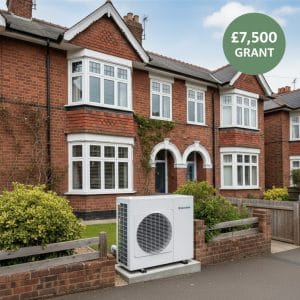
- The standard BUS air-source grant is £7,500 - confirm eligibility and the applicable grant with your MCS installer before accepting a quote.
- Compare 3 written system proposals - each should explain heat loss, operating temperatures, electricity requirements and any planned insulation improvements.
Heat Pump Size by Property Type
A 1-bed flat typically needs 4-5 kW, and a 2-bed terrace needs 5-7 kW. A 3-bed semi typically needs 7-10 kW, and a 4-bed detached needs 10-16 kW. Exact sizing depends on insulation level, window area, and heating system design.
The table below gives indicative heat pump sizes by property type. These are starting estimates only – a professional MCS-certified heat loss survey is required before purchase. Actual sizing can vary by ±2 kW depending on insulation upgrades and extension works. It also depends on the design flow temperature of your heating system.
| Property Type | Floor Area (m²) | Est. Heat Loss (kW) | Recommended ASHP Size | Typical Installed Cost |
|---|---|---|---|---|
| 1-bed flat | 40-55 | 2-4 kW | 4-5 kW | £7,000-£9,000 |
| 2-bed terrace | 60-80 | 4-6 kW | 5-7 kW | £7,000-£9,000 |
| 3-bed semi-detached | 85-110 | 6-9 kW | 7-10 kW | £9,000-£12,000 |
| 3-bed detached | 100-130 | 7-10 kW | 8-12 kW | £10,000-£14,000 |
| 4-bed detached | 130-180 | 9-13 kW | 10-16 kW | £11,000-£16,500 |
| 5+ bed / large detached | 180-250+ | 12-18 kW | 14-20 kW | £15,000-£22,000+ |
These figures assume a property built between 1960 and 2000 with cavity wall insulation and loft insulation already installed. If your home is older and uninsulated, expect to move up a band. If it’s a well-insulated modern build or newly retrofitted, you may drop a band. All installed cost estimates include VAT at 0% (current rate until 31 March 2027). The £7,500 BUS grant has NOT been deducted from these figures. Subtracting the flat £7,500 grant brings your net cost down by that amount from the range shown above. Our air source heat pump cost guide breaks down the full installation price.
How Heat Pump Sizing Works
Sizing is based on your home’s heat loss calculation, not just floor area. An MCS-certified installer must perform this calculation to qualify for the BUS grant.
A heat pump should be sized from a room-by-room heat-loss calculation at the design outdoor temperature. Do not copy the output of your existing boiler. Ask the installer to explain the proposed unit’s output at the design flow temperature and how it meets the calculated load.
The core calculation determines how quickly heat escapes from your home under the coldest conditions you’re likely to experience. In the UK, MCS design methodology uses a location-specific design outdoor temperature (around −3°C in much of southern England, lower in colder regions) and room-specific indoor target temperatures such as 21°C for living areas. Together, these set the temperature difference the heat pump must cover. The heat pump must be able to replace heat as fast as your home loses it at that worst-case scenario.
Key Factors in a Heat Loss Calculation
A proper MCS heat loss survey evaluates each of the following for every room in your home:
| Factor | What It Measures | Why It Matters |
|---|---|---|
| U-values (walls) | Rate of heat loss through wall construction (W/m²K) | Cavity wall insulation cuts this by ~50% |
| U-values (roof) | Heat loss through ceiling/loft | 270mm loft insulation can halve roof losses |
| U-values (floor) | Heat loss to ground | Solid floors lose more heat than suspended |
| U-values (windows) | Heat loss through glazing | Triple glazing has U-value of ~0.8 vs single glazing at 5.0 |
| Air changes per hour (ACH) | Rate of cold air infiltration | Draught-proofing significantly reduces ACH |
| Room dimensions | Volume of air each room must heat | High ceilings increase heating demand |
| Design temperatures | Location-specific outside temperature (around −3°C in southern England) / room-specific inside target | MCS standard for UK worst-case conditions |
Simple Rule-of-Thumb Formula
While this cannot replace a professional survey, the following formula gives a rough estimate you can use before booking an installer:
Floor area (m²) × heat loss factor (W/m²) = approximate heat demand (W). Divide by 1,000 to convert to kW. For example: a 100m² home with a heat loss factor of 60 W/m² = 6,000W = 6 kW heat pump.
Heat loss factors by property age and insulation level are set out in the section below. Note that the heat pump output you need should be at least equal to the calculated heat demand. Most installers select the next available model size up, to ensure adequate coverage at design temperatures.
Why Getting the Size Right Matters
An oversized heat pump costs more upfront and cycles on/off inefficiently. An undersized one triggers expensive backup electric heating and leaves rooms cold in winter.
Correct sizing is the single most important factor in the long-term economics of a heat pump installation. It affects not just comfort, but COP (Coefficient of Performance), equipment lifespan, and monthly running costs. Both oversizing and undersizing create serious problems, but for different reasons.
The Problems with Oversizing
An oversized heat pump reaches the setpoint temperature quickly, then switches off. It switches on again shortly after, as the home cools. This short-cycling behaviour has compounding costs:
| Problem | Cause | Impact |
|---|---|---|
| Short-cycling | Demand met too quickly; system cycles on/off | Compressor wear; reduced lifespan |
| Reduced COP | Start-up phase is inefficient; ideal COP requires sustained operation | Higher electricity bills than spec sheet suggests |
| Wasted capital cost | A larger unit costs more than the correctly sized model | Longer payback period |
| Noise & vibration | Frequent compressor start-ups create more mechanical stress | Increased noise; potential neighbour complaints |
The Problems with Undersizing
An undersized system may need supplementary heating during cold weather. Ask when backup heating is expected to run, how it is controlled and how its electricity use is included in the running-cost estimate. Avoid a design that relies on an unexplained allowance for backup heat.
FREE QUOTE COMPARISON
Compare Heat Pump Quotes from Trusted Suppliers
✓ £7,500 BUS grant available
£7,500 BUS grant available • MCS-certified installers • 100% free
Heat Pump Sizing by Property Age
A Victorian terrace loses heat 3-4 times faster than a modern new build. This requires a much larger heat pump per square metre. Insulation upgrades before installation are often more cost-effective than upsizing the heat pump.
The era in which your home was built is the most reliable proxy for its thermal performance before surveying. UK homes built before 1920 used solid brick construction with no insulation. Those built after 2010, by contrast, must meet Part L of the Building Regulations with significantly higher insulation standards. The table below shows how heat loss rates vary by construction era. It also shows the impact these have on heat pump selection.
| Construction Era | Typical Wall Construction | Typical U-Values (wall) | Heat Loss Rate (W/m²) | Notes for Heat Pump Sizing |
|---|---|---|---|---|
| Pre-1920 | Solid brick, no insulation | 1.8-2.1 W/m²K | 70-100 W/m² | Heat pump often not viable without major insulation works. Consider EWI or IWI first. |
| 1920-1960 | Cavity wall, no insulation | 1.4-1.7 W/m²K | 60-80 W/m² | Cavity wall insulation (CWI) typically available and cost-effective at ~£300-£500. |
| 1960-1990 | Cavity wall, partial insulation | 0.7-1.3 W/m²K | 45-65 W/m² | Variable depending on whether CWI has been retrofitted. Check EPC certificate. |
| 1990-2010 | Cavity wall, insulated | 0.35-0.6 W/m²K | 35-50 W/m² | Most suitable for standard heat pump installation. Good insulation base. |
| Post-2010 new build | Insulated cavity or timber frame | 0.18-0.28 W/m²K | 20-35 W/m² | Excellent heat pump candidate. Often needs smallest unit for floor area. UFH ideal. |
Consider planned insulation improvements before the heat-loss survey. The installer should calculate their effect for your property rather than assume a fixed percentage reduction or a guaranteed saving on heat pump size. Agree which improvements will be completed before the system is designed.
If your home was built before 1960, improving insulation before installing a heat pump is usually the smartest financial move. Better insulation means a smaller, cheaper heat pump and lower running costs for the life of the system. Your MCS installer should factor current and achievable insulation levels into the heat loss calculation.
Do I Need to Upgrade My Radiators?
Most homes need at least some radiator upgrades. Heat pumps run at 35-50°C flow temperature versus a gas boiler’s 70°C. As a result, radiators need to be roughly 2-2.5 times larger to emit the same heat output.
This is one of the most common questions homeowners have after learning about heat pump sizing. The short answer is: it depends on your existing radiators and insulation level. However, most UK homes will need at least some upgrades. Here’s why.
Heat pumps are designed to operate at lower flow temperatures than gas boilers. A condensing gas boiler might heat water to 70-80°C; a heat pump typically runs at 35-50°C. The lower the flow temperature, the more efficient the heat pump (higher COP). However, the amount of heat a radiator emits is directly related to a temperature difference. That’s the difference between the water flowing through it and the room air. At lower flow temperatures, a standard-sized radiator will emit significantly less heat.
When You Definitely Need New Radiators
You will almost certainly need radiator upgrades if:
| Scenario | Action Required | Typical Cost |
|---|---|---|
| Original single-panel radiators from 1970s-1990s | Replace with double-panel double-convector (K2) | No fixed per-unit rate – forms part of the £3,600-£9,000 typical radiator-upgrade budget |
| Undersized radiators (rooms that were always slightly cool) | Replace with larger surface area units | No fixed per-unit rate – forms part of the £3,600-£9,000 typical radiator-upgrade budget |
| Running at 45°C flow temperature target | Check heat output of each radiator at 45°C delta T | Survey cost £0 (part of MCS install) |
When Existing Radiators May Work
Your existing radiators may be adequate without replacement if:
| Scenario | Likely Outcome |
|---|---|
| Home already has modern K2 (double-panel double-convector) radiators | May work at 50°C flow; engineer will verify |
| Well-insulated home (EPC B or above) with lower heat demand | Existing radiators often sufficient at 45-50°C |
| Rooms where you’ve historically needed the thermostat below 65°C to stay comfortable | Good candidate; check sizing at lower flow temp |
| Victorian property with oversized original cast iron radiators | Often work extremely well at low flow temperatures |
Underfloor Heating: The Ideal Pairing
Underfloor heating (UFH) is the ideal distribution system for a heat pump. UFH operates at flow temperatures of just 30-40°C – even lower than what radiators need. This pushes the heat pump into its highest COP range. If you’re renovating or installing on a new build, specifying UFH throughout will significantly improve system efficiency. Retrofitting wet underfloor heating is a major job: it means lifting the existing floor and replacing the screed, and it costs several times more per square metre than the same system built into a screed during construction. Get it priced per room as part of the installation quote rather than assuming a rate, because the figure swings widely with floor build-up and access.
Radiator upgrades typically add £3,600-£9,000 to your installation cost, depending on how many radiators need replacing. Your MCS installer should carry out a room-by-room radiator adequacy check as part of the design process. If they don’t, ask for one explicitly.
Hot Water Cylinder Sizing
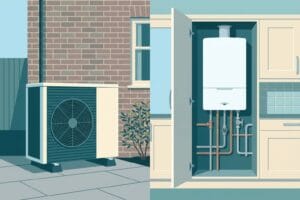
A family of 4 needs a 200-250 litre hot water cylinder. Heat pumps heat water more slowly than gas boilers. As a result, the cylinder must be larger, to store enough domestic hot water for peak demand periods.
Air source heat pumps heat water more slowly than gas boilers. A gas combi boiler heats water on demand at high temperature. A heat pump, by contrast, heats a stored cylinder over several hours at lower temperature. This means the cylinder must be sized generously to cover peak demand. Otherwise, you risk running out of hot water during morning routines.
| Household Size | Recommended Cylinder Size | Typical Cost (cylinder only) | Notes |
|---|---|---|---|
| 1-2 people | 150-180 litres | £600-£900 | Standard cylinder often sufficient |
| 3-4 people | 200-250 litres | £800-£1,200 | Most common for 3-bed semi; recommended minimum |
| 5-6 people | 250-300 litres | £1,000-£1,500 | Needed for busy households with multiple bathrooms |
| 7+ people / large property | 300-400 litres | £1,300-£2,000 | May require twin-coil cylinder for speed |
Most heat pump systems heat the cylinder once or twice per day on a timed schedule. This is typically overnight, when electricity tariffs are lower (if on Economy 7 or Octopus Go). The domestic hot water (DHW) demand adds to the system’s annual electricity consumption. This should be factored into your annual running cost estimates.
Legionella Pasteurisation
Guidance for stored hot water recommends cylinders reach around 60°C periodically to control Legionella bacteria. Heat pumps can achieve this. However, it operates outside their optimal COP range and typically uses the immersion heater backup. Most systems are configured to run a weekly pasteurisation cycle. This adds a modest amount to electricity consumption. Ask your installer how the cylinder’s pasteurisation cycle is configured and how much it adds to the running-cost estimate.
Single-Phase vs Three-Phase Electricity Supply
Most UK homes have single-phase electricity, which suits most domestic heat pumps. Larger systems may need a supply upgrade, and the cost depends on your network operator and the work needed.
Ask the installer to check your electricity supply, the heat pump’s electrical requirements and any other large loads in the home. Heat output in kW is not the same as electrical input. Your distribution network operator can confirm whether the proposed installation needs supply work.
| Scenario | Supply Required | Action Needed | Typical Cost |
|---|---|---|---|
| Typical domestic heat pump, adequate existing supply | Single-phase sufficient | None (check existing fuse rating) | £0 |
| Older property with a low-rated main fuse | Single-phase upgrade | Ask your DNO to upgrade the main fuse (often free) | Quoted by your DNO |
| Larger heat pump, single-phase | May work with inverter tech | Consult installer; check manufacturer spec | £0 if feasible |
| Very large heat pump OR simultaneous heavy loads | Three-phase preferred | DNO application for three-phase upgrade | Quoted by your DNO |
Where supply work is needed, obtain the scope, cost and lead time from your distribution network operator before committing to an installation date. Do not assume that every large heat pump requires three-phase power or that a particular fuse rating guarantees suitability.
For most UK homes, single-phase supply is adequate. Only large or poorly insulated properties needing a very large unit are likely to need a supply upgrade. Always verify the existing fuse rating with your installer before proceeding.
FREE QUOTE COMPARISON
Compare Heat Pump Quotes from Trusted Suppliers
✓ £7,500 BUS grant available
£7,500 BUS grant available • MCS-certified installers • 100% free
Ground Source vs Air Source: Does Size Differ?
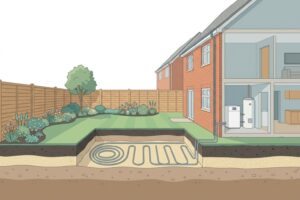
The required heat output (kW) is the same for ground and air source heat pumps. Ground source units extract heat at more consistent temperatures, so efficiency is higher. However, the output sizing still matches the same heat loss calculation.
You might choose an air source heat pump (ASHP), or a ground source heat pump (GSHP). Either way, the fundamental sizing question is identical. How much heat does your home lose per hour at design temperatures? The heat loss calculation is the same. The required output in kW will also be the same for both systems. What differs is how each system achieves that output and at what efficiency.
| Feature | Air Source Heat Pump (ASHP) | Ground Source Heat Pump (GSHP) |
|---|---|---|
| Heat output sizing | Same as GSHP for identical property | Same as ASHP for identical property |
| Source temperature | Varies −5°C to +20°C (seasonal) | Stable 8-12°C year-round |
| Typical COP | 2.5-3.5 (seasonal average) | Typically higher than air source (manufacturers quote around 3-4) |
| Space needed | Outdoor unit (0.5-1m²) | Borehole or ground loop (large garden) |
| Installed cost | £7,000-£16,500 | Around £15,000 for trench loops; boreholes cost considerably more |
| BUS grant | £7,500 | £7,500 |
| Best suited for | Most UK properties (retrofits, limited land) | New builds, large plots, well-insulated homes |
Ground source heat pumps draw from a more stable heat source, so they operate more efficiently in cold weather. That’s precisely when you need the most heat. This means a 7 kW GSHP will perform more reliably on a February night than a 7 kW ASHP. However, GSHP has a higher upfront cost and greater installation complexity. It requires either a vertical borehole drilled to roughly 75-200m depth, or horizontal ground loops across a large garden area. This is why ASHP remains the more popular choice for UK retrofits.
How to Get Your Home Assessed
An MCS-certified installer performs a free room-by-room heat loss survey as part of their quotation. This survey is mandatory for BUS grant eligibility and takes 1-3 hours on site.
The MCS (Microgeneration Certification Scheme) heat loss calculation is a mandatory requirement. It applies to any heat pump installation that claims the £7,500 Boiler Upgrade Scheme grant. It cannot be waived, approximated, or completed remotely using only floor plans, as it requires an on-site survey. Any installer who provides a fixed quote without visiting your property should be treated with caution.
What to Expect from a Site Survey
A professional MCS heat loss survey typically involves:
| Survey Activity | What the Installer Checks |
|---|---|
| Room-by-room measurement | Dimensions, ceiling height, number and size of windows |
| Construction inspection | Wall construction type (solid/cavity), presence of insulation, floor type |
| EPC review | Your Energy Performance Certificate for U-value baseline data |
| Radiator check | Type, size, and output of each radiator at reduced flow temperatures |
| Cylinder and pipework review | Existing cylinder size, condition; pipework sizing for heat distribution |
| Electrical supply check | Consumer unit capacity, existing fuse rating, earthing |
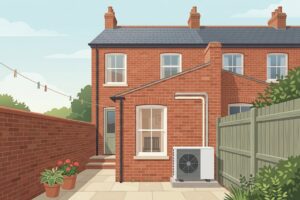
| Outdoor unit location assessment | Placement options, acoustic impact on neighbours, planning considerations |
The survey takes 1-3 hours depending on property size and complexity. Most MCS-certified installers provide the heat loss survey free of charge as part of the quotation process. Following the survey, they should provide you with a written design document. This should show the heat loss figure per room and the selected heat pump model, along with its rated output. It should also include radiator sizing recommendations and the proposed system design.
Red Flags to Watch For
The following are warning signs that an installer may not be following MCS best practice:
| Red Flag | Why It Matters |
|---|---|
| Quote given over the phone or via email without a site visit | Cannot be MCS-compliant; BUS grant will be refused |
| Sizing based only on number of bedrooms or floor area | Ignores insulation, construction, and room-by-room variation |
| Recommends a very large unit “just in case” | Deliberate oversizing to upsell; creates short-cycling problems |
| No written heat loss calculation provided | MCS requires this documentation; absence = non-compliance risk |
| Not MCS-certified | Cannot install under the BUS grant scheme; verify at mcscertified.com |
You can verify whether an installer holds MCS certification at mcscertified.com. The MCS installer database is searchable by postcode and technology type. Only MCS-certified installers can issue the MCS certificate required to claim the £7,500 BUS grant. As of 2026, the grant is applied at the point of purchase. Your installer claims it on your behalf and passes the saving to you directly in their quote.
Quick Sizing Reference Guide
Use floor area and property age as a starting point. First, multiply floor area (m²) by the W/m² factor for your era. Then divide by 1,000 for the approximate kW figure. Always confirm with a professional survey.
Use the tables below as a preliminary sizing guide before booking an installer. These figures are rule-of-thumb estimates based on MCS methodology and UK housing stock averages. They cannot replace a professional MCS heat loss survey and should not be used to finalise a purchase decision.
Step 1: Find Your Heat Loss Factor
| Property Era / Condition | Heat Loss Factor (W/m²) | Example: 100m² Home |
|---|---|---|
| Pre-1920, no insulation added | 80-100 | 8-10 kW |
| 1920-1960, no cavity insulation | 60-80 | 6-8 kW |
| 1920-1960, cavity insulation added | 45-60 | 4.5-6 kW |
| 1960-1990, partially insulated | 45-65 | 4.5-6.5 kW |
| 1990-2010, well insulated | 35-50 | 3.5-5 kW |
| Post-2010 new build (Part L compliant) | 20-35 | 2-3.5 kW |
| Passivhaus or highly retrofitted | 10-20 | 1-2 kW |
Step 2: Apply the Formula
Floor area (m²) × heat loss factor (W/m²) ÷ 1,000 = approximate heat demand (kW)
Select the nearest available heat pump model size at or above this figure. Most manufacturers offer units in 5 kW, 7 kW, 9 kW, 11 kW, 12 kW, 14 kW, and 16 kW increments. Our roundup of the best air source heat pumps covers which brands offer which sizes. It also shows how they compare on efficiency.
Step 3: Check Against Property Size Benchmarks
| Floor Area | Poorly Insulated (pre-1960) | Average (1960-2000) | Well Insulated (post-2000) |
|---|---|---|---|
| Under 60m² | 5-7 kW | 4-5 kW | 3-4 kW |
| 60-90m² | 6-9 kW | 5-7 kW | 4-5 kW |
| 90-120m² | 8-12 kW | 6-9 kW | 5-7 kW |
| 120-160m² | 10-14 kW | 8-12 kW | 6-9 kW |
| 160-200m² | 12-18 kW | 10-14 kW | 8-11 kW |
| 200m²+ | 16-22 kW+ | 12-18 kW | 10-14 kW |
Use the rule-of-thumb tables above to arrive at a ballpark figure before speaking to installers. This gives you a starting point for comparing quotes. It also helps you spot anything that seems significantly over or under-sized. However, no sizing is final without a professional MCS heat loss calculation. This is a legal requirement for the BUS grant, and good engineering practice regardless. Get at least three quotes from MCS-certified installers, each backed by a written heat loss calculation.
Your home might fall into a borderline sizing range. For example, your calculation might suggest 9 kW. You might be unsure whether insulation upgrades would bring it down to 7 kW. In that situation, the right approach is to improve insulation first and then survey again. Adding loft and cavity wall insulation before installation is almost always a financially optimal move. It reduces the required unit size and lowers running costs. It may also bring you within reach of government insulation grant schemes (such as the Warm Homes: Local Grant) that can cover part of the cost.