
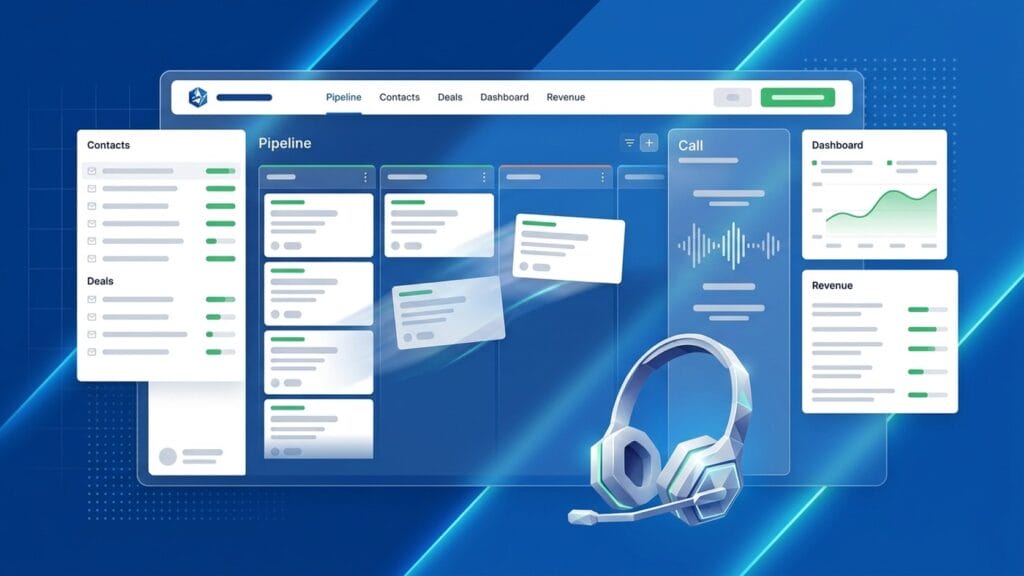
The best sales CRM for UK teams in 2026 is Pipedrive. It’s built pipeline-first, so every deal sits in a visual stage rather than buried in a contact record, and its entry tier starts at £14/seat/month billed annually with no per-feature paywall on core pipeline tools. This guide ranks seven CRMs specifically on sales-team fit, not general business features, so you can pick the one that matches how your reps actually sell.
A sales CRM is a different tool from an all-in-one business suite. We compared Pipedrive, Close CRM, Salesforce Sales Cloud, monday CRM, Freshsales, HubSpot Sales Hub and Creatio on pipeline visualisation, activity and call tracking, deal forecasting, and verified UK pricing. Every figure below was checked directly against each provider’s live pricing page in July 2026, and we flag USD pricing explicitly where a provider has no published GBP rate.
FREE QUOTE COMPARISON
Compare CRM Software Quotes from Trusted Suppliers
100% free • No obligation • Takes under 2 minutes
- Best all-round: Pipedrive - pipeline-first CRM from £14/seat/month billed annually, no feature paywall on core pipeline tools.
- Best for outbound calling: Close CRM - built-in dialer, email and SMS from one screen, from $35/user/month billed annually.
- Best for forecasting at scale: Salesforce Sales Cloud - AI-driven pipeline and deal insights from £156/user/month at Core.
- Best visual pipeline: monday CRM - board-based deals and quoting from £10/seat/month, minimum 3 seats.
- Budget sales pick: Freshsales - genuine free tier for 3 users, paid plans from £7/user/month.
What Makes a CRM Built for Sales Teams Different?
A general CRM organises contacts. A sales CRM organises deals in motion: pipeline stages, activity logging, call and email tracking, and forecasting against a target. If your team’s day is prospecting, calling and closing rather than ticketing or campaigns, that distinction should drive your shortlist, not the brand name.
The core difference between a sales CRM and a general business CRM is what sits at the centre of the interface. A sales CRM puts the deal pipeline first: every opportunity is a visual card moved through stages like Qualified, Proposal and Negotiation, with activity (calls, emails, meetings) logged against it automatically where possible. A general CRM, by contrast, is often contact-first or ticket-first, built to serve marketing, support and sales from one shared record. For a dedicated sales team, pipeline-first design translates directly into fewer clicks to log an outcome and a clearer forecast of what’s likely to close this month. Our wider what is a CRM guide covers the category from first principles if you’re comparing sales-specific tools against a broader platform; this guide only ranks the seven CRMs above on how well they serve a team whose job is selling.
Pipeline management, activity tracking, deal forecasting and outbound calling are the four capabilities that separate a genuine sales CRM from a relabelled contact database. See our best CRM software hub if you want the full market view across sales, service and marketing use cases before narrowing to sales specifically.
Sales CRM Comparison Table
Prices below are verified from each provider’s live pricing page in July 2026. Close CRM prices in USD with no published GBP rate, so we’ve kept its figures in dollars rather than guessing a conversion. Creatio now shows GBP on its UK pricing page, so its figures are in pounds.
| Provider | Best For | Price (from) | Key Feature | Free Tier |
|---|---|---|---|---|
| Pipedrive PICK | Pipeline-first sales teams | £14/seat/mo | Visual pipeline, 500+ integrations | No (14-day trial) |
| Close CRM | Outbound calling & SMS | $35/user/mo | Built-in dialer, AI sales agent | No (14-day trial) |
| Salesforce Sales Cloud | Enterprise forecasting | £20/user/mo | Agentforce AI, deal insights | Limited Free Suite |
| monday CRM | Visual, hybrid teams | £10/seat/mo | Board pipeline, quotes & invoices | No (14-day trial) |
| Freshsales | Budget sales teams | Free / £7/user/mo | Freddy AI, built-in phone | Yes, 3 users |
| HubSpot Sales Hub | Teams on the wider HubSpot stack | Free / £7/seat/mo | Sequences, deal journey analytics | Yes, 2 users |
| Creatio | Process-heavy sales ops | £44/user/mo (est.) | No-code workflow automation | No (trial, length unverified) |
Pipedrive EDITOR’S PICK

Pipedrive was designed by salespeople around a single question: what does this deal need next? Every pipeline stage, activity reminder and report exists to answer that, which is why it stays the reference point for teams that sell rather than manage tickets or campaigns.
Lite is £14/seat/month billed annually (£168/seat/year): lead and calendar management, a real-time sales feed and AI-powered report creation across 500+ integrations. Growth (£39/seat/month) adds full Gmail/Outlook sync, automation sequences and a meeting scheduler. Premium (£59/seat/month, Pipedrive’s “Most Popular” tier) adds LeadBooster lead generation and e-signature contracts. Ultimate tops out at £79/seat/month with security rules and extended phone support. All figures are ex-VAT, and there’s no permanent free tier, only a 14-day full-access trial, no credit card required.
What makes it a genuine sales CRM rather than a contact manager with a pipeline bolted on is the depth from Growth upward: nurturing sequences, forecast reports and a meeting scheduler. For the full breakdown, read the Pipedrive review, or see Salesforce vs Pipedrive if you’re weighing it against the enterprise alternative.
Close CRM

Close was built for teams that sell by phone, email and SMS directly from the CRM, not a separate dialer. Calling isn’t an add-on here: it’s the reason the product exists, and that shows in how little friction sits between a lead and a live call.
Close prices in USD, no published GBP rate. Solo is $9/user/month billed annually ($19 monthly) but capped at a single user, really a solo-founder tier. The realistic team entry point is Essentials at $35/user/month billed annually ($49 monthly), unlimited users, though automated workflows aren’t included until Growth at $99/user/month billed annually.
Scale ($139/user/month billed annually) adds a predictive dialer, unlimited call recording and live call coaching. There’s a 14-day free trial and a 30-day money-back guarantee, no credit card required.
Every tier from Essentials up includes Close’s built-in AI sales agent, branded Chloe, which scores leads and automates workflow. Growth and Scale add a power dialer and predictive dialer respectively, so reps spend their day talking to prospects, not manually dialling. G2 rates Close 4.7/5 from 1,900+ reviews, the highest sentiment score in this comparison. For outbound-led, cold-calling and SMS-heavy prospecting, this is the CRM built specifically for that job.
Salesforce Sales Cloud
Salesforce Sales Cloud, now sold as Agentforce Sales, is the CRM most sales leaders reach for once forecasting accuracy and pipeline visibility across a growing team matter more than simplicity. It’s also the most expensive option here at the top end.
Starter Suite is £20/user/month, priced identically monthly or annually: built-in sales flows, lead routing and AI-assisted email sync. Pro Suite steps up to £80/user/month billed annually, adding quoting, forecasting and customisation.
Core (£156/user/month billed annually) adds deal insights and conversation intelligence; Advanced (£316/user/month) adds predictive AI and a full sandbox. Max, the top tier, is £440/user/month with unmetered AI usage. A feature-capped Free Suite exists at £0; the practical free option is a 30-day trial, no credit card required.
The jump from Starter to Core is real: deal insights and conversation intelligence genuinely change how a sales manager forecasts a quarter. G2 rates Salesforce 4.4/5 across 95,000+ verified reviews, the largest review base here, though that covers the seller-wide platform, not Sales Cloud alone. Read our Salesforce review for the full breakdown, or Salesforce vs Pipedrive if you’re deciding between the two.
monday CRM

monday CRM puts every deal on a colour-coded board rather than a list, which suits teams that think visually or split time between sales and delivery. It’s a different product from monday.com Work Management, built specifically around pipeline, quoting and invoicing.
Basic is £10/seat/month billed annually (£13 monthly): up to 1,000 contacts and deals, one dashboard and mass email sequences. Standard (£14/seat/month billed annually) raises the ceiling to 10,000 contacts with 250 automations a month. Pro, the “Most Popular” tier at £24/seat/month billed annually, supports 100,000 contacts and 25,000 automations. Ultimate is quote-only for enterprise-scale governance. Every plan requires a minimum of 3 seats, and there’s no permanent free tier, only a 14-day trial.
The board format suits hybrid teams running sales and account management side by side, since deals, quotes and invoices sit on one visual surface. Built-in AI (a Sidekick assistant and AI Notetaker) is credits-based on every paid tier. For small, cost-sensitive teams, our best CRM for small business guide covers where monday CRM ranks against lighter alternatives.
Freshsales

Freshsales is the option to shortlist when the budget is genuinely tight. A free plan for up to 3 users, built-in phone and AI-assisted scoring cover a lot of ground before the first invoice arrives.
The free plan supports up to 3 users: Kanban views across contacts, accounts and deals, email templates, built-in phone and live chat, no credit card required. Paid plans start at Growth (£7/user/month billed annually), adding custom fields, basic workflows and Slack. Pro (£29/user/month billed annually) introduces Freddy AI deal insights, sales sequences and multiple pipelines. Enterprise (£49/user/month billed annually) adds field-level permissions and a sandbox. A Branded documents add-on (formerly CPQ) is £15/user/month on any plan.
Freddy AI handles contact scoring and deal insights from Pro upward, unusually early in a pricing ladder for AI features other vendors reserve for their top tier. Sentiment is mixed: Freshsales scores around 4.5/5 on G2 and Capterra, but Trustpilot shows 1.4/5 from 117 reviews on a merged Freshworks-wide profile, so treat it as directional. For a budget-conscious team needing pipeline, calling and basic automation, the free tier proves the workflow before paying.
HubSpot Sales Hub

HubSpot Sales Hub makes most sense as an add-on to a marketing or service Hub you already run, rather than a standalone pick. Its free tier is genuinely usable, but the paid step-up carries costs that don’t show in the headline seat price.
The free CRM covers up to 2 users, 1,000 contacts and one pipeline, HubSpot-branded. Starter (£7/seat/month billed annually as a limited-time offer, £18 monthly) removes branding, adds 2 pipelines and deal-stage automation. Professional (£81/seat/month billed annually) adds conversation intelligence, forecasting and up to 300 workflows, but carries a mandatory one-time onboarding fee of £1,310, not part of the per-seat price. Enterprise is £155/seat/month plus a £3,050 onboarding fee. AI “Breeze” agents run on pay-as-you-go credits on top.
Those onboarding fees are the detail buyers miss when comparing HubSpot’s seat price against Pipedrive or monday CRM: a five-seat Professional rollout costs £1,310 upfront, on top of £385/month in seats. Trustpilot sits at a low 1.7/5 from 1,100+ reviews, recurring complaints about upselling and lock-in, though G2 and Capterra put HubSpot closer to 4.4/5.
If your marketing or service team already runs on HubSpot, Sales Hub can be worth the onboarding cost; if not, the CRMs above do more for less.
Creatio

Creatio is a no-code platform first and a sales CRM second: the Sales product sits on top of a composable “Business & AI Studio” platform fee, which makes it the most complex pricing structure in this comparison, and the least suited to a small team.
Creatio prices in GBP on its UK pricing page. You need a Platform tier first, from £32/user/month (Growth) or £61/user/month (Enterprise), then the Sales module at £12/user/month on top: a working seat from roughly £44/user/month before AI or support, an estimate rather than a single published figure. Metered AI Credit packages start at £4,178/year for 500,000 credits, with a £8,300/year minimum purchase and a standard 3-year contract, both confirmed on Creatio’s live pricing page.
That structure only makes sense once you’re customising workflow automation deeply enough to justify a no-code BPM engine underneath your CRM, a mid-market to enterprise decision, not a small sales team’s. G2 rates it 4.6/5 from 358 reviews; Trustpilot shows 3.5/5 from a much smaller 35-review sample, indicative only. Most sales teams reading this guide will get more value faster from Pipedrive or Close.
How to Choose the Right Sales CRM
The right sales CRM depends on your sales motion more than your team size. Match the tool to how your reps actually spend their day, not to the brand with the most feature checkboxes.
Choose Pipedrive if you want a pipeline-first CRM with no core feature paywall and the widest integration library at the entry tier. Choose Close if your team’s day is calls and outbound texts and you want a dialer built into the CRM, not bolted on. Choose Salesforce Sales Cloud if forecasting accuracy and deal insights across a growing team matter more than simplicity or price.
Choose monday CRM if your team thinks visually and wants quoting and invoicing on the same board as the pipeline. Choose Freshsales if budget is the constraint and you want to prove the workflow free before paying. Choose HubSpot Sales Hub only if you already run HubSpot’s marketing or service tools and want one connected record. Choose Creatio if your sales operation needs bespoke, no-code process automation and the £8,300/year minimum isn’t a barrier.
Which Sales CRM Fits Your Sales Motion: Inbound, Outbound or Field?
Not every sales team sells the same way, and the best CRM for one motion can be the wrong pick for another. Match the tool to how leads reach your reps and how deals actually close.
Inbound-led teams, where leads come from marketing and reps qualify rather than cold-prospect, are best served by Pipedrive’s pipeline reporting or HubSpot Sales Hub if marketing already lives there. Outbound-led teams, cold-calling and texting prospects who haven’t raised a hand, should look at Close CRM first: its built-in dialer, SMS and AI-assisted scoring exist to remove friction from high-volume prospecting.
Field sales teams, who need mobile access and visual status between site visits, tend to fit monday CRM’s board layout or Salesforce’s mobile app if deal size justifies Core-tier cost.
How Much Does Sales CRM Software Cost in the UK?
Sales CRM pricing runs from genuinely free to several hundred pounds per user each month, and the headline seat price rarely tells the whole story once onboarding fees and minimum contracts are factored in.
At the budget end, Freshsales and HubSpot offer usable free tiers, while Pipedrive and monday CRM start from £10-£14/seat/month for a feature-complete pipeline. Close CRM’s realistic team entry point is $35/user/month (Essentials). Salesforce and Creatio sit at the top: Salesforce from £156/user/month at Core, Creatio requiring a £8,300/year minimum regardless of headcount. For the full breakdown across our CRM cluster, including hidden costs like HubSpot’s onboarding fees, see our CRM software costs guide.
Last updated: July 2026. Pricing is verified against each provider’s live UK pricing page at the time of writing and can change; always confirm current rates directly with the provider before purchasing. Close CRM prices in USD, so its figures are shown in dollars, not converted to pounds. Creatio now shows GBP on its UK pricing page.