The Glass and Glazing Federation estimates that 80 million windows across UK homes need replacing to meet net zero targets. Yet most homeowners sit on the decision for years, unsure whether they actually need new windows or just a quick repair.
This guide gives you a clear framework: seven diagnostic signs, a repair-versus-replace cost comparison, and everything you need to know about building regulations, FENSA certification, and security standards – so you can make the right call for your home in 2026.
FREE QUOTE COMPARISON
Compare Double Glazing Quotes from Trusted Suppliers
✓ Save up to £400 per window
100% free • No obligation • Takes under 2 minutes
- 80 million UK windows need replacing - Glass and Glazing Federation estimates for meeting net zero targets by 2050
- Replace when repair costs exceed 50% of a new window’s price - with new uPVC windows at £350-£600 installed, that threshold is roughly £175-£300 per window
- New windows cost £400-1,200 each - depending on size, material and glazing type in 2026 UK market
- Building Regulations Part L requires U-value of 1.4 - or better for replacement windows to meet current energy efficiency standards
- FENSA certification avoids ~£700 in retrospective fees - the one-off building control approval cost you’d otherwise face without a compliance certificate
7 Signs Your Windows Need Replacing
Replace your windows if you see condensation between panes, feel persistent draughts, notice frame rot, or your windows are over 20 years old with multiple problems.
Not every window problem demands a full replacement. Run through these seven diagnostic signs to understand what you are actually dealing with.
| Sign | What It Means | Urgency | Likely Fix |
|---|---|---|---|
| Condensation between panes | Sealed unit has failed – argon gas escaped, thermal performance is gone | Moderate | Replace glass unit or full window |
| Draughts through closed windows | Frame warping, seal degradation, or compression failure | High – direct energy cost impact | Try draught-proofing first; if it fails, replace |
| Difficulty opening or locking | Frame distortion or mechanism wear; security risk if window won’t lock | Moderate to high | Hardware may be repairable; frame distortion usually means replacement |
| Visible rot or frame damage | Timber rot spreads; uPVC cracking/discolouration is permanent | High for timber | Splice repair if under 10% of frame; otherwise replace |
| Excessive outside noise | Poor acoustic performance – single glazing gives ~25dB; modern DG achieves 35–41dB | Quality of life | Replacement with acoustic double glazing or secondary glazing |
| Rising energy bills (unexplained) | Windows account for 10–25% of home heat loss; old single glazing can be 40% | Financial – ongoing vs one-off cost | Upgrade to A-rated energy efficient windows |
| Security concerns | Older windows lack multi-point locking, PAS 24 glass, or reinforced frames | High – insurance may require upgrade | Replacement with PAS 24-compliant windows |
One sign on its own rarely demands immediate replacement. Three or more – particularly in a window older than 15 years – is a clear signal to replace rather than keep patching.
Repair vs Replace: A Practical Framework
If repair costs exceed 50% of the replacement price, replace. A failed glass unit costs £55–£145 to replace; a new window costs £350–£550 – so a failed glass unit is usually worth replacing on its own unless the frame is also failing.
The 50% rule is a useful starting point: if the repair quote is more than half what a replacement would cost, replacement almost always makes more financial sense over the long term.
Note the distinction on condensation: moisture on the inside surface of the glass is a room ventilation problem. Condensation between the two panes – inside the sealed unit – means the unit has failed and cannot be repaired, only replaced.
FREE QUOTE COMPARISON
Compare Double Glazing Quotes from Trusted Suppliers
✓ Save up to £400 per window
100% free • No obligation • Takes under 2 minutes
What Do Replacement Windows Cost in 2026?
A uPVC casement window costs £350–£550 installed. A full 3-bed semi costs about £3,750 in white uPVC, or £7,500–£12,000 in softwood timber (MyJobQuote).
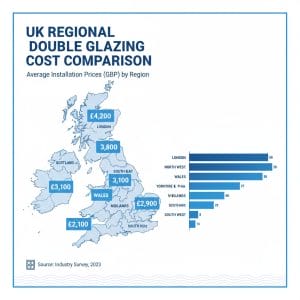
All prices below include supply and professional installation. Costs vary by region, installer, and specification – for city-specific pricing, see our guides for Manchester, Birmingham, Bristol, and Edinburgh. Always get at least three quotes from rated double glazing companies before committing.
| Frame Material | Casement (per window) | Sash (per window) | Full House (3-bed semi) |
|---|---|---|---|
| uPVC | £350–£550 | £700–£1,100 | £3,750 |
| Aluminium | £600–£850 | £1,100–£1,400 | £4,700–£5,600 |
| Timber (species not split) | £750–£1,100 | £1,500–£2,000 | £7,500–£12,000 (softwood) |
Triple glazing adds roughly 15–25% to the unit price but delivers meaningfully better thermal performance (U-values as low as 0.8 W/m²K vs 1.2–1.4 for double). For most UK homes, A-rated double glazing with argon fill and Low-E glass is the practical sweet spot. Use our double glazing cost calculator to get a personalised estimate for your property.
One important financial note: Double glazing is standard-rated at 20% VAT – it does not qualify for the 0% energy-saving-materials relief (GOV.UK Notice 708/6), which covers insulation, solar panels and heat pumps but excludes glazing. An installer charging 20% VAT on a residential window job is applying the rate correctly.
Replacing all windows in one go often costs less per window than doing them in stages, since installers can spread survey, scaffolding and callout costs across the whole job. See the full double glazing cost guide for a detailed breakdown, including bay windows, bifold doors, and regional price differences. If you are on a qualifying benefit or have an EPC rating of D or below, check the double glazing grants guide before paying full price.
UK Building Regulations You Need to Know
All replacement windows must comply with Building Regulations covering energy (Part L), ventilation (Part F), fire escape (Part B), and fall prevention (Part K) – not just energy efficiency.
Replacing windows is notifiable work under Building Regulations. That does not mean you need planning permission – it means the installation must be certified as compliant, either by a registered installer or through local authority building control.
| Regulation | What It Covers | Key Requirement | Common Gotcha |
|---|---|---|---|
| Part L – Energy Efficiency | Thermal performance | U-value ≤1.4 W/m²K, or WER Band B minimum | Any A-rated window exceeds this easily – not a concern with reputable installers |
| Part F – Ventilation | Indoor air quality | Trickle vents required unless existing ventilation is adequate | Many homeowners try to remove trickle vents – this is non-compliant and can cause condensation problems |
| Part B – Fire Safety | Means of escape | Upper floor bedroom windows must open ≥0.33m² clear area, minimum 450mm on each dimension | Switching from opening to fixed glazing in a bedroom can breach Part B |
| Part K – Protection from Falling | Fall prevention | Restrictors required where sill is below 800mm from floor level in upper storeys | Child safety restrictors must be fitted by default – not an optional add-on |
| Part O – Overheating | Solar gain management | Primarily affects new builds and major extensions | Only relevant if you are significantly increasing the glazed area of your property |
The regulation most homeowners stumble on is Part F. The 2021 update increased ventilation requirements, and trickle vents are now required by default on replacement windows. Some installers offer discrete acoustic designs if you are worried about aesthetics or noise intrusion.
Part B catches people out when they change the window type. If you replace an opening window with a fixed-light design in a first-floor bedroom, you may remove the only means of fire escape from that room. Always flag this to your installer before ordering.
FENSA, Certass, and Why Certification Matters
A FENSA certificate proves Building Regulations compliance and is required when selling your home. Without one, you need retrospective building control approval – which costs around £700.
Window replacement is notifiable under Building Regulations, but this does not mean dealing with the council. FENSA (Fenestration Self-Assessment Scheme) is the government-authorised Competent Person Scheme that lets registered installers self-certify their own work. Over 13 million certificates have been issued since 2002, covering roughly half of all UK homes.
Here is how the certification process works in practice:
- Your FENSA-registered installer notifies the scheme automatically after completing the work
- You receive a FENSA certificate within 6–8 weeks of completion
- The notification is registered with your local authority – without any involvement from you
- The certificate is stored on the national FENSA register, searchable by postcode
Why does the certificate matter so much? When you sell, your solicitor will ask for evidence that replacement windows comply with Building Regulations. Without it, you face three outcomes: retrospective building control approval (around £700), an indemnity insurance policy (£50–£100, but not all buyers’ solicitors accept this), or a price reduction.
It is one of the most common survey flags in property conveyancing – and it can delay or collapse chains at the worst possible time.
Certass is the main alternative to FENSA – equally valid, government-authorised, and accepted by all solicitors. Some installers prefer it due to lower registration fees. Assure is a third scheme covering the same bases. All are equally acceptable. The Competent Persons Register (competentperson.co.uk) lets you verify that any installer is genuinely registered before you sign a contract.
If your installer is not registered with any scheme, you must apply for local authority building control approval before work starts – not retrospectively. The inspector will visit during installation to verify compliance. This route costs more and takes longer, but it is the legal alternative to FENSA if you need to use an unregistered installer for any reason.
FREE QUOTE COMPARISON
Compare Double Glazing Quotes from Trusted Suppliers
✓ Save up to £400 per window
100% free • No obligation • Takes under 2 minutes
Security Standards: PAS 24 and Secured by Design
PAS 24:2022 is the security standard for replacement windows. It requires multi-point locking and reinforced frames. Some insurers require it for ground-floor windows – check your policy.
All new builds are legally required to use PAS 24-compliant windows under Approved Document Q. For replacement windows, PAS 24 is not a legal requirement – but it is strongly recommended by police, and increasingly required by insurers for ground-floor and accessible windows.
PAS 24:2022 (the current version from the British Standards Institution) sets out what a security-enhanced window must achieve:
- Multi-point locking mechanism – minimum two locking points on casement windows
- Laminated or toughened glass to specified thickness
- Reinforced frame construction with security-grade hinges
- Anti-drill, anti-pick, and anti-bump lock cylinders
- Mechanical loading tests simulating a forced attack
Secured by Design (SBD) is the police-backed accreditation scheme that marks products meeting these standards. Some insurers offer reduced premiums for SBD-accredited installations. Before replacing ground-floor windows, check your home insurance policy – if it specifies a minimum security standard, non-compliant windows could affect your cover.
Safety glazing rules run alongside security requirements. Windows within 800mm of a door opening (see our guides to bifold and patio door costs), below 800mm from the floor, or in bathrooms must use safety glass – either toughened (breaks into blunt fragments) or laminated (holds together if broken). Ask your installer to confirm which locations in your home require safety glazing and that the specification includes it.
Conservation Areas and Listed Buildings
Conservation area homes may need planning permission to replace windows. Listed buildings almost always need listed building consent – check your local planning portal before ordering anything.
Most UK homes can replace windows without planning permission under permitted development rights. Two categories of property are exceptions: conservation area properties and listed buildings.
Conservation areas are designated by local councils to protect the character of neighbourhoods with special architectural or historic interest. In a conservation area:
- Single houses usually do not need planning permission for like-for-like window replacement
- Flats and properties above commercial premises almost always do
- Article 4 Directions – used in many conservation areas – remove permitted development rights entirely, meaning even detached houses need permission
- Permitted materials are often restricted: uPVC may be refused in favour of timber
Listed buildings require listed building consent for any window changes, regardless of conservation area status. Grade II listing (the most common) applies to around 400,000 properties in England alone. The consent process examines how your proposed changes affect the building’s character and significance.
For listed properties, conservation officers often specify slimline double glazing (14mm units) or vacuum glazing (6mm total thickness) – both of which can achieve acceptable thermal improvement while preserving the appearance of traditional single-glazed windows. Some listed buildings are restricted to single glazing entirely, which limits energy improvements but can sometimes be offset with high-quality secondary glazing.
Contact your local conservation officer before ordering windows for any listed or conservation area property. This is free advice that can prevent expensive mistakes – including enforcement notices requiring you to remove non-compliant windows at your own cost. For complex cases, a heritage consultant is worth the fee. Check your planning portal or the Historic England register to confirm your property’s status.
The Replacement Process: What to Expect
From first contact to completed installation typically takes 6–12 weeks. Installation day itself takes one day for 3–5 windows, two to three days for a full house.
| Stage | Typical Duration | What Happens |
|---|---|---|
| Survey and quote | 1–2 weeks after contact | Installer measures windows, confirms specification, issues written quote |
| Manufacturing | 4–8 weeks | Windows made to measure; bespoke timber can take 8–12 weeks |
| Installation day | 1 day (3–5 windows); 2–3 days (full house) | Old windows removed, new frames fitted, gaps sealed and finished |
| Making good | 1–2 days after | Internal plasterwork, window boards, decoration – often a separate trade |
| FENSA certificate | 6–8 weeks after completion | Installer notifies FENSA, certificate arrives by post |
Spring and autumn are the best times to install – mild temperatures allow sealants to cure properly, and demand is lower than the summer peak, which can mean shorter manufacturing lead times and more competitive pricing.
When choosing an installer, verify the following before signing anything:
- FENSA or Certass registration – check the Competent Persons Register directly, not just the installer’s word
- Public liability insurance – minimum £2 million cover; ask for the certificate
- Written quote with breakdown – materials, labour, disposal of old windows, any structural work
- Product and installation warranty – uPVC typically carries a 10-year product guarantee; installation workmanship should be covered for at least 2 years
- Glass unit guarantee – most units carry a 10-year guarantee against seal failure and inter-pane condensation
Get at least three quotes. Compare the best double glazing companies to understand the market. Avoid door-to-door salespeople, same-day pressure decisions, and any installer who cannot show you their FENSA registration number. Local firms typically offer better aftercare than national chains – though nationals like Anglian and Everest carry longer-established guarantees and insurance backing.
Keep every document you receive: the written quote, the installation contract, the product data sheets, the FENSA certificate, and the warranty paperwork. Solicitors will ask for these when you sell.