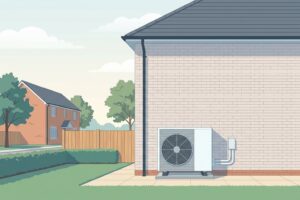
An air-to-air heat pump heats the air in your rooms directly through indoor fan units, rather than heating water for radiators. It is the same hardware as a modern air conditioning system, run in reverse. That single design difference decides almost everything about whether one suits your home.
Air-to-air units are cheaper to install than air-to-water heat pumps, they cool as well as heat, and since 2026 they qualify for a £2,500 government grant. But they produce no hot water at all, which means they cannot fully replace a boiler in most UK homes.
FREE QUOTE COMPARISON
Compare Heat Pump Quotes from Trusted Suppliers
✓ £2,500 grant available
100% free • No obligation • Takes under 2 minutes
- Air-to-air heat pumps produce no domestic hot water - you will still need an immersion heater, an existing boiler, or a separate hot water system alongside it
- The Boiler Upgrade Scheme pays £2,500, not £7,500 - the higher figure is the air-to-water rate, and several comparison sites currently quote it against air-to-air by mistake
- They cool as well as heat - the one capability air-to-water heat pumps and gas boilers do not offer, which matters more each UK summer
- Running cost at the current price cap is 26.11p per kWh of electricity - divided by the unit’s efficiency, so a SCOP of 3.5 gives roughly 7.5p per kWh of delivered heat
- Installation needs no radiators, no cylinder and no wet pipework - which is why it is the cheapest heat pump route for flats, extensions and single rooms
What Is an Air-to-Air Heat Pump?
An air-to-air heat pump is a heating system that extracts warmth from outside air and delivers it directly into rooms as warm air. It consists of an outdoor unit and one or more indoor wall, floor or ceiling units, connected by refrigerant pipework rather than water pipes.
If you have seen a wall-mounted air conditioning unit in an office or hotel room, you have seen the indoor half of an air-to-air heat pump. Most modern units are reversible: they move heat inward in winter and outward in summer. In the UK these are often sold as “air conditioning with heating” rather than as heat pumps, which is a large part of why buyers get confused about grants and running costs.
Air-to-Air vs Air-to-Water: The Difference That Matters
Air-to-water heat pumps heat water, which then circulates through radiators or underfloor heating and fills a hot water cylinder. Air-to-air heat pumps heat air only. Everything else follows from that.
| Air-to-air | Air-to-water | |
|---|---|---|
| Heats your rooms | Yes, as warm air | Yes, via radiators or underfloor |
| Provides hot water | No | Yes |
| Provides cooling | Yes | Rarely, and only on specific models |
| Uses your existing radiators | No | Yes, though they may need upsizing |
| Boiler Upgrade Scheme grant | £2,500 | £7,500, or £9,000 off gas grid |
| Can fully replace a gas boiler | No, not without a separate hot water solution | Yes |
| Visible indoor units | Yes, one per room heated | No, uses existing radiators |
The hot water gap is the deciding factor for most households. A typical UK home needs roughly the same amount of energy for hot water whether it has a heat pump or not, and an air-to-air system contributes nothing towards it. If you remove your gas boiler and install air-to-air alone, you will be heating all your water by immersion element at full electricity price, which is the most expensive way to do it.
In most UK homes with a wet heating system, air-to-air works best alongside your existing setup or in a specific space, not as a whole-house boiler replacement. If your goal is to remove a gas boiler entirely, an air-to-water heat pump is the system that actually does that job, and it attracts the £7,500 grant rather than £2,500.
The £2,500 Air-to-Air Heat Pump Grant
Air-to-air heat pumps qualify for a £2,500 grant under the Boiler Upgrade Scheme in England and Wales. This is new. Under the original scheme rules air-to-air was excluded entirely, and it became eligible only through a 2026 amendment to the regulations.
The Boiler Upgrade Scheme (England and Wales) (Amendment) Regulations 2026 amended the scheme’s grant categories “to introduce new categories of grant related to air-to-air heat pumps”, and rewrote the qualifying-technology wording to cover “an air-to-water heat pump or an air-to-air heat pump”. The same instrument extended the scheme through to 2030 and removed the EPC requirement.
GOV.UK confirms the current rate at £2,500 towards an air-to-air heat pump, against £7,500 for air source (air-to-water) and ground source systems.
Several major comparison and installer sites currently apply the £7,500 Boiler Upgrade Scheme figure to air-to-air systems. That figure is the air-to-water rate. If a quote for indoor wall units and no hot water cylinder references £7,500 of grant funding, the numbers are wrong and your actual out-of-pocket cost will be £5,000 higher than shown. Our full guide to UK heat pump grants sets out every scheme and rate.
How to Claim It
The grant is claimed by your installer, not by you, and it is deducted before you are invoiced. Three conditions apply:
- Your installer must be MCS certified. Many air-to-air systems are fitted by air conditioning firms that hold refrigerant handling qualifications but not MCS certification. Those installations cannot claim the grant
- The property must be in England or Wales. Scotland and Northern Ireland run separate schemes
- One grant per property. If you have already claimed the Boiler Upgrade Scheme for another system, you cannot claim again
FREE QUOTE COMPARISON
Compare Heat Pump Quotes from Trusted Suppliers
✓ £2,500 grant available
100% free • No obligation • Takes under 2 minutes
Air-to-Air Heat Pump Running Costs
Running cost depends on three numbers: how much heat your home needs, how efficiently the unit converts electricity into heat, and what you pay per unit of electricity. The arithmetic is simple enough to do yourself, and doing it yourself is the only way to get a figure that reflects your actual tariff.
The current Ofgem price cap sets electricity at 26.11p per kWh for direct debit customers, with a 57.19p daily standing charge, for the period 1 July to 30 September 2026.
The formula is:
- Cost per kWh of heat = electricity unit rate ÷ SCOP
- Annual cost = your annual heat demand in kWh ÷ SCOP × electricity unit rate
SCOP is seasonal coefficient of performance, the unit’s average efficiency across a heating season. Worked through at the current cap rate, assuming a SCOP of 3.5:
26.11p ÷ 3.5 = 7.5p per kWh of delivered heat. Heating a room that needs 2,000 kWh a year therefore costs about 2,000 ÷ 3.5 × 26.11p, or roughly £149 a year, plus standing charge.
Substitute your own numbers. If your unit’s published SCOP is 4.2, the delivered-heat cost falls to 6.2p per kWh. If you are on a heat pump tariff below the cap rate, it falls further.
Run the same calculation against your gas rate to compare honestly: gas is cheaper per kWh, but a boiler is far less efficient, so the comparison turns on both figures rather than one. Our heat pump running costs guide works this through in detail, and the running cost calculator does the arithmetic for you.
Any “air-to-air costs £X per year” headline is out of date the moment Ofgem changes the cap, which happens every three months, and it assumes a home size and efficiency that probably is not yours. We publish the formula and the current rate instead so you can produce a number that is actually true for your house.
What Air-to-Air Installation Costs
Air-to-air installation is quote-based and there is no published national price list, so treat every figure below as an indicative third-party estimate rather than a fixed price. Cost is driven mainly by how many indoor units you need, since each room you want heated requires its own.
Published estimates from UK sources put a typical installed air-to-air system in the low thousands: GreenMatch quotes a range of roughly £2,400 to £8,800 depending on system size, which is materially less than the £8,000 to £16,500 installed range we record for air-to-water systems in our air source heat pump cost guide.
Three things drive the number:
- Number of indoor units. A single-room system is far cheaper than a multi-split covering four rooms. This is the dominant cost factor
- Whether you need cooling-grade installation. Reversible systems need proper refrigerant commissioning by an F-Gas qualified engineer
- MCS certification. MCS-certified installers often price above non-certified air conditioning firms, but only they unlock the £2,500 grant, so compare the net figure rather than the headline
Heat pumps installed in residential property carry 0% VAT until 31 March 2027, after which the rate returns to 5%, per HMRC VAT Notice 708/6. Your installer applies this automatically, so check the quote shows 0%.
Should You Get an Air-to-Air Heat Pump?
Air-to-air suits a narrower set of homes than air-to-water, but where it fits, it fits very well and costs considerably less. The question is not which technology is better in the abstract, but which one matches what your property needs.
| Your situation | Better choice | Why |
|---|---|---|
| You want cooling in summer as well as heating | Air-to-air | The only heat pump type that reliably reverses to cool |
| Heating a flat, extension, loft or garden room | Air-to-air | No radiator circuit needed, far less disruptive to fit |
| No wet heating system in the property | Air-to-air | Installing pipework and radiators would cost more than the heat pump |
| Hot water already handled and staying that way | Air-to-air | The hot water gap stops mattering |
| Heating a space intermittently, not continuously | Air-to-air | Warms a room quickly from cold, unlike a radiator circuit |
| You want to remove a gas or oil boiler completely | Air-to-water | Air-to-air cannot produce hot water, so the boiler stays |
| You need domestic hot water from the system | Air-to-water | Air-to-air has no cylinder connection at all |
| You have working radiators throughout | Air-to-water | Reuses the existing circuit rather than adding indoor units |
| You want the largest available grant | Air-to-water | £7,500, or £9,000 off gas grid, against £2,500 |
| Heating a whole house continuously through winter | Air-to-water | Steady low-temperature output suits continuous whole-house heating |
The most common good fit is a well-insulated flat or a modern extension where there is no existing radiator circuit, hot water comes from elsewhere, and summer overheating is already a problem. The most common bad fit is a homeowner who wants to replace a gas boiler, sees the lower price, and does not realise they are also taking on full-price immersion heating for all their hot water.
If you are still weighing system types, our guide to heat pump sizing covers how output is matched to a property, and are heat pumps worth it works through the wider financial case.
How We Researched This Guide
Grant rates were verified against GOV.UK’s Boiler Upgrade Scheme guidance and the text of the 2026 amendment regulations on legislation.gov.uk. The electricity unit rate is Ofgem’s published price cap for the current period. The VAT position comes from HMRC VAT Notice 708/6. All were checked in August 2026.
Installation costs are the one figure we cannot verify from a primary source, because air-to-air installation is quoted per job and no UK national price list exists. Where we give a range we name the third party it came from rather than presenting it as our own verified figure. Get at least three quotes before committing.
Last updated: August 2026. Grant rates and the Ofgem price cap change regularly; check the linked sources before making a decision.