Most guides to commercial heat pumps skip the thing a business most needs to know: the Boiler Upgrade Scheme is not domestic-only. Ofgem’s own wording is that it funds heat pumps “in homes and non-domestic buildings”, and GOV.UK confirms you can claim on a property you own even when it is a business or one you rent to tenants.
What actually decides whether your building qualifies is not its use class or your company structure. It is a single number: 45kWth. Above that, a commercial installation falls outside the scheme entirely.
FREE QUOTE COMPARISON
Compare Heat Pump Quotes from Trusted Suppliers
✓ £7,500 BUS grant available
100% free • No obligation • Takes under 2 minutes
- The £7,500 grant applies to non-domestic buildings, not just homes - Ofgem funds heat pumps in “homes and non-domestic buildings”, and business-owned property is explicitly eligible
- 45kWth is the cap that decides it - a single system above that sits outside the Boiler Upgrade Scheme, which is how large commercial installations are excluded
- Shared ground loops get 300kWth instead - which is why networked ground source is the route for multi-unit or multi-building schemes
- Off the gas grid, the grant rises by £1,500 to £9,000 - for air or ground source replacing oil or LPG, running until 31 March 2027
- Most new builds are excluded - which catches out commercial fit-outs, where specifying a heat pump at build stage is the obvious moment
Yes, Your Business Can Claim the Grant
The Boiler Upgrade Scheme covers homes and small to medium non-domestic buildings in England and Wales. Ofgem describes it as providing grants for heat pumps “in homes and non-domestic buildings”, and the GOV.UK eligibility page puts the ownership test plainly: you must own the property, “including if it’s a business, a second home, or a property you rent out to tenants”.
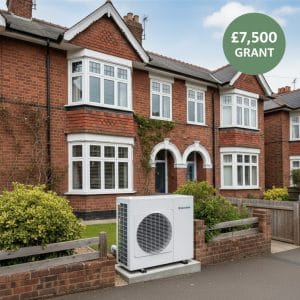
The grant values are the same as domestic. An air source heat pump, meaning air-to-water, attracts £7,500. A ground source heat pump attracts £7,500, and that figure includes water source systems and those on shared ground loops. A biomass boiler attracts £5,000. Where the building sits off the gas grid and currently runs on oil or LPG, GOV.UK adds a further £1,500 for air or ground source, taking the total to £9,000 until 31 March 2027.
| Technology | Grant | Notes for non-domestic |
|---|---|---|
| Air source (air-to-water) | £7,500 | Same rate as domestic |
| Ground source | £7,500 | Includes water source and shared ground loops |
| Off gas grid, on oil or LPG | +£1,500 (£9,000 total) | Air or ground source, until 31 March 2027 |
| Biomass boiler | £5,000 | Same rate as domestic |
| Air-to-air | £2,500 | Position for non-domestic is unclear – see below |
Ofgem’s scheme page presents the £2,500 air-to-air grant as applying to residential property only. GOV.UK’s own “what you can get” page lists the same grant with no property-type restriction attached. The two official sources do not agree, so we are not going to tell you either way. If air-to-air is what you are considering for a commercial building, confirm the position with your installer or Ofgem before you budget for the grant.
FREE QUOTE COMPARISON
Compare Heat Pump Quotes from Trusted Suppliers
✓ £7,500 BUS grant available
100% free • No obligation • Takes under 2 minutes
The 45kWth Cap Is the Real Test
The scheme caps an individual system at 45kWth. That single number is what separates a commercial building that can claim from one that cannot, and it is a capacity test rather than a test of what your business does or how big the premises are.
Where more than one system is installed, the ceiling is 70kWth. Shared ground loop systems are treated differently again and can run to 300kWth. That gap matters more than it first appears: a site that would blow through the cap as several separate installations may sit comfortably inside it as one networked ground source scheme, which is a design decision worth raising before anyone specifies equipment.
| Configuration | Capacity ceiling | Typical use |
|---|---|---|
| Individual system | 45kWth | A single building or unit |
| Multiple systems | 70kWth | Several systems on one site |
| Shared ground loop | 300kWth | Multi-unit and multi-building schemes |
Above these ceilings there is no equivalent grant for a private business, and the project has to stand on its own numbers. Public sector bodies have a separate route in the Public Sector Decarbonisation Scheme, which private companies cannot use. Sizing therefore does real commercial work here, not just engineering work, and our guide to heat pump sizing covers the heat loss calculation that produces the kWth figure in the first place.
What Does a Commercial Heat Pump Cost?
We are not publishing a range. No primary UK source publishes commercial heat pump installation costs. Commercial systems are sized against a specific building’s heat loss and quoted individually, so there is no rate card to check a figure against.
Plenty of sites will give you a number anyway. Those figures trace back to comparison sites rather than to manufacturers, installers or government, and a commercial heat loss calculation is exactly the kind of thing a generic range gets wrong, because a leisure centre, a listed manor house and a garden centre have almost nothing in common thermally.
What you can usefully anchor on is the domestic end of the market, where prices are published, and treat it as a floor rather than a guide. Our air source heat pump cost guide covers domestic installed pricing in detail. A commercial system will cost more than that, and the gap is set by capacity, distribution and the building itself.
There is one further cost question worth putting to your accountant rather than your installer: how the installation is treated for capital allowances. We are deliberately not giving figures on that, because the treatment turns on whether the equipment counts as an integral feature, and getting it wrong is expensive.
Air Source or Ground Source for a Commercial Building?
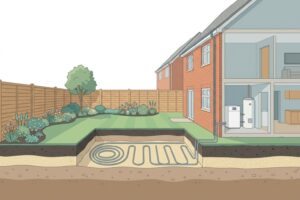
The trade-off is the same as domestic but the numbers behind it are larger, which changes the answer more often. Air source is cheaper to install and needs no groundworks. Ground source costs more upfront and needs either land or boreholes, and repays it through higher and more stable efficiency.
Two things push commercial buildings towards ground source more than they push homes. The first is run hours: a building heated hard for long periods compounds an efficiency advantage that a lightly used home never realises. The second is the shared ground loop allowance, since 300kWth against 45kWth is the difference between a scheme qualifying and not.
Kensa, the main UK ground source manufacturer, claims commercial and industrial ground source projects reduce upfront and running costs by 25% and cut carbon by 35% against air source. That is the manufacturer’s own figure for its own technology rather than independent testing, so treat it as a best case and ask any installer to show the calculation for your building.
Running Costs: What Actually Drives Them
A heat pump generates roughly three units of heat per unit of electricity, on the Energy Saving Trust’s general figure, and a well designed ground source system reaches higher. Electricity costs several times more than gas per unit, so that multiplier is the entire economic case. Lose it and the sums invert.
What loses it in commercial buildings is almost always flow temperature. Efficiency falls as flow temperature rises, and plant rooms are frequently set up to run hot because that is what the old boiler wanted. Drop a heat pump into a distribution system designed for 70 to 80°C, leave the controls alone, and you get a system that technically works and economically does not.
This is why the commercial case rests on the survey rather than the equipment. Emitter sizing, flow temperature and control strategy decide the running cost, and they are decided before anything is bought. Our heat pump running costs guide works through the arithmetic on domestic figures, and the mechanism is identical at commercial scale even though the absolute numbers are not.
Run hours cut the other way, in your favour. A building heated hard for long periods converts an efficiency advantage into cash faster than a home ever will, which is why the payback case for a school or a care setting can look considerably better than the equivalent domestic one. The wider financial argument in our guide on whether heat pumps are worth it applies here, with the caveat that a business is also weighing capital allowances and, increasingly, reporting obligations that a household is not.
Which Commercial Buildings Actually Suit One
Heat pumps suit buildings that can accept a lower flow temperature and run for long, steady periods. Schools, offices, leisure centres, care settings, farms and garden centres all appear regularly in UK commercial installations, and listed buildings and council facilities such as depots and fire stations show up more often than people expect.
The awkward cases are buildings with high intermittent demand, very high flow temperature requirements from existing plant, or a distribution system sized for a boiler running at 70 to 80°C. None of these rules a heat pump out, but each adds cost that belongs in the business case rather than surfacing halfway through installation. The same logic applies as in our heat pump versus gas boiler comparison: what you are replacing drives the numbers more than what you are buying.
Two eligibility traps are worth checking before you spend money on design. Most new build properties are excluded from the Boiler Upgrade Scheme, which catches commercial fit-outs where specifying a heat pump at build stage would otherwise be the obvious move. Properties that have already received funding for a heat pump or biomass installation are also excluded. Our full guide to UK heat pump grants covers the application sequence and the MCS certification requirement that sits behind it.
How We Researched This Guide
Scheme eligibility, grant values, exclusions and the capacity ceilings come from Ofgem’s Boiler Upgrade Scheme pages and GOV.UK’s guidance on what you can get and how to check eligibility, all verified on 31 August 2026. Commercial building types and the ground source comparison figure come from Kensa, attributed in the text because they are the manufacturer’s own claims.
Where sources disagreed or published nothing, we have said so rather than picking a number. That applies to commercial installation costs, which no primary source publishes, and to the air-to-air grant’s status for non-domestic property, where Ofgem and GOV.UK do not currently say the same thing.