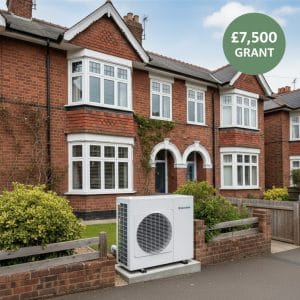
Most air source heat pumps are specified for a mild British winter. Daikin builds for a harsher one. The Altherma 3 H HT F keeps operating down to minus 28 degrees, among the lowest floors on the market, and it delivers hot water at 65 degrees into radiators sized for a gas boiler.
Those two numbers define who this heat pump is for. If you are in the north, on an exposed site, or retrofitting a house whose radiators are staying put, Daikin answers a question the mainstream units dodge.
FREE QUOTE COMPARISON
Compare Heat Pump Quotes from Trusted Suppliers
✓ £7,500 BUS grant available
100% free • No obligation • Takes under 2 minutes
- Operates down to minus 28 degrees, second only to Samsung in our verified set - against minus 25 for Vaillant, Mitsubishi and Nibe, and minus 20 for Grant and Panasonic
- Hot water to 65 degrees and explicit high-temperature radiator compatibility - the retrofit argument, because your existing radiators may not need upsizing
- Outdoor sound pressure of 43 to 48 dBA on the H HT F - Daikin’s own figure, 44 to 50 dBA on the Altherma 3 M, not directly comparable with other brands’ sound power ratings
- Rated up to A+++ for heating - on the A+++ to D scale, with heating, cooling and hot water from one unit
- Daikin publishes no price at all - not installed, not supply-only, which is the single biggest gap when comparing it against brands that do
What Daikin Costs
Daikin publishes no retail price and no installed price anywhere on its UK site. Everything is quoted through installer networks after a survey.
We are not going to invent a range to fill the gap. Figures for Daikin circulating online come from installer networks and comparison sites rather than from Daikin, and a heat pump price is set by your property’s heat loss, your emitters and your groundworks far more than by the badge on the unit.
What you can do is anchor on the market. Our air source heat pump cost guide sets out installed pricing across the market, and the Octopus Cosy is the one mainstream brand that publishes a typical figure, which makes it a useful reference point even if you buy something else.
Daikin units are MCS certified and eligible for the Boiler Upgrade Scheme on the same terms as any other air-to-water heat pump. Our guide to heat pump grants covers what you get and who qualifies.
FREE QUOTE COMPARISON
Compare Heat Pump Quotes from Trusted Suppliers
✓ £7,500 BUS grant available
100% free • No obligation • Takes under 2 minutes
The Cold Weather Case
Every air source heat pump loses efficiency as the outside air gets colder, and every one has a temperature below which it simply stops. That floor is the specification most buyers never look at and northern buyers should look at first.
| Brand | Operating floor |
|---|---|
| Samsung EHS Mono HT Quiet | −30°C (100% capacity retained to −25°C) |
| Daikin Altherma 3 H HT F | −28°C |
| Vaillant aroTHERM Plus | −25°C |
| Mitsubishi Ecodan | −25°C |
| Nibe | −25°C |
| Grant Aerona3 | −20°C |
| Panasonic Aquarea T-CAP | −20°C |
UK design temperatures run to about minus 3 in the south, minus 4 to minus 5 in the Midlands, and minus 7 or lower in northern Scotland and the Highlands. No UK property routinely sees minus 28, so this is headroom rather than a threshold you will meet.
Headroom still matters, because a unit running well inside its envelope holds capacity better than one running near its limit. On an exposed northern site that is the difference between a heat pump that copes with a cold snap and one that hands over to its immersion heater, which is where running costs go wrong.
High Temperature and the Retrofit Argument
The H HT in the model name stands for high temperature, and it is the reason this unit exists. It produces domestic hot water up to 65 degrees and connects to underfloor heating, high-temperature radiators and heat pump convectors.
That matters because the standard heat pump retrofit story involves upsizing radiators. A typical heat pump runs at 35 to 45 degrees where a gas boiler ran at 70 to 80, so emitters sized for the boiler are undersized for the heat pump. A high-temperature unit narrows that gap and can leave much of the existing system in place.
It is not a free pass. Running any heat pump hotter costs efficiency, so a high-temperature unit that never drops its flow temperature will cost more to run than a well-designed low-temperature system. Our guide to heat pump radiators covers which rooms typically need changing, and it is worth reading before you conclude you can skip the work entirely.
The SCOP Question
Daikin rates the H HT F up to A+++ for heating on the A+++ to D scale, but it publishes SCOP per model number in downloadable specification tables rather than as a headline on the product page.
A SCOP quoted at 35°C and one quoted at 55°C are not comparable, and the gap between them is large. This matters more with Daikin than with most brands, because a high-temperature unit is often specified to run hot, which is exactly the condition that lowers the number.
So ask your installer for the SCOP of the specific model at the flow temperature your property will actually run at. That single question tells you more than any brand comparison, and it applies whichever unit in our brand comparison you end up choosing.
Noise, Size and Refrigerant
Outdoor sound pressure runs 43 to 48 dBA on the H HT F and 44 to 50 dBA on the Altherma 3 M monobloc. Daikin quotes sound pressure, which brands measure at different distances and conditions, so do not set it against another brand’s sound power figure. Ask the installer for a site-specific noise assessment, which matters on a terrace or anywhere a boundary noise limit applies.
The floor-standing H HT F with its integrated 180 litre cylinder is 1650mm tall, 595mm wide and 625mm deep, so it needs a utility space rather than a cupboard. The monobloc Altherma 3 M is 870 by 1380 by 640mm.
Daikin’s UK range runs on R-32. That is a lower global warming potential than the older R-410A it replaced, but it is not in the same category as the R-290 propane used by the Vaillant aroTHERM Plus. If refrigerant footprint is a deciding factor for you, that is a real difference and worth weighing.
One thing to raise with any installer quoting you Daikin: the range is mid-transition. Daikin now lists an Altherma 4 series alongside the Altherma 3 units covered here, so a quote may reference either generation. Ask which series is being proposed and get the specification sheet for that exact model, because the naming is close enough to be genuinely confusing on a written quote.
How Daikin Compares on Use Case
The three mainstream brands we have reviewed in depth are not really competing for the same house. Reading them as a ranked list is the mistake; reading them as three answers to three different problems is more useful.
| Brand | Strongest case | Weakest point |
|---|---|---|
| Daikin Altherma 3 H HT | Cold or exposed sites, and retrofits keeping existing radiators | No published price anywhere |
| Octopus Cosy | Mainstream retrofit wanting price, grant and install handled together | Tariff benefits need an Octopus account |
| Vaillant aroTHERM Plus | R-290 propane refrigerant | Warranty beyond two years is conditional on installer tier and servicing |
Daikin’s position in that table is the narrowest and the most defensible. Samsung’s EHS Mono HT Quiet goes lower still on paper at minus 30, though it retains full capacity only to minus 25, so on the combination of a deep cold floor and 65 degree hot water Daikin is one of the most direct answers where both constraints bind.
Where they do not bind, the argument weakens quickly. A well-insulated southern home running underfloor heating at 35 degrees gets nothing from a high-temperature unit and pays for capability it will never use. That house is better served by a standard low-temperature system, and the money saved is better spent on the emitter design that actually drives efficiency.
Who Should Buy One
Daikin suits cold sites and awkward retrofits. If you are in northern England, Scotland or anywhere exposed, or if you are keeping radiators sized for a gas boiler, the combination of a minus 28 floor and 65 degree hot water is one of the most direct answers we have verified.
It suits you less if you want a published price before you engage with an installer, if refrigerant footprint is a priority, or if your home is already suited to low-temperature heating, where a cheaper standard unit will do the same job more efficiently. Our guide on heat pump sizing is the place to start working out which of those you are.
Our Verdict
Daikin Altherma 3 H HT review: operates to -28C, 65C hot water for existing radiators, 43-48 dBA. The cold-weather pick, but Daikin publishes no price.
Daikin scores 7.9 out of 10. The cold-weather envelope and high-temperature capability are among the strongest we have verified, and for a northern or radiator-constrained retrofit few units answer the brief as directly. The absence of any published price, and a SCOP you have to dig for, are what hold the score down.
FREE QUOTE COMPARISON
Compare Heat Pump Quotes from Trusted Suppliers
✓ £7,500 BUS grant available
100% free • No obligation • Takes under 2 minutes
How We Researched This Review
Specifications come from Daikin UK’s own product pages for the Altherma 3 H HT F and Altherma 3 M, checked on 1 September 2026. The comparative operating floors come from our own brand research file, verified on 4 August 2026 against each manufacturer’s published data.
We have not published a Daikin price or a Daikin SCOP, because neither is stated on the product pages we checked. Warranty terms come from Daikin UK’s own warranty page, checked on 6 October 2026. Where a figure exists only in third-party listings, we have left it out rather than pass it off as manufacturer data.