

Most UK businesses spend more on energy than they realise, and costs can swing wildly depending on office size and how people use the space. A typical UK office uses somewhere between 8 and 12 kWh of electricity per square foot each year, with bills ranging from £3,103 for a small 5-person office to £34,854 for a 100-person workspace.
We cover the full details in our npower Business Solutions review, including pricing and real-world feedback.
FREE QUOTE COMPARISON
Compare Business Energy Quotes from Trusted Suppliers
✓ Save up to 45% on energy bills
100% free • No obligation • Takes under 2 minutes
The real costs of running an office go far beyond just lighting and computers. Air conditioning alone can swallow up nearly 30% of your total energy spend, and equipment left on overnight keeps draining your wallet for no good reason.
Use our free Business Energy Cost Calculator to compare costs for your specific requirements.
- Small offices use 2,500–5,000 kWh annually - while large offices consume over 50,000 kWh per year
- Heating accounts for 40–60% of energy costs - making it the biggest expense factor for most UK offices
- Energy-efficient lighting saves up to 75% - LED upgrades reduce electricity bills significantly compared to traditional bulbs
- Office size multiplies costs by 10x - large offices pay £8,000+ annually versus £800 for small spaces
- Smart controls cut consumption by 15–25% - automated systems outperform manual heating and lighting management
Understanding Office Energy Consumption in the UK
A typical UK office uses 15,000–25,000 kWh of electricity per year, with smaller offices closer to 15,000 kWh and larger operations exceeding 50,000 kWh annually.
A typical UK office uses between 15,000 and 25,000 kWh of electricity per year, translating to annual energy costs of £3,100 to £5,500 depending on the current unit rate and office size. Heating accounts for 30 to 60 percent of total energy consumption, while lighting and IT equipment together represent roughly 25 percent. Smaller offices of 100 to 500 square feet spend approximately £800 to £2,000 per year, while larger commercial spaces above 2,000 square feet can exceed £34,000 annually.
The biggest cost reduction opportunities lie in heating controls, LED lighting upgrades, and behavioural changes around equipment standby modes. Businesses on standard variable tariffs typically pay 20 to 30 percent more than those on fixed-term energy contracts, making regular tariff comparison one of the simplest ways to reduce annual energy expenditure without capital investment.
Office energy use covers both electricity and gas, but electricity usually takes the bigger bite out of the budget. Most UK offices go through 15,000 to 25,000 kWh of electricity each year, while gas usage jumps up or down depending on how much heating the building needs and how well it keeps the cold out.
We cover the full details in our Regent Gas review, including pricing and real-world feedback.
For a closer look at this provider, read our full Yorkshire Gas and Power review.
What Counts as Office Energy Use?
Office energy use means all the electricity and gas needed to keep things ticking over. That includes lighting, heating, cooling, computers, printers, and the kitchen kit.
Electricity powers most office gear. Old lighting systems suck up loads of energy, especially if you haven’t upgraded the bulbs. Computers run all day and often lurk on standby all night.
Air conditioning and ventilation chew through electricity in the warmer months. The kitchen adds its own load with fridges, microwaves, and coffee machines.
Gas mostly heats the place up in winter. Plenty of UK offices use gas boilers for central heating. Some also use gas for hot water in the kitchen or bathrooms, though that’s a smaller piece of the pie.
How old the building is really matters. Newer offices usually have better insulation and more efficient heating, so they use less energy than older ones that leak heat everywhere.
Business Electricity Consumption Explained
UK office electricity use for small businesses usually lands between 15,000 and 25,000 kWh a year. That means an average annual bill of £2,700 to £5,500, depending on how big the office is and how people use it.
Small offices tend to use about 20,000 kWh per year. Medium-sized businesses might hit 50,000 kWh. Larger operations can easily top those numbers.
Some things that push usage up:
- Operating hours – longer days, higher bills
- Equipment efficiency – old computers and lighting burn more power
- Employee habits – leaving stuff on overnight wastes electricity
- Building design – poor insulation means you spend more on heating and cooling
Where your office is affects the price you pay. London offices might get slightly better rates than places like Merseyside, though people use energy in similar ways.
Lots of businesses use smart meters now. They help you spot when your usage spikes and where you’re wasting energy.
Business Gas Consumption in Offices
Gas use in UK offices swings a lot between seasons and building types. Small offices usually get through 22,500 to 25,000 kWh of gas a year, which costs about £1,800 to £2,000.
Heating eats up most of that gas. Old buildings with thin insulation need more gas to stay warm. Modern offices with efficient boilers and good insulation get by with less.
Seasons matter a lot. Gas bills shoot up in winter when the heating’s on full blast, and drop right down in summer.
How much gas you use depends on:
- Insulation quality
- Heating system efficiency
- Thermostat settings
- Size and layout of the building
Some offices use gas to heat water in kitchens and bathrooms, but that’s a tiny fraction compared to space heating.
Microbusinesses burning through about 10,000 kWh of gas pay around £914 a year. Medium businesses using 47,500 kWh face bills of roughly £3,672.
FREE QUOTE COMPARISON
Compare Business Energy Quotes from Trusted Suppliers
✓ Save up to 45% on energy bills
100% free • No obligation • Takes under 2 minutes
Average Energy Usage by Office Size
A 5-person office uses roughly 15,000 kWh of electricity per year costing £3,103, a 30-person office around 50,000 kWh at £10,423, and a 100-person office over 65,000 kWh at £34,854 annually.
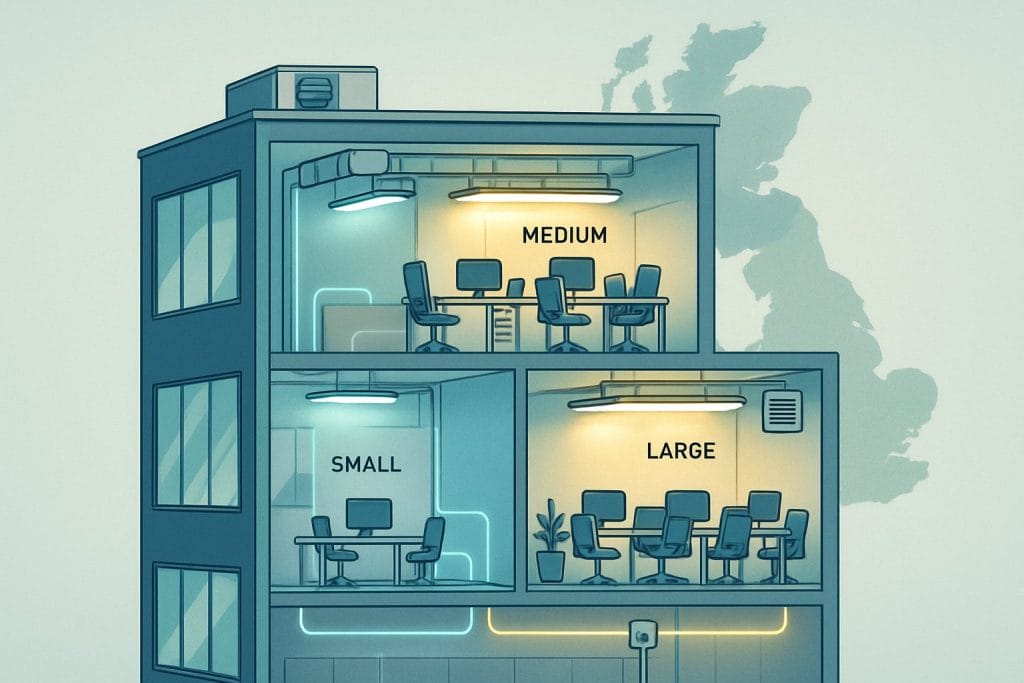
How much energy an office uses depends a lot on size and what the business does. Micro businesses usually use about 15,000 kWh of electricity a year, while big companies can chew through more than 50,000 kWh.
Micro and Small Businesses
Micro businesses are the smallest energy users in the UK office world. They typically get through 10,000 kWh of gas and up to 15,000 kWh of electricity each year.
Small businesses use more, generally around 25,000 kWh of gas and up to 25,000 kWh of electricity a year.
What drives these numbers? The size of the office, for one. Bigger spaces need more heating and cooling. Equipment needs stay pretty modest compared to larger firms.
Surprisingly, many micro business owners have no clue what they’re using. Studies suggest 70% don’t know their gas use, and 64% are in the dark about their electricity patterns.
Small offices usually stick to standard business hours, which keeps their energy use lower than round-the-clock operations. The main energy hogs are computers, printers, and the lights.
Medium and Large Offices
Medium-sized businesses ramp things up. They’ll typically use 45,000 kWh of gas and up to 50,000 kWh of electricity a year.
Large businesses go way beyond that, burning through more than 65,000 kWh of gas and over 50,000 kWh of electricity annually.
Longer hours make a big difference. Many medium and large offices keep the lights on late or even run 24/7.
More equipment in the building means more power gets used. Big offices have extra computers, servers, and specialist kit. Climate control systems have to work harder across all that space.
Larger businesses usually pay more attention to their energy use. They’re the ones installing smart meters and tracking everything.
Influence of Industry Type
Offices in manufacturing or heavy industry use a lot more energy than your average commercial space. They need power for machinery, heating materials, and processes that run all the time.
Businesses in finance or consulting tend to use less. Most of their energy goes on lighting, heating, cooling, and electronics.
Tech companies and data centres are in another league. Servers need constant power and cooling, so their bills are huge.
Retail offices can be all over the place. If they’ve got warehousing or refrigeration, their energy use climbs. Purely admin spaces use less.
Transport industry offices sometimes need to charge vehicles as well as run the usual office kit, so their electricity use gets a boost too.
Key Factors Impacting Office Energy Consumption
The biggest factors affecting office energy consumption are building size, occupancy levels, insulation quality, operating hours, and equipment efficiency — with air conditioning alone accounting for 30% of electricity spend.
Loads of things affect how much energy an office gets through each year. Building size, where you are, and how you use the space all play a part.
Office Size and Occupancy
How big the office is sets the baseline for energy use, no matter the business. Micro offices typically use 5,000 to 15,000 kWh of electricity a year, while medium ones can hit 30,000 to 50,000 kWh.
The number of people in the office is crucial. Occupancy levels are one of the biggest drivers of annual energy use in office buildings, since more staff means more lighting, heating, cooling and equipment running for longer.
Energy use shoots up as more people work in the space. More staff means more lighting, heating, and ventilation running all day.
Building square footage gives you a rough guide:
- Micro offices: 5,000-15,000 kWh per year
- Small offices: 15,000-30,000 kWh per year
- Medium offices: 30,000-50,000 kWh per year
How you use the space matters too. Offices with flexible work setups often use less energy per square foot than those running at full capacity all the time.
Building Location and Insulation
Where the building sits affects energy needs through the local climate and what the infrastructure’s like. Offices up north usually need more heating in winter, which pushes up energy use.
The quality of insulation really counts. Well-insulated offices spend less on heating and cooling than older places where heat just leaks away.
Windows and wall materials make a difference. Single-glazed windows lose more heat than double or triple glazing, so you’ll need more energy to stay comfortable.
Local energy supply can change your costs:
- Urban offices might have better grid connections
- Rural spots can get hit with higher transmission fees
- Some areas have easier access to renewables
The age of the building matters. Newer builds usually meet higher efficiency standards, so they use less energy than older properties that haven’t been upgraded.
Operating Hours and Equipment Use
How long your office stays open each day has a big impact. Offices running 24/7 use about three times as much energy as those on a 9-to-5 schedule.
Your choice of equipment matters too. Air conditioning alone can eat up about 30% of the office’s total electricity bill, making it the single biggest energy user.
Modern offices are packed with computers, servers, and kitchen appliances. Each workstation left running all day adds to overall electricity use, and across a full office these loads add up quickly.
Here’s what usually takes the biggest bites out of the electricity bill:
- Air conditioning: 30%
- Lighting: 26%
- Computers: 10%
- Kitchen appliances: 6%
Longer hours just multiply these numbers. Offices with evening or weekend shifts see much higher energy use across the board.
Breakdown of Office Energy Costs
UK business electricity costs 23–27p per kWh for small businesses and 20–25p per kWh for larger firms in 2026, with gas at 5.9–6.6p per kWh. A 5-person office pays around £3,103 per year; a 100-person office around £34,854.
What you pay for office energy depends on electricity and gas rates, plus how much you use. Most UK businesses shell out about £3,061 a year for electricity, but the bill can swing a lot depending on size and habits.
Cost Per kWh for Electricity and Gas
Most UK offices pay around 23–27p per kWh for electricity on standard variable tariffs as of early 2026. That’s typical for small to medium offices, though rates have fallen from the 2022–2023 crisis peak. For a full breakdown, see our business energy costs guide.
Gas is cheaper. Business gas usually costs between 4p and 7p per kWh, depending on how much you use and the deal you’ve signed.
Bigger businesses can sometimes negotiate better rates by buying in bulk. They might pay 20–25p per kWh for electricity and 3–5p per kWh for gas.
Energy suppliers offer a range of tariffs. Fixed-rate contracts lock in your price, so you’re protected from sudden jumps. Variable rates change with the market, which can save you money if the timing’s right. If your usage is low enough, a no standing charge tariff might cut costs further.
Typical Annual and Monthly Office Energy Bills
A 5-person office (375-475 sq ft) usually spends about £3,103 per year on energy. That works out to roughly £259 a month for both electricity and gas.
Medium offices with 30 employees (2,250-2,850 sq ft) face annual energy bills of £10,423. Their monthly costs hover around £869.
Large offices with 100 people (7,500-9,500 sq ft) pay £34,854 a year. They shell out approximately £2,905 every month just for energy.
Air conditioning eats up the biggest chunk of the bill in larger offices. It can cost as much as £10,100 per year, which is nearly 30% of the total energy spend.
Comparison with Domestic Energy Use
Business electricity usage leaves domestic consumption in the dust. The average UK home uses 8.5-10 kWh of electricity each day, but small offices burn through much more per square foot.
Business gas use also tops household consumption. Homes typically use 33-38 kWh of gas daily, while offices need extra heating for bigger spaces and longer hours.
Per-person energy costs might look lower in offices because everyone shares heating, lighting, and equipment. Still, total consumption stays higher thanks to computers, printers, and air conditioning.
Large businesses get through about 155,000 kWh a year in total energy. That’s enough to power 15 to 20 average homes for a whole year.
FREE QUOTE COMPARISON
Compare Business Energy Quotes from Trusted Suppliers
✓ Save up to 45% on energy bills
100% free • No obligation • Takes under 2 minutes
Strategies for Improving Energy Efficiency in Offices
Offices can cut energy bills by up to 30% through targeted efficiency measures including smart meters, optimised heating controls, LED lighting upgrades, and staff engagement programmes.
Offices can knock up to 30% off their energy bills with targeted efficiency steps. Start with an energy assessment, tweak heating and cooling, upgrade lighting and equipment, and get everyone on board with energy-saving habits.
Energy Assessment and Monitoring
Understanding how much energy you’re using forms the backbone of any efficiency plan. An energy broker can help benchmark your usage against similar businesses and find better deals.
Smart meters show real-time data for electricity and gas use. They help you spot waste and identify peak times.
Energy audits dig into the details. These checks cover heating, lighting, equipment, and insulation, flagging up problem areas.
Key monitoring activities include:
- Installing smart meters for accurate data
- Running monthly energy reviews
- Tracking usage at different times of day
- Comparing results with similar offices
Regular monitoring shows if efficiency measures work. It also helps you catch new issues before they balloon into bigger problems.
Optimising Heating and Cooling
Heating soaks up 49% of office energy use. Cutting heat loss and using controls properly can save a lot.
Temperature settings matter more than you’d think. Offices should aim for 19°C when heating and 24°C or higher for cooling. Corridors and storage can stay cooler.
Heat loss reduction measures:
- Add draught proofing to doors and windows
- Insulate hot water tanks, boilers, and pipes
- Put heating reflectors behind radiators
- Keep radiators clear of furniture and clutter
Smart heating controls help avoid wasted energy. You can programme them to adjust temperatures based on who’s in and when.
Annual servicing keeps boilers, heaters, and air conditioning running smoothly. Well-maintained systems use less energy and break down less often.
Reducing Lighting and Equipment Costs
Almost half of business electricity gets used outside of normal hours. Lighting controls and efficient kit can trim these unnecessary costs.
Motion sensors and timers keep lights on only when needed. Meeting rooms, corridors, and storage areas get the biggest benefit from automation.
Natural light can do a lot of the heavy lifting. Desks near windows, pale paint, and vertical blinds all help make the most of daylight.
Equipment efficiency improvements:
- Swap desktops for laptops (50 watts vs 140 watts daily)
- Use power-saving settings on all devices
- Set printers to power down automatically
- Replace old kitchen appliances with energy-efficient models
Staff should turn off monitors and computers at the plug before leaving. That stops standby power draining energy overnight and at weekends.
Employee Engagement and Behaviour Change
Small behaviour tweaks can deliver fast savings without spending a penny. Engaged staff make efficiency gains stick.
Training helps employees see how their actions affect energy use. When people understand the impact, they’re more likely to change habits.
Effective engagement strategies:
- Ask staff to switch off lights when leaving rooms
- Encourage using stairs instead of lifts for short trips
- Share monthly energy data with teams
- Recognise departments that hit efficiency targets
Clear labels on switches make it easier for everyone to use equipment correctly. Mark out what each switch controls and add safe operating notes where needed.
Keep energy efficiency in the spotlight with regular updates. Monthly newsletters, team chats, and notice boards can share tips and celebrate wins.
Practical Tips for Reducing Office Energy Consumption
The highest-impact energy savings come from setting thermostats to 19°C for heating, installing motion-sensor lighting, switching desktops to laptops (50W vs 140W), and switching off equipment at the plug overnight.
Small businesses could cut energy bills significantly with the right changes. Since heating makes up 49% of energy use in non-domestic buildings, it’s the best place to start.
High-Impact Changes for Small Businesses
Heating and cooling controls offer the biggest savings for most offices. Setting thermostats to 19°C for heating and 24°C for cooling can cut energy use noticeably while keeping things comfortable.
Seal up draughts around doors and windows to keep heat in. Block unused openings and clear away anything blocking radiators so heating works better.
Lighting improvements are quick wins. Motion sensors in meeting rooms, corridors, and storage stop lights burning when nobody’s around. Offices often use nearly half their electricity when empty – seems mad, right?
Encourage staff to switch off lights when leaving, and put desks near windows to maximise daylight. It’s simple, but it works.
Equipment management helps by switching off computers, monitors, and shared equipment at the plug. That stops energy leaking away during evenings and weekends.
Using Smart Technology
Smart heating controls adjust temperatures automatically based on who’s in and when. They account for weekends, bank holidays, even daylight saving, so you don’t heat empty buildings.
Programmable thermostats let you set different zones across the office. Corridors and storage can stay cooler, and meeting rooms only heat up when booked.
Automated lighting systems use sensors and timers to match artificial lighting with natural light and occupancy. Timer switches make sure lights actually go off after hours.
Smart power strips cut off standby power from office kit. They sense when computers or printers go to sleep and cut the juice, so you’re not paying for phantom loads.
Energy monitoring systems track how and when you use energy. Real-time data helps you spot which equipment hogs the most power and when spikes happen.
Upgrading to Energy Efficient Appliances
Computer equipment can save a surprising amount with the right upgrades. Laptops usually use just 50 watts compared to 140 watts for desktops over a standard working day.
Switching to LED monitors can cut power use by up to 70%. Turning on power-saving settings across all devices helps too, as computers automatically use less when idle.
Kitchen appliances are often overlooked but can make a difference. New fridges with A+++ ratings use far less electricity and keep food at safer, more stable temperatures.
If you swap out old kettles, microwaves, and coffee machines for energy-efficient ones, you’ll see lower bills. Make sure fridge seals are in good shape to stop cold air escaping. For even bigger savings, commercial solar panels can offset a significant chunk of your daytime electricity use.
Manufacturing and production equipment benefits from regular servicing and smart upgrades. Turning off motors during breaks and tweaking speeds saves energy without slowing you down.


