


Deputy is one of the most widely used shift scheduling and time and attendance platforms in the UK, trusted by more than 390,000 workplaces globally across hospitality, retail, healthcare, and care sectors. With verified GBP pricing from £3.25/user/month and a suite of features that includes AI-powered auto-scheduling and demand forecasting, it competes directly against scheduling alternatives like RotaCloud and Planday – at a lower entry price point.
But the headline rate doesn’t tell the full story. We reviewed Deputy’s UK pricing in detail, tested its feature set, and compared it against its closest competitors to give you a clear picture of where it excels, where it falls short, and who it’s genuinely built for.
FREE QUOTE COMPARISON
Compare Time & Attendance Quotes from Trusted Suppliers
✓ From £2/employee per month
100% free • No obligation • Takes under 2 minutes
- Pricing starts at £3.25 per user monthly - competitive cost for comprehensive shift scheduling and time tracking platform
- Perfect for hospitality and retail operations - industry-leading scheduling features for shift-based businesses with complex rotas
- Mobile app occasionally crashes during peak usage - stability issues frustrate managers updating schedules during busy periods
- Annual billing from £3.25/user/month - undercuts most UK-native scheduling rivals, though a £20/month minimum spend applies on monthly plans
Key Features
Deputy combines AI-powered scheduling, geofenced time clocking, demand forecasting, and Working Time Regulations compliance in a single platform from £3.25/user/month.
AI Auto-Scheduling
Deputy’s Core and Pro tiers include a genuinely capable auto-scheduling engine. Rather than just filling empty shifts, it generates compliant rotas that factor in wage budgets, break requirements, staff qualifications, and fair-hour distribution rules. For managers at multi-site hospitality or retail operations spending 4-6 hours per week building rotas manually, this is a meaningful operational saving. The auto-scheduler doesn’t require additional configuration to apply UK Working Time Regulations – rest period rules and hour caps are built into the engine by default.
Demand Forecasting
Deputy integrates with point-of-sale, footfall, and delivery data to predict staffing requirements before managers create schedules. Instead of guessing how many staff you’ll need on a Saturday afternoon, Deputy surfaces a suggested headcount based on historical trading patterns. This feature is particularly well-suited to hospitality and retail where customer volume is variable – and it’s included in the Core tier at £4.25/user/month rather than gated behind an enterprise plan.
Geofenced Mobile Time Clock
Employees clock in and out via iOS or Android app, with GPS coordinates recorded at that moment. Geofencing restricts clocking to within a set radius of the designated premises, preventing remote clock-ins. All timestamps are tied to physical location, which significantly reduces buddy-punching on shift-based teams. Deputy also supports biometric face recognition for clock-in on compatible kiosk hardware – included in the Core tier.
Real-Time Attendance Dashboard
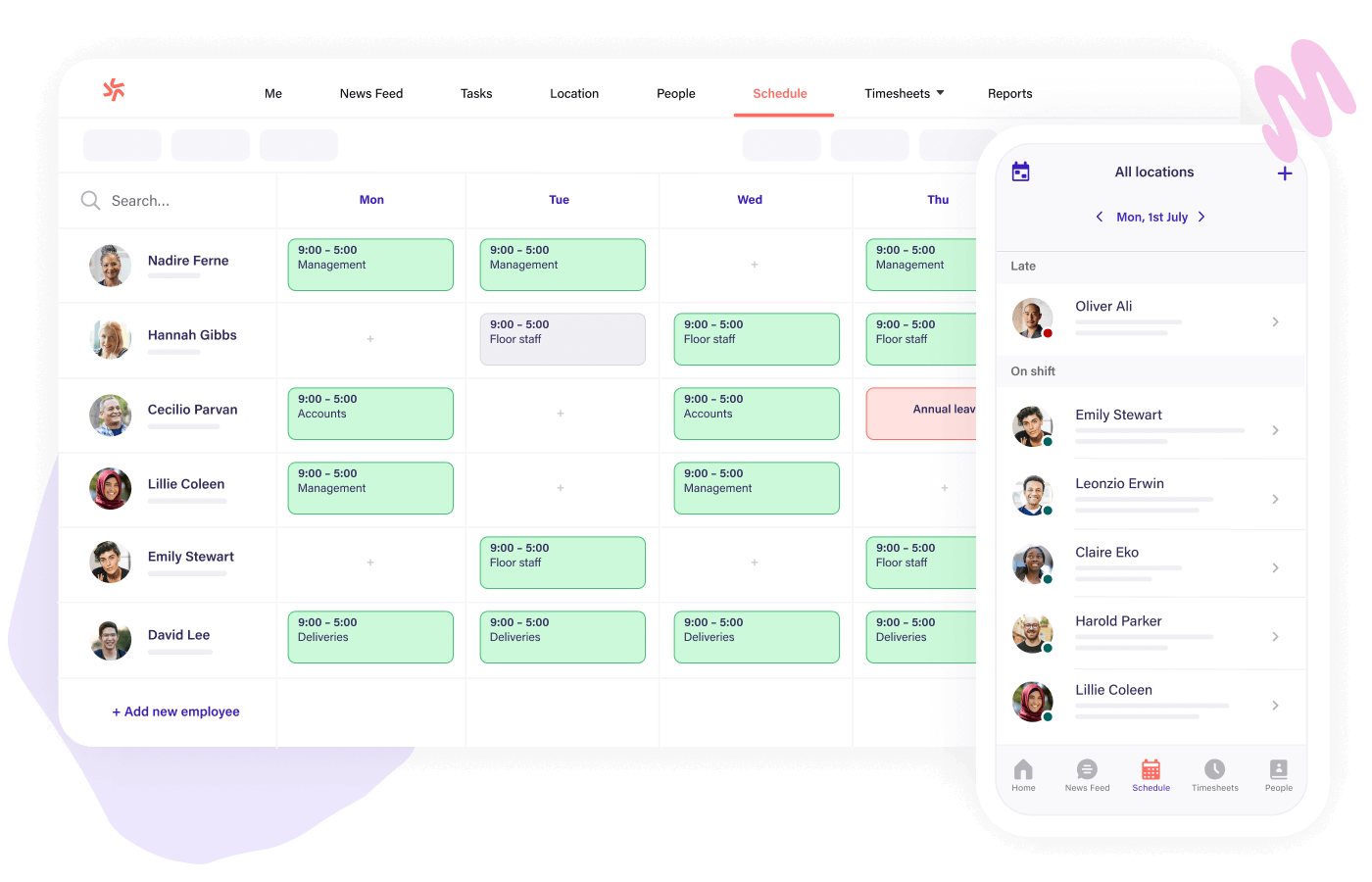
The operations dashboard gives managers a live view of who is currently on shift, who is late, and who is on break across all locations simultaneously. Push notifications fire when a staff member fails to clock in for a scheduled shift, enabling immediate action rather than end-of-day discovery. This multi-location visibility is available from the Lite tier – unlike some competitors that restrict cross-site views to higher plans.
Payroll Integration
Deputy integrates with Xero, QuickBooks, ADP, Sage, and several other payroll providers. Approved timesheets push directly to payroll without manual export. The depth of integration varies by provider – Xero is the most tightly coupled – but for most common UK payroll setups, the sync is reliable. Note that Deputy does not process payroll natively; it produces timesheets and exports them. Businesses that want scheduling and payroll in one platform will need to look elsewhere.
Pricing Breakdown
Deputy costs from £3.25/user/month on annual billing, with a £20/month minimum spend on monthly plans. Pro costs £6.50/user/month and bundles analytics and messaging add-ons.
Deputy uses per-user monthly pricing, available on annual billing (upfront or in monthly instalments) or rolling monthly contracts. All admin and manager accounts count as billed users.
| Plan | Annual Price | Monthly Price | Best For |
|---|---|---|---|
| Lite | £3.25/user/month | Not published | Basic scheduling, timesheets, compliance |
| Core ⭐ Most Popular | £4.25/user/month | Not published | Auto-scheduling, demand forecasting, biometrics |
| Pro | £6.50/user/month | Not published | SSO, custom access levels, dedicated support |
Add-ons (all include 30-day free trials):
| Add-on | Price | Included In |
|---|---|---|
| HR Module | £2.00/user/month | Not included |
| Messaging+ | £1.40/user/month | Pro |
| Analytics+ | £1.00/user/month | Pro |
Important caveats:
- £20/month minimum spend applies to monthly billing only (effective September 2025). On monthly billing, a team of 4 on Lite pays the £20 minimum rather than the roughly £14 a per-user rate would suggest. This makes Deputy expensive for very small teams on flexible billing.
- No mid-contract downgrades on annual plans. If headcount drops after signing an annual contract, you remain contracted at the original user count. A significant lock-in risk for seasonal businesses.
- Add-ons erode the value proposition. A Lite team that adds Analytics+ (£1), Messaging+ (£1.40), and HR Module (£2) is paying £7.65/user/month – more than the Pro annual rate. Review which add-ons you actually need before committing to a lower tier.
User Interface & Ease of Use
Deputy’s interface is polished and mobile-first, with a clear operations dashboard – but the Location/Area/Position hierarchy can be confusing to configure initially for new users.
Deputy’s desktop interface is well-organised, with scheduling, timesheets, and attendance split into clearly separated modules. The scheduling view is particularly strong – colour-coded by employee, shift costs shown in real time, and drag-and-drop rescheduling. The mobile app mirrors the desktop experience closely, which matters for teams where floor managers are the primary users.
The main friction point is initial setup. Deputy models your business as Locations > Areas > Positions – a hierarchy that’s powerful for multi-site operations but unnecessarily complex for single-location teams. New users frequently misconfigure this, which causes downstream errors in scheduling and reporting. There is no simplified mode for straightforward single-site businesses. Plan for a 1-2 week setup and onboarding period.
Employee-facing self-service is strong: shift swaps, leave requests, and availability updates are all handled via the app without manager involvement. Employees rate the mobile experience highly in third-party reviews, which matters for adoption in high-turnover environments like hospitality.
Customer Support
Deputy’s default support path is AI-first and self-serve. Reaching a human requires escalation and is not straightforward – a notable friction point for businesses with frequent support needs.
Deputy provides 24/7 support via chat, but the initial tier is AI-assisted. Escalating to a human agent requires working through the bot first, and multiple reviews note the escalation path as slow. Core tier customers get access to a customer success manager for onboarding, but ongoing support reverts to the self-serve model. Pro tier customers get dedicated support as a named feature.
For businesses with high staff turnover who need frequent onboarding calls for new managers, or for teams running shift-critical operations where a scheduling system outage has immediate business impact, this support model is a genuine concern. RotaCloud and Planday both offer more accessible phone or direct chat support at comparable price points.
The knowledge base is comprehensive. Most common configuration tasks – setting up leave types, configuring geofencing, connecting to Xero – are documented with step-by-step guides and video walkthroughs. Self-sufficient teams will find the documentation sufficient for day-to-day operations.
How Deputy Compares
| Feature | Deputy Core (£4.25) | RotaCloud (from ~£5) | Planday (from ~£3) |
|---|---|---|---|
| Auto-scheduling | ✓ Yes (AI-powered) | ✗ Manual | ✓ Yes (Pro tier) |
| Demand forecasting | ✓ Yes | ✗ No | ✗ No |
| Biometric clock-in | ✓ Yes (Core+) | ✗ No | ✗ No |
| Multi-site dashboard | ✓ Yes (all tiers) | ✓ Yes | ✓ Yes |
| Native payroll | ✗ No | ✗ No | ✗ No |
| UK-native support | ✗ AI-first | ✓ Direct chat/phone | ✓ Direct chat |
| Free trial | ✓ Yes | ✓ Yes | ✓ Yes |
Deputy’s clearest advantage over RotaCloud is the AI auto-scheduling and demand forecasting at the Core tier – features RotaCloud doesn’t offer at any price point. RotaCloud’s advantage is simpler setup, UK-native support, and better fit for teams with static or predictable schedules who don’t need predictive staffing. Planday competes closely on price but lacks the biometric and forecasting features that make Deputy compelling for variable-demand operations.
FREE QUOTE COMPARISON
Compare Time & Attendance Quotes from Trusted Suppliers
✓ From £2/employee per month
100% free • No obligation • Takes under 2 minutes
Pros & Cons
Our Verdict
For more on this topic, see our guides to best time and attendance systems, and time and attendance costs.
The strongest all-round pick for shift-based UK teams - AI scheduling and geofenced clocking from £3.25/user/month, though the £20 monthly minimum stings tiny teams.
Use our free T&A ROI Calculator to get a personalised cost estimate based on your specific requirements.
Who Should Use Deputy?
Deputy is well-suited to: Multi-site hospitality, retail, or care businesses with 15-200 employees where rota complexity is high and scheduling eats significant manager time. Particularly strong where demand is variable and clock-in accountability across dispersed locations is a compliance requirement.
Consider alternatives if:
- You have fewer than 6 users – the £20/month minimum spend makes it expensive on monthly billing. A simpler tool like Clockify or RotaCloud will cost less.
- You want payroll in one platform – Deputy produces timesheets but doesn’t process payroll. Sage HR or Factorial HR offer scheduling within an integrated HR and payroll suite.
- Your team works remotely or on project-based work – Deputy is built for shift-based, location-anchored environments. GPS timestamps and geofencing are irrelevant for remote-first teams.
- You need continuous GPS monitoring through shifts – Deputy records location at clock-in and clock-out only. Field service tools like BigChange or Trackunit cover in-shift location tracking.


