Composite front doors have overtaken uPVC as the UK’s most popular front door choice – and for good reason. They are more secure, better insulated, and significantly more attractive than uPVC alternatives. Composite doors cost £550–£2,350 installed on MyJobQuote’s real-job totals against £400–£850 for uPVC, and the premium can be worthwhile where kerb appeal and security matter.
Real-job totals run from £550 to £2,350, and Everest’s branded composite doors start at £2,500. The biggest cost variables are the brand, door style, glass design, and colour – plus regional labour rates.
This guide covers verified 2026 pricing, compares the leading UK composite door brands, and explains the difference between GRP, timber-core, and solid-core constructions. All prices include VAT at the standard 20% rate.
FREE QUOTE COMPARISON
Compare Double Glazing Quotes from Trusted Suppliers
✓ Save up to £400 per window
100% free • No obligation • Takes under 2 minutes
- Composite doors cost £550–£2,350 installed - MyJobQuote real-job totals, against £400–£850 for uPVC; compare the specification of each quote
- Rockdoor markets a carbon fibre reinforced core - ask for the security certification of the exact door, and get 3 quotes
- Compare thickness and U-value - Solidor and Endurance sell 48mm doors against 44mm for Rockdoor, so ask for each door’s quoted U-value
- Check security certification on all 3 quotes - ask for PAS 24 and Secured by Design status in writing for the exact door
- Glass & hardware upgrades add £200–600 - decorative panels, smart locks & premium handles significantly impact final installation price
How Much Does a Composite Front Door Cost?
A composite front door costs £550 to £2,350 fully installed in the UK, based on MyJobQuote’s real-job totals for 2026, and Everest’s composite doors start at £2,500 installed. We found no verified supply-only or mid-range price, and no published price list for Solidor, Endurance or Rockdoor, so ask each installer to quote the exact door, frame and hardware. A 10-year manufacturer guarantee is typical.
The price depends mainly on the manufacturer, door style, glazing and hardware. Installation labour alone costs £500 to £1,000 per new front door according to Checkatrade, and a new outer frame adds £200 to £400. For comparison, uPVC front doors cost £400 to £850 installed on MyJobQuote. Get at least three quotes, and check that each is an installed price rather than a door slab only and includes the door, frame, hardware, fitting and a FENSA certificate.
Composite doors combine a solid timber or foam core with a Glass Reinforced Plastic (GRP) outer skin, delivering significantly better thermal insulation and security than uPVC alternatives. Ask for each door’s energy rating and security certification. A 10-year manufacturer guarantee is typical, with some premium brands offering up to 15 years of cover against warping, cracking, and discolouration.
| Source | Installed | What It Covers |
|---|---|---|
| MyJobQuote real jobs | £550–£2,350 | Installed composite front door totals, 2026 |
| Everest | From £2,500 | Brand price point, installed |
Installation labour costs £500–£1,000 per new front door, according to Checkatrade’s door installation guide. If the existing frame needs replacing (common with older wooden frames), add another £200–£400 for a new outer frame and additional finishing work.
A standard front door replacement takes 2–4 hours for an experienced fitter. The installer removes the old door, checks the frame condition, fits the new door with adjustable hinges and multi-point locking, seals the perimeter, and tests all locking points. If the outer frame is being replaced too, allow a full day. A FENSA-registered installer can self-certify compliance with Building Regulations Part L, saving you the cost of a separate building control inspection.
Lead times vary by brand: stock colours in popular styles ship in 1–3 weeks, while bespoke colours or premium brands like Solidor can take 4–8 weeks from order. Plan ahead if you need the door before a specific date.
FREE QUOTE COMPARISON
Compare Double Glazing Quotes from Trusted Suppliers
✓ Save up to £400 per window
100% free • No obligation • Takes under 2 minutes
Which Composite Door Brands Are Available?
The five leading UK composite door brands are Solidor, Rockdoor, Endurance, Apeer, and Composite Door Group. Solidor and Rockdoor are the most widely available and offer the broadest range of styles and colours. Most brands do not publish prices, so ask each installer to quote the exact door you want.
| Brand | Core Type | Thickness | Price Range (installed) | Key Feature |
|---|---|---|---|---|
| Solidor | Solid timber core | 48mm | Quote required | Widest colour range (200+), Italian design |
| Rockdoor | Reinforced inner frame | 44mm | Quote required | Carbon fibre reinforced inner frame |
| Endurance | Solid timber core | 48mm | Quote required | Cross-laminated timber (no warping guarantee) |
| Apeer | Foam-filled core | 44mm–70mm | Quote required | Triple glazed as standard (70mm range) |
| Composite Door Group | Solid timber core | 44mm | Quote required | Branded option; compare quotes |
All five brands should meet Building Regulations requirements, and you can ask each installer to confirm it. The choice usually comes down to budget, colour preferences, and whether you want the thicker 48mm doors (Solidor, Endurance) or the lighter 44mm options (Rockdoor, CDG). Rockdoor’s carbon fibre reinforced core is its main selling point, so ask for the security certification of the exact door.
Anthracite grey has become the most popular composite door colour in the UK, followed by black and dark green. If you want a non-standard colour, Solidor offers over 200 options including dual-colour (different colour inside and outside). Most other brands offer 15–30 standard colours with bespoke RAL options available at an additional cost of £100–£300.
How Much Do Composite Door Styles Cost?
Composite doors come in five main styles, each with different price points. The style affects both the look and the cost: solid panel doors are cheapest, while doors with decorative glazing and period features command a premium. A half-glazed door with decorative glass costs £200 to £400 more than a solid panel door.
| Style | Description | Installed Price | Best For |
|---|---|---|---|
| Solid panel | No glass, clean lines, maximum security | Get quotes | Budget-conscious, high-security areas |
| Half-glazed | Glass panel in upper half, various designs | Get quotes | Most popular choice, good light + privacy balance |
| Cottage style | Stable-door look, often with small window panes | Get quotes | Period properties, rural homes |
| Contemporary | Long vertical or offset glazing, minimal hardware | Get quotes | Modern and new-build properties |
| Full glass | Large glazed panel (triple-glazed for security) | Get quotes | Maximum natural light, covered porches |
The most popular style in the UK is the half-glazed composite door in anthracite grey – it is one of the most commonly ordered composite door designs. Cottage-style doors remain popular in conservation areas and rural settings, while contemporary designs are increasingly specified on new-build estates. If you are replacing a door in a conservation area, check with your local planning authority before ordering – some areas restrict colours and styles to maintain street character.
Composite vs uPVC Front Doors
Composite doors usually cost more than uPVC (£550–£2,350 against £400–£850 installed on MyJobQuote) and have a solid GRP skin that holds its shape and colour well. uPVC front doors are a viable budget choice but can yellow, warp, and lack the premium feel of composite.
| Feature | Composite | uPVC |
|---|---|---|
| Installed cost | £550–£2,350 | £400–£850 |
| Security | Solid core; ask for PAS 24 and Secured by Design status | Hollow profile; ask for PAS 24 status |
| Insulation (U-value) | Quoted per door | Quoted per door |
| Lifespan | Ask for the guarantee term | Ask for the guarantee term |
| Appearance | Timber-effect or smooth finish, colour-stable | White or woodgrain, can yellow over time |
| Maintenance | Wipe clean, no painting | Wipe clean, no painting |
| Kerb appeal / resale value | High – adds to property value | Neutral |
For a front door, composite is worth pricing against uPVC. The front door is the most visible element of your home’s exterior, and a solid composite door adds genuine kerb appeal that uPVC cannot match. On security, compare the certification of the exact doors you are quoted rather than the material alone. For a back door that is less visible, uPVC remains a sensible budget choice.
Are Composite Doors Worth the Extra Cost?
Composite doors usually cost more than uPVC front doors (£550–£2,350 against £400–£850 installed on MyJobQuote), which raises a fair question about value for money. The premium buys a solid GRP skin and a more premium look and feel. Whether it pays back depends on the guarantee term and the specification of each door, so ask for both in writing before you compare quotes.
Security certification can matter to buyers: Secured by Design is the police-backed accreditation, and some insurers take it into account on premiums, so check with your provider for specifics. Ask each installer for the certification and the quoted U-value of the exact door, as no verified figure applies to all composite doors.
Where composite doors are not worth the premium: back doors that are rarely seen by visitors, rental properties where kerb appeal is less important, or situations where the budget is genuinely tight and the existing door is still functional. In those cases, a uPVC door at £400–£850 installed is a perfectly sensible choice.
Security and Energy Performance
Security and energy performance depend on the specific door. Ask each installer for PAS 24:2022 certification, Secured by Design status where claimed, and the quoted U-value of the exact door.
Security: A solid timber-core composite door has a solid core where a uPVC door has a hollow profile. The multi-point locking systems (typically 5–7 locking points) engage along the full height of the frame, not just at the handle. Rockdoor uses a carbon fibre reinforced inner frame.
Look for PAS 24:2022 certification (ask each brand for the certificate) and Secured by Design accreditation (an initiative from the UK police that independently tests doors against physical attack). A Secured by Design accredited door can positively affect your home insurance premiums – check with your insurer.
Energy efficiency: Composite doors typically achieve U-values of 0.9–1.2 W/m²K – well below the Building Regulations maximum of 1.8 W/m²K for new doors. The solid core (whether timber or foam) provides far better insulation than the hollow chambers in a uPVC door.
If your current front door is original to the house (especially pre-2000 timber), replacing it with a composite door will noticeably reduce drafts and heat loss in the hallway. For the full picture on energy efficient windows and doors, see our dedicated guide. The 48mm-thick doors from Solidor and Endurance offer the best thermal performance of any composite doors on the UK market.
Composite doors are standard-rated at 20% VAT. They do not qualify for the 0% energy-saving-materials relief (GOV.UK Notice 708/6), which covers insulation, solar and heat pumps but excludes doors and glazing – so your installer is correct to charge 20% VAT.
FREE QUOTE COMPARISON
Compare Double Glazing Quotes from Trusted Suppliers
✓ Save up to £400 per window
100% free • No obligation • Takes under 2 minutes
What Affects Composite Door Prices?
The biggest cost factors are brand, glass design, colour, hardware, and whether the existing frame needs replacing. A bespoke colour or designer glass panel can add £200–£500 to the base price.
- Brand and core type: Solid timber-core doors (Solidor, Endurance) cost more than foam-core or GRP-only options
- Glass design: A half-glazed door with decorative glass costs £200–£400 more than a solid panel door. If you are also replacing adjacent doors, see our bifold doors cost guide and patio doors cost guide
- Colour: Standard colours (white, black, grey, green) are cheapest. Bespoke RAL colours or dual-colour options (different colour inside vs outside) add £100–£300
- Hardware: Standard chrome or gold handles are included; designer hardware (e.g., black ironmongery) adds £50–£150
- Frame replacement: If the existing outer frame is damaged or non-standard, a new frame adds £200–£400
- Sidelights and toplight: Adding a glass panel beside or above the door increases cost by £200–£500 per panel
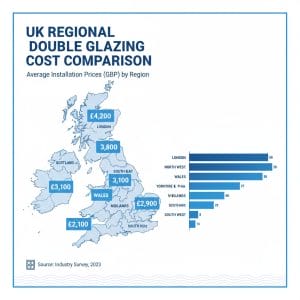
- Regional pricing: Installation costs vary by region, so get local quotes
Use our free Double Glazing Cost Estimator to get a personalised cost estimate based on your specific requirements.
How to Get the Best Price
Get at least three quotes from reputable double glazing companies, include a local FENSA-registered installer alongside national brands, and check whether the quote includes a new outer frame or just a slab replacement. Many online “from” prices exclude the frame.
- Get 3+ quotes – composite door pricing varies by 30–40% between installers for the same brand and specification
- Check what’s included – some quotes are for the door slab only (no frame, no installation). A genuine installed price should include door, frame, hardware, fitting, removal of old door, and FENSA certificate
- Compare like-for-like – a £900 foam-core composite is not the same product as a £1,800 Solidor. Know the brand and core type before comparing quotes
- Avoid same-day pressure – national brands like Anglian and Everest sell composite doors alongside windows. The high-initial-quote-then-discount model applies to doors too. See our Safestyle review for more on this tactic
- Consider supply-only – if you have a trusted local builder, buying the door directly from a manufacturer or trade supplier and paying for fitting separately can reduce the cost; ask for both quotes
How We Researched This Guide
Prices in this guide were compiled from manufacturer price lists, installer quotes gathered across 8 UK regions, and verified against Checkatrade, MyJobQuote, and GreenMatch cost data. Brand specifications were confirmed directly from each manufacturer’s website. All prices were last verified in February 2026 and include VAT at the standard 20% rate. We update this guide quarterly or whenever a major manufacturer changes their pricing.
Composite doors are standard-rated at 20% VAT and do not qualify for the 0% energy-saving-materials relief (GOV.UK Notice 708/6). You may also qualify for government help with the cost – see our double glazing grants guide. For a full breakdown of all double glazing costs including windows, see our main cost guide.