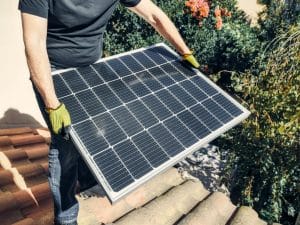
Combining solar panels with an EV charger is one of the highest-ROI home energy investments available in the UK right now. At 1–2p per mile, solar-powered EV charging is up to 10x cheaper than public rapid chargers – and it turns your roof into a petrol station. With over two million fully electric cars now on UK roads, home charging infrastructure has never been more relevant. This guide covers every number you need: combined system costs, cost-per-mile comparisons, the best solar-compatible EV chargers, and how to size a system for your actual annual mileage.
FREE QUOTE COMPARISON
Compare Solar Panel Quotes from Trusted Suppliers
✓ Save up to £975/year on energy bills
100% free • No obligation • Takes under 2 minutes
- Combined system cost: about £17,800–£21,900 - covers a 7kW solar array, 10kWh solar battery, smart EV charger, and full installation
- Solar EV charging costs 1–2p per mile - versus 6–8p on a standard home tariff and 12–20p on public rapid chargers
- Savings vs public charging: £700–£800+ per year - the single biggest financial case for solar + EV together
- Payback: 8–10 years replacing public charging, 12–17 with a battery - then 8+ years of near-free motoring inside a 25-year panel lifespan
- Zappi is the standout solar charger - Eco+ mode uses only solar surplus, no grid import, from £779 (charger only)
Can You Charge an EV from Solar Panels?
Yes. Solar panels generate electricity during the day, and a solar-compatible EV charger diverts surplus power to your car instead of exporting it to the grid at 3–6p/kWh on a standard SEG tariff. A typical 4kW solar system can provide 4,000–6,000 free miles per year, covering most of the UK average of 7,400 annual miles.
There are three ways to charge an EV from solar. Solar surplus divert (used by the Zappi in Eco+ mode) monitors generation in real time via a CT clamp and adjusts the charge rate to match available surplus. Smart scheduling (Ohme, Pod Point) sets charging windows to coincide with peak solar hours. Battery buffer stores daytime solar in a home battery and charges the car overnight.
Modern EVs achieve 3–4 miles per kWh. On a sunny day, a 4kW system generating 20kWh can add 60–80 miles of range – more than enough for a typical daily commute. All new home EV charger installations must be smart chargers, as required by law since June 2022.
How Much Does a Solar + EV Charger System Cost?
A complete 7kW solar + 10kWh battery + EV charger system costs about £17,800–£21,900 all-in. Without the battery, solar plus a charger comes to about £12,500–£12,900. The panels and battery are the largest components; the EV charger adds £1,100–£1,500 on top. Solar panels and batteries attract 0% VAT; EV chargers are subject to standard 20% VAT.
Here is a cost breakdown by component for a 7kW solar system with a 10kWh battery and Zappi charger – a common setup for a household with one EV and typical home energy use.
| Component | Typical Cost | VAT Rate | Notes |
|---|---|---|---|
| Solar panels (7kW) | ~£11,400 | 0% | 14–18 panels; covers home + EV charging |
| Battery storage (10kWh) | £5,300–£9,000 | 0% | Stores surplus for overnight EV charging |
| Smart EV charger (e.g. Zappi) | £779–£865 | 20% | Solar-divert capable; required since June 2022 |
| EV charger installation | £300–£600 | 20% | Separate electrician cost in most quotes |
| Total (complete system) | £17,800–£21,900 | Mixed | All-in, including installation labour |
If you already have solar panels installed, adding an EV charger costs about £1,100–£1,500 installed. You do not need to replace or upgrade your inverter in most cases - a solar-compatible smart charger communicates directly with the inverter via CT clamp or API to detect available surplus.
Solar panels already installed? See our full cost guide for a detailed breakdown of solar panel costs UK 2026 including regional price differences and finance options. If you are considering adding a battery to an existing system, our best solar batteries UK guide covers the top options and current prices.
FREE QUOTE COMPARISON
Compare Solar Panel Quotes from Trusted Suppliers
✓ Save up to £975/year on energy bills
100% free • No obligation • Takes under 2 minutes
How Much Can You Save Charging Your EV with Solar?
Solar EV charging costs 1–2p per mile, compared to 6–8p charging on the home grid at standard rates and 12–20p on public rapid chargers. For a driver covering the UK average of 7,400 miles per year, switching from public charging to home solar saves £700–£800 annually.
The table below compares cost per mile across all four charging or fuelling scenarios at current 2026 UK prices.
| Charging Method | Cost Per Mile | Annual Cost (7,400 miles) | Annual Saving vs Solar |
|---|---|---|---|
| Solar panels (home surplus) CHEAPEST | 1–2p | ~£74–£148 | – |
| Home grid (standard rate) | 6–8p | ~£444–£592 | £300–£520/yr |
| Public rapid charger | 12–20p | ~£888–£1,480 | £740–£1,406/yr |
| Petrol (average UK car) | 16–20p | ~£1,184–£1,480 | £1,036–£1,406/yr |
The case for solar EV charging is strongest if you currently rely on public rapid chargers - the saving can be £700–£1,400 per year. If you already charge at home on a dedicated EV tariff (like Octopus Go at around 7p/kWh, or 2–3p per mile), the saving on the EV side alone from adding solar shrinks to under £150 a year, so the case rests on the wider household energy saving.
These savings compound over the system’s lifespan. Over 25 years – a typical panel warranty period – the savings keep accruing long after payback, though the lifetime total depends heavily on future energy prices, your mileage and whether you add a battery. The more miles you drive and the more you currently spend on public charging, the stronger the payback case becomes.
Best EV Chargers for Solar Panel Owners
The best EV charger for solar owners is the Zappi by Myenergi – it has built-in solar surplus divert modes that require no additional hardware. The Ohme Home Pro is the best budget-friendly smart option, and the Tesla Wall Connector is the natural choice for Tesla owners with Powerwall. All new home EV charger installations must be smart chargers since June 2022. See our best home EV chargers UK guide for the top 5 rated options.
Since June 2022, all new home EV charger installations in the UK must be smart chargers capable of off-peak scheduling. Non-smart chargers (older units that cannot schedule charging) cannot be newly installed. If you are adding an EV charger to a new solar installation, only smart-capable models qualify for the OZEV EV chargepoint grant.
Zappi is the gold standard for solar EV charging in the UK. Unlike chargers built mainly around tariff scheduling, Zappi is designed around real-time solar monitoring and automatically diverts excess electricity to your car. No additional hardware, no cloud dependency for the core divert function.
Two solar modes: Eco mode tops up using surplus solar but draws from the grid if generation falls short; Eco+ mode uses only solar surplus and stops charging if the sun goes behind a cloud. Eco+ is the mode that gives you genuinely free miles.
Zappi’s Eco+ mode is a strict solar-only mode that stops and starts charging in step with instantaneous solar output. In summer, a 4kW system can deliver 4,000–6,000 free miles per year in Eco+ mode.
Price: From £779 (charger only) | Solar divert: ✓ Built-in (Eco / Eco+ modes) | Output: 7kW
The Ohme Home Pro is the best smart charger for EV drivers on smart energy tariffs, particularly Octopus Go and Octopus Agile. It automatically schedules charging for the cheapest overnight rates and can layer solar surplus on top during the day. Ohme is a preferred charger partner for Octopus Intelligent Go, with scheduling controlled through the Octopus API.
Price: From £999 installed | Solar divert: ✓ Via app scheduling | Output: 7.4kW
For Tesla owners with a Powerwall battery, the Tesla Wall Connector is the natural choice. It integrates directly with the Tesla app and Powerwall to create a closed-loop system: solar charges the Powerwall, the Powerwall charges your car overnight. Non-Tesla EVs can use it, but lose the smart energy management features.
Price: From £475 (Tesla owners; £530+ third-party) | Solar divert: ✗ No true solar divert (Powerwall enables managed/tariff charging, not solar-surplus diversion) | Output: 7.4kW single-phase, up to 22kW three-phase
The Andersen A3 is a premium, UK-designed EV charger aimed at homeowners who want aesthetics alongside performance. It supports solar surplus diversion (included as standard) and integrates with a range of UK energy tariffs. At £995 for the unit (£1,430 installed direct from Andersen), it sits at the premium end of this list, but for buyers who treat it as part of a premium home energy installation rather than a utility purchase, the build quality justifies the price.
Price: From £995 (unit), £1,430 installed | Solar divert: ✓ Built-in (surplus or hybrid mode) | Output: 7kW
Pod Point Solo 3S is one of the most widely installed home EV chargers in the UK. It is smart (compliant with the 2022 requirement), app-controlled, and supports off-peak scheduling. Unlike the earlier Solo 3, the 3S adds solar integration, with a solar-only mode and a solar plus grid hybrid mode, so it suits solar owners who want a simple charger with installation included.
Price: From £999 (inc. installation) | Solar divert: ✓ Solar-only and hybrid modes | Output: 7kW
FREE QUOTE COMPARISON
Compare Solar Panel Quotes from Trusted Suppliers
✓ Save up to £975/year on energy bills
100% free • No obligation • Takes under 2 minutes
What Size Solar System Do You Need to Charge an EV?
To cover the UK average of 7,400 miles per year, you need approximately 2,000–2,500kWh of annual generation directed to EV charging, requiring a 4–6kW solar system. A 7kW system with a 10–15kWh battery is the recommended setup for households combining home energy use with EV charging – it covers both without needing to import from the grid on most summer days.
| Annual Mileage | kWh Needed for EV | Recommended Solar Size | Battery Needed? | Est. Solar Miles/Year |
|---|---|---|---|---|
| Up to 5,000 miles | ~1,250–1,670kWh | 4kW | Optional (7.5kWh) | 4,000–5,000 miles |
| 7,400 miles (UK avg) | ~1,850–2,470kWh | 7kW | Recommended (10kWh) | 4,000–6,000 miles |
| 10,000 miles | ~2,500–3,330kWh | 9–10kW | Required (12–15kWh) | 6,000–8,000 miles |
| 15,000+ miles (high driver) | ~3,750–5,000kWh | 10kW+ | Required (15kWh+) | Partial coverage only |
Assumptions: 3–4 miles per kWh (typical modern EV), average UK solar yield of ~800–900kWh per kWp per year. High-mileage drivers above 15,000 miles will always need to supplement solar with grid or off-peak tariff charging – solar alone cannot cover the full mileage demand even with a large system.
A battery is not strictly necessary for EV charging - you can schedule daytime charging to coincide with peak solar generation. But without a battery, you lose the option to store midday surplus for evening charging. For most households, a 10kWh battery adds £5,300–£9,000 to the system cost but significantly increases the proportion of charging that comes from your own solar, typically from 30–40% to 60–80%.
For a full breakdown of solar system sizes and costs by regional pricing, see our solar panel costs by region UK guide.
Do You Need a Battery for Solar EV Charging?
A battery is not strictly necessary – you can schedule daytime charging to coincide with peak solar generation. But without one, you lose the ability to store midday surplus for evening or overnight charging, which is when most people plug in.
How Solar EV Charging Actually Works
Solar EV charging works by detecting surplus electricity – generation above what your home is currently consuming – and redirecting it to your car instead of exporting it to the grid for around 3–6p/kWh on most standard SEG tariffs. There are three main methods: solar surplus divert (real-time), smart scheduling (time-based), and battery buffer (stored solar for later).
Understanding which method your charger uses matters for how much free mileage you actually get.
Method 1: Solar Surplus Divert (Zappi Eco+ mode)
A CT clamp is fitted to your electricity meter. It measures the exact flow of power into or out of the grid in real time. When generation exceeds consumption, the charger automatically draws the surplus – topping up your EV at whatever rate is available. The Zappi in Eco+ mode will throttle charge rate down to as low as 1.4kW to follow fluctuating solar output.
Method 2: Smart Scheduling (Ohme, Pod Point)
You set charging windows in an app aligned with your solar generation hours – typically 10am–3pm in summer. The charger draws from the grid at those times, but if you are also generating solar, the net effect is solar-powered charging. This is simpler but less precise than real-time divert.
Method 3: Battery Buffer (any system with home battery)
Solar charges the home battery during the day. The battery charges the car at night. This is the most flexible arrangement – it decouples generation time from charging time and is the only method that reliably gives you solar-powered charging regardless of when you plug in. The Tesla Powerwall + Wall Connector combination is purpose-built for this workflow.
If you are on an Octopus Agile or Octopus Go tariff, combine solar surplus divert during the day with off-peak scheduled charging overnight. This hybrid approach - solar by day, cheap grid by night - delivers the lowest total cost per mile even on cloudy days. Ohme is particularly well-optimised for this strategy.
VAT and Grants for Solar EV Charging
Solar panels and battery storage attract 0% VAT in the UK, significantly reducing the upfront cost of the generation side of a solar EV system. EV chargers carry standard 20% VAT. The EV chargepoint grant (up to £500 off installation, increased from £350 on 1 April 2026) is available only to renters and flat owners – homeowners lost access in April 2022.
| Component | VAT Rate | Grant Available? |
|---|---|---|
| Solar panels | 0% | ECO4 (income-qualified) |
| Battery storage | 0% | None currently |
| EV charger | 20% | OZEV grant (£500, renters/flats only) |
The 0% VAT on panels and batteries is the most impactful incentive for homeowners. On an average 7kW solar installation of about £11,400, this saves roughly £2,300 compared with the standard 20% rate. For a full breakdown of available grants, see our solar panel grants UK guide and our EV charger grants guide.
Is It Worth Adding Solar Panels Just for EV Charging?
If your only motivation for adding solar is to charge an EV cheaply, the numbers are marginal as a standalone case – but the combination of EV savings, home energy savings, and export tariffs (Smart Export Guarantee, SEG) typically produces a payback of 8–17 years, depending on your current charging costs and whether you add a battery. The case is strongest if you currently charge predominantly on public rapid chargers.
DESNZ data shows the real-terms median cost per kW fell 9% for 4-10kW systems in 2025/26. A typical 7kW system averages around £11,400 installed (0% VAT, DESNZ 2025/26) and generates approximately 5,500–6,000kWh per year. Even without an EV, this system saves the average UK household £600–£700 per year on electricity bills. Add EV savings and the combined annual saving rises to £900–£1,200 for most households.
| Scenario | Annual Saving | System Cost | Payback Period |
|---|---|---|---|
| Solar panels only (no EV) | ~£600–£700/yr | ~£11,400 | 16–19 years |
| Solar + EV (was grid charging) | ~£900–£1,000/yr | £12,500–£12,900 | 12–14 years |
| Solar + EV (was public charging) BEST ROI | ~£1,300–£1,500/yr | £12,500–£12,900 | 8–10 years |
| Solar + battery + EV (full system) | ~£1,200–£1,500/yr | £17,800–£21,900 | 12–18 years |
The EV chargepoint grant (up to £500 off, increased from £350 in April 2026) is currently available only to renters and flat owners - not homeowners who own a house. Homeowners lost access to this grant in April 2022. However, the 0% VAT on solar panels and batteries still applies to homeowners and significantly reduces the up-front cost of the generation side of the system.
Our full guide to whether solar panels are worth it covers the broader financial case including SEG payments, ECO4 grants, and the impact of battery storage on ROI.
FREE QUOTE COMPARISON
Compare Solar Panel Quotes from Trusted Suppliers
✓ Save up to £975/year on energy bills
100% free • No obligation • Takes under 2 minutes
Our Verdict
A solar + EV charger combination makes its strongest financial case for drivers who currently rely on public rapid charging. The cost-per-mile gap drives the case: 1–2p per mile from solar versus 12–20p on public rapid chargers. For a driver covering 7,400 miles per year, that difference alone saves £700–£800 annually.
The Zappi is the right charger for most solar owners – its real-time CT clamp divert mode is purpose-built for solar and delivers free miles with no scheduling required. If you are an Octopus Energy customer, the Ohme Home Pro pairs tariff intelligence with solar awareness for a lower upfront cost – see our Zappi vs Ohme comparison for the full feature breakdown. For Tesla owners with Powerwall, the Wall Connector creates a seamless closed-loop system.
A 7kW solar system with a 10kWh battery is the recommended sizing for a single-EV household covering average UK mileage. The combined system costs about £17,800–£21,900 all-in and pays back in roughly 12–18 years at the savings above, leaving roughly 7–13 years of near-free electricity within a 25-year panel life. If you mainly use public rapid chargers today, solar plus a charger without the battery (about £12,500–£12,900) pays back fastest, in 8–10 years.
FREE QUOTE COMPARISON
Compare Solar Panel Quotes from Trusted Suppliers
✓ Save up to £975/year on energy bills
100% free • No obligation • Takes under 2 minutes