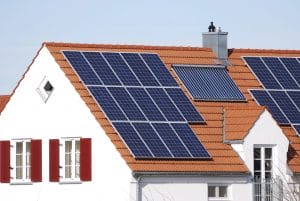
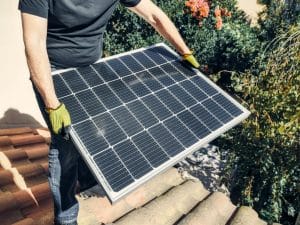
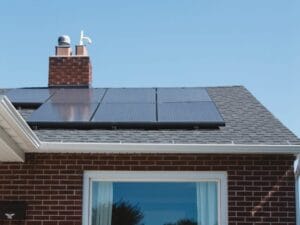
Monocrystalline solar panels are now the dominant choice for UK homes, accounting for roughly 90% of residential installations in 2026. They achieve 20–26% efficiency by using high-purity single-crystal silicon, which costs more to produce than the multi-crystal (polycrystalline) alternative. But in the UK, where roof space is limited and electricity prices are high, efficiency per square metre typically matters more than cost per watt.
Polycrystalline panels – recognisable by their blue, speckled appearance – were the industry standard until around 2016. They are cheaper to manufacture, slightly less efficient at 13–20%, and still a competitive option for large-roof commercial installations or budget-first residential buyers with ample space. A third category, thin-film panels, offers very low efficiency (7–13%) but is lightweight, flexible, and useful for specialist applications such as curved roofs, ground arrays, and off-grid installations.
This guide explains the differences between monocrystalline, polycrystalline, and thin-film solar panels. You get a clear comparison table, recommended brands for each type, and a definitive verdict on which panel type is right for most UK homeowners in 2026.
FREE QUOTE COMPARISON
Compare Solar Panel Quotes from Trusted Suppliers
✓ Save up to £975/year on energy bills
100% free • No obligation • Takes under 2 minutes
- Monocrystalline panels achieve 20-26% efficiency - the highest available for residential use, producing more electricity per m² than any other type
- UK mono installs run £1,200-£1,800 per kW - polycrystalline is now rarely quoted for new home installs, saving roughly £300-£400 on a 4kW system where legacy stock remains
- Thin-film efficiency is just 7-13% - requiring nearly twice the roof area of mono for the same output, making it unsuitable for most UK homes
- Monocrystalline panels last 25-30 years - performance warranties run 25 years across major brands, with product warranties from 12-15 years up to 40 years (SunPower Maxeon)
- Polycrystalline still makes sense for large commercial roofs - where roof space is not a constraint and cost-per-kW installed is the primary consideration
Monocrystalline vs Polycrystalline vs Thin-Film: Full Comparison
The three main solar panel types differ in efficiency, cost, appearance, and ideal application. Monocrystalline leads on efficiency and longevity; polycrystalline leads on upfront cost per kW; thin-film leads on weight and flexibility for non-standard applications.
The differences stem from how the silicon is processed. Monocrystalline cells are cut from a single cylindrical silicon ingot (the Czochralski process), creating a uniform crystal structure with minimal grain boundaries. This is why the cells are dark, and why electrons flow through them so efficiently. Polycrystalline cells are cast from molten silicon poured into a rectangular mould; multiple crystal structures form as it cools, creating the characteristic blue mosaic pattern and slightly higher electron resistance. Thin-film panels deposit photovoltaic material (usually cadmium telluride, amorphous silicon, or copper indium gallium selenide) onto glass, metal, or plastic – a much simpler process that cannot achieve crystalline silicon’s electron mobility.
| Factor | Monocrystalline | Polycrystalline | Thin-Film |
|---|---|---|---|
| Efficiency range | 20–26% | 13–20% | 7–13% |
| Cost per kW installed KEY STAT | £1,000–£1,500 | ~£900 | £400–£800 |
| Appearance | Black / dark blue cells | Blue speckled cells | Uniform dark surface |
| Roof space needed (4kW) | ~16 m² | ~19–20 m² | ~28–32 m² |
| Lifespan | 25–30 years | 25 years | 15–20 years |
| Performance warranty | 25 years (80% output) | 25 years (80% output) | 10–25 years |
| Low-light performance | Very good | Good | Good (amorphous Si) |
| Temperature coefficient | −0.3% to −0.4%/°C | −0.4% to −0.5%/°C | −0.2% (cadmium telluride) |
| Best for | Most UK homes | Large roofs, commercial | Curved roofs, off-grid, portables |
The temperature coefficient figure is worth noting: all solar panels lose efficiency as they heat up, but the rate of loss differs. Monocrystalline panels lose 0.3–0.4% output per degree Celsius above 25°C; thin-film (particularly cadmium telluride) performs better in high heat at just −0.2%/°C. In the UK, however, sustained high temperatures are rare, so this advantage is largely theoretical for domestic installations.
FREE QUOTE COMPARISON
Compare Solar Panel Quotes from Trusted Suppliers
✓ Save up to £975/year on energy bills
100% free • No obligation • Takes under 2 minutes
Why Monocrystalline Dominates the UK Market
Monocrystalline panels dominate UK residential installations because the UK’s characteristic limited roof space and high electricity prices make efficiency per square metre the primary buying criterion. A monocrystalline system generates more electricity from the same roof area than any alternative.
Consider a typical 3-bedroom semi-detached in the UK with 22m² of usable south-facing roof space. A monocrystalline 22% efficiency panel allows installation of a 5kW system in that space. The same roof with 15% efficiency polycrystalline panels accommodates only 3.5kW – a 30% reduction in generation capacity. North-facing roofs benefit most from high-efficiency mono panels, where every percentage point of efficiency translates directly into usable generation from an already-constrained orientation. Over 25 years at current electricity prices, that difference in annual generation (roughly 1,200 kWh) is worth approximately £7,000–£12,000 in additional savings and SEG income.
The price gap between mono and poly has also narrowed significantly. In 2016, polycrystalline panels cost 25–30% less per watt; by 2026, the premium for monocrystalline has fallen to 10–20%. Fitting more polycrystalline panels to achieve the same output needs extra mounting hardware, scaffolding, and installation labour. Factor that in and the total installed cost difference often falls below £300–£400 on a standard domestic system. The efficiency and longevity advantages of mono easily justify this.
When Polycrystalline Still Makes Sense
Polycrystalline panels remain competitive for three specific use cases. The first is large commercial roofs where space is not a constraint. The second is budget-priority residential buyers where the lower upfront cost decides it. The third is agricultural or industrial installations where roof area is effectively unlimited.
For UK commercial installations on flat industrial or agricultural buildings – warehouses, factory roofs, barn conversions – the calculus changes. If you have 1,000m² of roof available, squeezing out maximum efficiency per panel matters less than minimising cost per kWh installed. Both Canadian Solar and Trina Solar have moved their current ranges to monocrystalline TOPCon. Where poly modules remain available, they can deliver a lower total installed cost on very large systems – particularly where installation is simple and labour is a small share of project cost.
For domestic buyers with a strict budget below £5,000, polycrystalline offers a route to a smaller but functional system. A 3kW polycrystalline array at ~£4,200 will generate approximately 2,550 kWh per year and cut bills by £500–£700. That is still a positive return over the panel’s lifetime. If budget is a primary concern, see our guide to cheapest solar panel options for the most cost-effective routes to installation without sacrificing MCS certification. Always check that your installer is MCS-certified before committing – see our guide to solar grants for eligibility requirements.
Thin-Film Solar: Niche Applications Only
Thin-film solar panels are not suitable for mainstream UK residential use. The 7–13% efficiency figure applies to residential amorphous-silicon products. Utility-scale cadmium telluride (First Solar’s Series 7, ~19%) is not sold for homes. At residential efficiencies, thin-film needs nearly twice the roof area of mono panels for the same output – a fundamental constraint for most UK homes with limited south-facing roof space.
The genuine advantages of thin-film are its light weight (as low as 2.5 kg/m² versus 10–12 kg/m² for crystalline silicon) and flexibility, which makes it viable for:
- Curved or irregular roofs where rigid crystalline panels cannot be mounted
- Motorhomes, boats, and off-grid vehicles where weight and flexibility are essential
- Building-integrated PV (BIPV) where panels replace roof tiles or cladding for aesthetic integration
- Portable solar systems for camping, expeditions, and temporary power
For any standard UK home looking to install solar panels, thin-film is not the right choice. The 15–20 year lifespan (compared to 25–30 years for crystalline silicon) also means thin-film may need replacing before it has paid back its installation cost on a domestic property.
FREE QUOTE COMPARISON
Compare Solar Panel Quotes from Trusted Suppliers
✓ Save up to £975/year on energy bills
100% free • No obligation • Takes under 2 minutes
Recommended Panel Brands by Type
Panel brand quality varies significantly. Premium manufacturers offer longer warranties, better bankability (the company will exist to honour those warranties in 2046), and more consistent quality control than budget brands. For a 25-year investment, brand selection matters.
| Type | Brand | Efficiency Range | Warranty | Notes |
|---|---|---|---|---|
| Monocrystalline RECOMMENDED | SunPower (Maxeon) | 22–24% | 40-year combined | Highest efficiency; premium price, US brand |
| Monocrystalline | REC Group | 21–22.3% | 25 years (product + performance) | Norwegian-founded, strong UK installer network |
| Monocrystalline | JA Solar | 21–23% | 25 years | Best value mono; excellent manufacturing quality |
| Monocrystalline | Longi Solar | 21–23.9% | 25 years | World’s largest mono manufacturer; strong bankability |
| Polycrystalline | Canadian Solar | 17–20% | 25 years | Legacy stock only – current residential ranges are mono TOPCon |
| Polycrystalline | Trina Solar | 17–19% | 25 years | Legacy stock only – current ranges are mono (Vertex S+) |
| Thin-Film | First Solar | 18–19% (Series 7) | 25 years | Premium thin-film for commercial; cadmium telluride |
Note that LG Solar, which was previously a leading monocrystalline brand, exited the solar panel market in 2022. Existing LG panels continue to be covered by warranty through a third-party scheme, but LG is no longer a purchasing option. Warranties from manufacturers who exit the market – a real risk with budget brands – can become difficult to enforce, which is one reason to favour established, financially stable manufacturers even at a modest price premium.
If upfront cost is a barrier, check whether you qualify for free solar panels through ECO4 or grants.
For hot water rather than electricity, see our solar thermal vs solar PV comparison.
Use our solar panel savings calculator to compare the long-term financial returns from monocrystalline versus polycrystalline systems based on your roof size and electricity usage.
Monocrystalline vs Polycrystalline: Our Verdict
Monocrystalline panels are the right choice for approximately 90% of UK homeowners in 2026. The efficiency advantage is decisive for homes with limited roof space, and the price premium over polycrystalline has narrowed to the point where it is rarely the deciding factor.
The case for monocrystalline is strongest when your roof space is below 25m² (most UK semi-detached and terraced properties). It also wins when you want to maximise generation from available space, or when you are investing for the long term and want the best 25-year performance warranty available. For a broader view of top-rated solar panel brands across all categories – including premium mono options with the longest warranties – see our full buying guide. You can also calculate savings for your chosen panel type using our interactive calculator before committing to a brand or system size.
Polycrystalline remains a rational choice for commercial and large agricultural installations where space is unlimited and cost-per-kW is the primary concern. For residential use, its lower price advantage has eroded as monocrystalline manufacturing costs have fallen – the typical £300–£400 saving on a 4kW domestic system is difficult to justify given the 15–20% lower output per m². If you are still weighing up whether solar is worth it for your property in the first place, our dedicated guide covers the full financial case with worked examples.
Thin-film should be considered only for curved, irregular, or weight-constrained applications – it is not competitive for standard UK residential solar installations. Whatever panel type you choose, ensure your installer holds MCS (Microgeneration Certification Scheme) accreditation, as this is required to claim SEG export payments and access most solar grants. Always obtain at least three quotes from MCS-certified installers and compare panel specifications, not just headline prices. If you plan to add battery storage later, confirm your chosen panel brand is compatible with leading hybrid inverters such as those used by Fox ESS and Tesla Powerwall. See our solar panel output guide for detailed generation comparisons across panel types and roof orientations.
FREE QUOTE COMPARISON
Compare Solar Panel Quotes from Trusted Suppliers
✓ Save up to £975/year on energy bills
100% free • No obligation • Takes under 2 minutes