Payhawk is the best expense platform for UK businesses with multiple entities or ERP needs. It pairs multi-currency Visa cards with genuine two-way sync to NetSuite, SAP S/4HANA and Dynamics 365. At 7.9/10, it earns a strong recommendation for finance teams that have outgrown card-only tools. Its published pricing only stretches to the smallest customer tier, though.
The platform bundles corporate cards, bill pay, procure-to-pay and travel into one modular subscription. It targets UK and European businesses running more than one legal entity, or a mainstream ERP stack. Its published entry point, the Growth Program, only covers single-entity businesses under 20 employees. Everything above that needs a custom quote. That is the trade-off for the integration depth on offer.
- Entry price from £149/month - the Growth Program covers up to 20 employees, 10 cards and 10 seats on a single entity.
- Two-way ERP sync - live connections to NetSuite, SAP S/4HANA and Microsoft Dynamics 365, plus Xero.
- Built for multiple entities - Standard and Enterprise tiers consolidate spend across legal entities from one dashboard.
- OCR in 65+ languages - receipt capture reads international expenses, useful for multi-country teams.
- Onboarding can take weeks - KYB checks for multi-entity setups add lead time versus card-only rivals.
What Is Payhawk?
Payhawk is a spend management platform for UK and European businesses. It combines multi-currency corporate cards with expense automation and ERP-grade accounting integrations. It sits between simple card tools like Pleo and heavyweight enterprise suites like SAP Concur.
The platform issues physical and virtual Visa cards in multiple currencies. Every transaction then routes through OCR receipt capture and configurable approval workflows. Larger customers also get two-way sync into their ERP or accounting system. That combination targets finance teams managing more than one legal entity. Consolidating spend visibility across entities is normally a manual, spreadsheet-heavy job without it.
Payhawk’s product lines are grouped into modules: Travel, Cards & Expenses, Bill Pay and Procure-to-Pay. Standard and Enterprise customers pick and pay for the modules they need. They do not buy one fixed bundle. That is more flexible than most card-led competitors. It does mean the true monthly cost depends on which modules a business switches on.
Payhawk Key Features
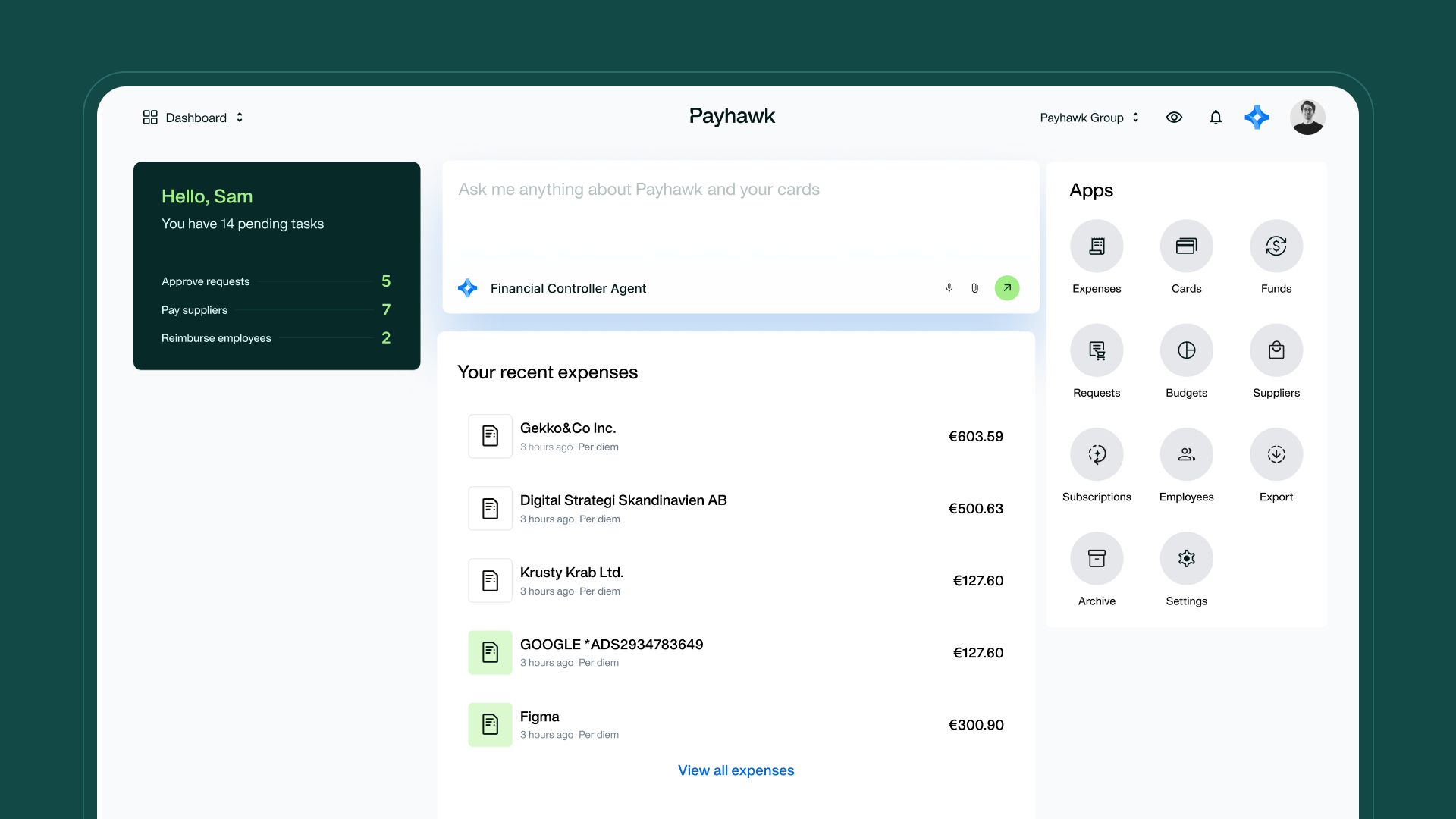
Payhawk’s standout features are its ERP-grade integrations and multi-entity consolidation. These sit alongside multi-currency cards, receipt OCR in 65+ languages, and built-in mileage and per-diem handling.
Multi-Currency Cards
Payhawk issues physical and virtual Visa cards that hold multiple currencies. Employees travelling or transacting internationally avoid the FX fees that single-currency cards attract. Card limits, merchant restrictions and single-use virtual cards are configurable per employee or per team. That gives finance controllers a way to cap risk without blocking legitimate spend.
Receipt Capture and Expense Automation
OCR receipt capture supports 65+ languages. That matters for businesses with staff or offices outside the UK submitting receipts in their local language. Mileage and per-diem reimbursements are handled natively too. Expense claims that are not card transactions still flow through the same approval and accounting pipeline, rather than a separate spreadsheet process.
Multi-Entity Consolidation
From the Standard tier upward, Payhawk consolidates spend across multiple legal entities into a single dashboard. Per-entity budgets, approval chains and reporting come as standard. Most card-led competitors lack this feature outright. It is the main reason group finance teams choose Payhawk over a cheaper, single-entity tool.
Payhawk Pricing UK 2026
Payhawk publishes one price: the Growth Program from £149 a month. Everything above it sits behind a sales quote built from a platform fee plus per-user and module charges.
The Growth Program is the only tier with a public price. It costs from £149 a month for UK and EEA businesses with fewer than 20 employees, on a single entity. That includes 10 cards, 10 seats, and up to 15 invoices plus 15 reimbursements a month. It is a genuinely capable starting point for a small business that just needs cards, OCR and Xero sync without ERP complexity.
Standard and Enterprise tiers are quote-only. They are built from a platform fee plus a per-user charge, plus usage-based pricing across whichever modules the business activates: Travel, Cards & Expenses, Bill Pay and Procure-to-Pay. There is no free tier at any level. Two businesses of similar size can pay very different amounts, depending on which modules they switch on. Budgeting for Payhawk above the Growth Program means getting a tailored quote, not reading a pricing page.
| Tier | Monthly Price | Included | Best For |
|---|---|---|---|
| Growth Program | From £149 | 10 cards, 10 seats, single entity, up to 15 invoices + 15 reimbursements/mo | Small UK/EEA businesses under 20 staff |
| Standard | Quote only | Platform fee + per-user + module usage; multi-entity consolidation | Growing businesses with 2+ entities |
| Enterprise | Quote only | Full module set incl. Travel, Bill Pay, Procure-to-Pay; ERP sync | Larger organisations on NetSuite, SAP or Dynamics |
Payhawk Integrations and ERP Sync
Payhawk’s integration depth is its clearest differentiator. It offers genuine two-way sync into NetSuite, SAP S/4HANA and Microsoft Dynamics 365, not just a one-way data export.
Two-way sync means changes made in the ERP flow back into Payhawk. Updated cost centres or approval statuses stay consistent across both systems without manual reconciliation. That is a materially different proposition to tools that only push expense data out once a month. Xero also gets two-way sync. QuickBooks is supported via export, a lighter integration for businesses that do not need live bidirectional data.
For finance teams already running an ERP, this is usually the deciding factor over cheaper competitors. A business managing payroll through dedicated payroll software, and provisioning users via an HRIS platform, can plug Payhawk into the same NetSuite or Dynamics instance. That avoids a third disconnected system for spend.
Payhawk Pros and Cons
Payhawk’s strengths are integration depth and multi-entity support. The trade-offs are quote-only pricing above the entry tier, and onboarding that can take longer than card-only rivals.
Who Is Payhawk Best For?
Payhawk is best for UK and European businesses running multiple legal entities. It also suits any team whose accounting already lives inside NetSuite, SAP S/4HANA or Dynamics 365 and wants spend data to sync both ways automatically.
It also suits businesses under 20 employees on a single entity that want multi-currency cards and OCR from day one. That works provided the Growth Program’s 10-card, 10-seat limit fits their headcount. Companies expecting to add entities as they grow can start on Growth. They can move to Standard later without re-platforming.
It is a weaker fit for very small, single-entity teams who just want simple card spending with no ERP ambitions. It also suits businesses that need pricing certainty before a sales conversation less well, since only one of three tiers is published.
Best Payhawk Alternatives
Moss and Pleo are the two most common Payhawk alternatives. Both are lighter on ERP integration, but cheaper and faster to onboard for single-entity UK teams.
Moss has no per-user pricing and a genuine free tier for up to 3 users. That suits a small team that does not need multi-entity consolidation. Pleo publishes every price tier from £9.50 a month, so cost is known before any sales call, though per-user fees climb as the team grows. Neither offers Payhawk’s two-way SAP or NetSuite sync. ERP-heavy businesses will still land on Payhawk. Our full expense management software comparison and business expense cards guide cover both in more depth, alongside six other providers.
Our Verdict on Payhawk
Payhawk scores 7.9/10. It is the strongest choice for multi-entity or ERP-heavy UK businesses. Its only real drawbacks are quote-only pricing above the entry tier, and a slower onboarding process.
Payhawk scores 7.9/10: from £149/month, two-way NetSuite and SAP sync, and multi-entity consolidation. See pricing, features and our verdict.
Payhawk earns its place at the top of the multi-entity and ERP category. The two-way NetSuite, SAP S/4HANA and Dynamics 365 sync, combined with genuine per-entity consolidation, is not something Moss or Pleo currently match. Multi-currency cards also remove a real cost for internationally active teams.
The catch is transparency and speed. Only the Growth Program has a public price. Any business above 20 employees, or with more than one entity, needs a sales conversation to size the cost. Multi-entity KYB checks can take a couple of weeks to clear. For a single-entity small business, Pleo or Moss will likely be quicker to set up and cheaper to run. For a group with multiple entities or an existing ERP, Payhawk is worth the extra onboarding time.